
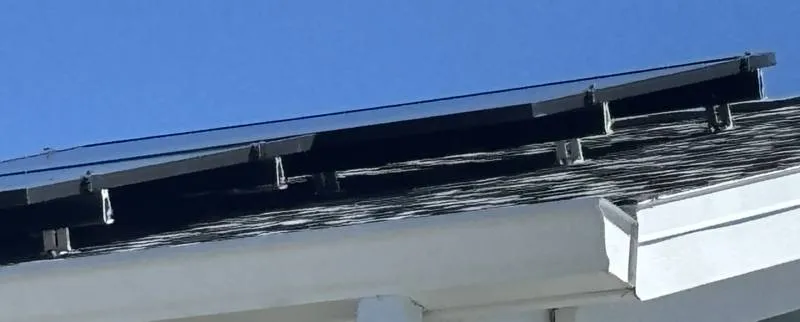
Where Your Solar Panels Go During a Roof Replacement
Between the detach and the reinstall, a Tampa Bay solar array spends anywhere from two days to several weeks off the roof, and that stretch is where more damage happens than during the removal itself. Modules stacked flat on a driveway, leaned against a garage wall in the afternoon sun, or left with their connectors open in a thunderstorm come back with microcracks and wet connectors that show up as lost production months later, long after anyone remembers who stacked them. How the panels are handled in between is a line a homeowner should see on the quote. Fused Solar and Roofing is a licensed roofing (CCC1331058), electrical (EC13014750), and building contractor (CBC1252064), all three in-house.
1. What a module can and cannot take
A solar module is a sheet of tempered glass over a laminate of silicon cells, designed to be supported along its frame by rails and clamps and to take wind and hail loads spread across its face. It is not designed to be stood on, to carry the weight of six other modules stacked on it, to be set down on its corner, or to flex across a point load like a stone on a driveway. A cell cracked that way still looks perfect under the glass and still produces, at first; it then degrades under heat cycling and shows up as a module that runs hot and under-produces a year later.
The connectors on the back are rated for weather when mated. Unmated, open to a Florida afternoon storm, they take water, and a corroded connector is a resistance point that heats, fails, or trips the inverter.
🔑 Key Takeaway: Modules survive hurricanes on the roof and break on the driveway. The damage from bad storage is invisible on the day and expensive a year later.
2. How Fused removes and labels them
Before any module comes off, the system is shut down at the inverter and the disconnect and locked out, and the array is photographed in place. Each module is labeled with its position in the array, row and column and string, so it goes back exactly where it came from; on microinverter and optimizer systems that keeps the monitoring map accurate. Connectors are capped as each module comes off. Modules are carried down one at a time, never slid or lowered on a rope, and go directly onto a rack.
The rails, clamps, and wiring come down labeled too, and the old mounts are removed from the roof so the roofer has a clean deck. Fused does not reuse the mounts, so those are not stored; new ones go in with the reinstall.
3. Where they are stored
Modules are stored on edge in A-frame or vertical racks, or on pallets with spacers, never stacked flat face to face, and never with weight on the glass. The rack goes under cover: in the homeowner's garage if there is room, under a tarped frame in the yard if not, or on Fused's truck to its shop when the roof will be open for more than a few days or the site cannot protect them. Covered means out of direct sun and rain, with air around the modules so condensation does not sit on the connectors.
The quote says which of those applies. A homeowner should know whether the panels will be in the garage or across town, and for roughly how long.
💡 Pro Tip: Clear a garage wall before the detach date. Modules racked on edge in a garage are the safest, cheapest storage there is, and the reinstall day goes faster when the panels are twenty feet from the ladder.
4. How long they are off
The detach is the day before or the morning of the tear-off. A shingle roof on a typical Tampa Bay home is one to two days; tile and metal run longer. The roofing inspection follows, and the reinstall is scheduled within days of it passing. With one company doing the roof and the solar, modules are typically off for one to two weeks. With two companies coordinating, or a leasing company's crew on its own calendar, it can be a month or more, and the storage has to be good enough for that.
Rain delays on the roof are the usual reason the gap grows. Every day the panels are off is a day of production the homeowner does not get, so a short gap is worth money, not just convenience.
5. What goes wrong when storage is bad
Fused's service department sees the results on systems other crews reinstalled: a string that produces fifteen percent less than its twin because three modules were stacked under the rest; a microinverter that faults in the first summer because its connector took water on the lawn; a module with a shattered backsheet from being set on gravel; an array put back in the wrong order so the monitoring shows the wrong panel failing. None of it was visible on reinstall day, and by the time it shows, the roofer has been paid and the homeowner is calling a third company.
⚠️ Warning: If you see your panels lying flat on the driveway or stacked face to face, stop the work and photograph it before anything else happens. That photograph is the record if production is down later.
6. The reinstall is also an inspection
Because every module is handled twice, the detach and reinstall is the one time in a system's life that each panel can be looked at up close, front and back. Fused inspects each module for cracks, delamination, hot-spot discoloration, and backsheet damage as it comes off and again as it goes on, checks every connector, and tests the strings or microinverters after reconnection. A module that was already failing is caught here and replaced, under the manufacturer's warranty where that applies, rather than reinstalled to fail on the new roof.
Who is allowed to do each part of a detach and reinstall, and why, is covered in our guide at https://fusedsolarandroofing.com/post/who-can-remove-reinstall-solar-florida
7. On the quote
The detach and reinstall line on a quote should say how the modules will be labeled, how and where they will be stored, who is responsible for them while they are off the roof, and that they will be inspected and the system tested before it is turned back on. If it does not, ask. Fused's proposals state it, and Fused carries the responsibility for the modules from the moment they leave the roof until the system is re-commissioned.
8. Why homeowners bring the detach and reinstall to Fused
Fused Solar and Roofing is a licensed roofing (CCC1331058), electrical (EC13014750), and building contractor (CBC1252064), all three in-house. Fused does the detach, the roof, and the reinstall under its own permits, so the modules are handled by one crew that will also be the one testing the system afterward and answering for it if production is down, and the gap between detach and reinstall is one company's calendar rather than two. Every penetration Fused makes on the reinstall carries its written 25-year no-leak guarantee.
🔑 Key Takeaway: Ask where the panels will be while the roof is open and how they will be stacked. The right answer is on edge, in a rack, under cover, labeled, for as few days as the roof allows.
Roof coming up and want the panels handled right? Request a free detach and reinstall quote at https://fusedsolarandroofing.com/solar-panel-removal
Frequently Asked Questions
How should solar panels be stored during a roof replacement?
On edge in racks or on pallets with spacers, never stacked flat face to face, under cover out of sun and rain, with connectors capped and each module labeled with its position in the array.
How long are solar panels off the roof during a re-roof?
Usually one to two weeks when one company does the roof and the solar; a month or more when two companies or a leasing company's crew have to coordinate. Rain delays on the roof are the usual reason the gap grows.
Can solar panels be damaged by being stacked on a driveway?
Yes. Cells crack under point loads and stacking weight while the glass looks fine, and the damage shows as lost production months later. Connectors left open in rain corrode.
Do my panels go back in the same place?
On a Fused job, yes. Each module is labeled by row, column, and string so it returns to its original position, which keeps the monitoring map accurate on microinverter and optimizer systems.
Does Fused inspect the panels during the detach and reinstall?
Yes. Each module is inspected front and back as it comes off and goes on, every connector is checked, and the strings or microinverters are tested after reconnection. Failing modules are replaced rather than reinstalled.
Who is responsible for the panels while they are off the roof?
On a Fused job, Fused, from the moment they leave the roof until the system is re-commissioned. Ask any other contractor to put the same in writing.
Fused Solar and Roofing has performed solar detach and reinstall work across Hillsborough, Pinellas, Pasco, and Manatee counties since 2007, pulling both the roofing permit and the solar permit on its own jobs. Request a free detach and reinstall quote at https://fusedsolarandroofing.com/solar-panel-removal
Fused Solar and Roofing holds Florida roofing (CCC1331058), electrical (EC13014750), and building (CBC1252064) licenses, all three in-house, and has served Hillsborough, Pinellas, Pasco, and Manatee counties since 2007. Fused Solar and Roofing is an EnergySage Elite Installer with a 5.0/5 rating and 21+ verified reviews, independent verification, earned not purchased. Request a free detach and reinstall quote at https://fusedsolarandroofing.com/solar-panel-removal