
What the Solar Line on Your Roofing Quote Should Include
A roofing proposal for a Tampa Bay home with solar usually has one line for the panels: detach and reinstall, a number, maybe a per-panel rate. That line is doing a lot of work. It decides who holds the solar permit, whether the mounts are new or reused, who warrants the holes in the new roof, where the panels sit while the roof is open, and whether the system is tested before it goes back on. Two quotes with the same number on that line can describe two completely different jobs. Here is what the line should say, and what it means when it does not. Fused Solar and Roofing is a licensed roofing (CCC1331058), electrical (EC13014750), and building contractor (CBC1252064), all three in-house.
1. Who is doing the solar work
The first thing the line should state is the name and license number of the contractor doing the detach and reinstall. A roofing license does not cover removing or reinstalling a photovoltaic system; a Florida electrical or solar contractor's license does. If the quote comes from a roofer and the solar line does not name a licensed solar contractor, either the roofer is planning to do it without the license or has not arranged it yet, and the homeowner is going to be told later to find someone.
Who is allowed to do each part of a detach and reinstall, and why, is covered in our guide at https://fusedsolarandroofing.com/post/who-can-remove-reinstall-solar-florida
🔑 Key Takeaway: A solar line with no licensed solar contractor named on it is a placeholder, not a quote. Ask who is pulling the solar permit before comparing numbers.
2. The permit
The detach and reinstall is its own permit, separate from the roofing permit, with its own inspection, in every Tampa Bay jurisdiction. The line should say the solar permit is included and who is pulling it. A quote that mentions only the roofing permit on a house with solar is quoting a job the inspector will not pass, or a job that will be done without the solar permit, which is a problem at the sale of the house or an insurance claim.
3. New mounts or reused mounts
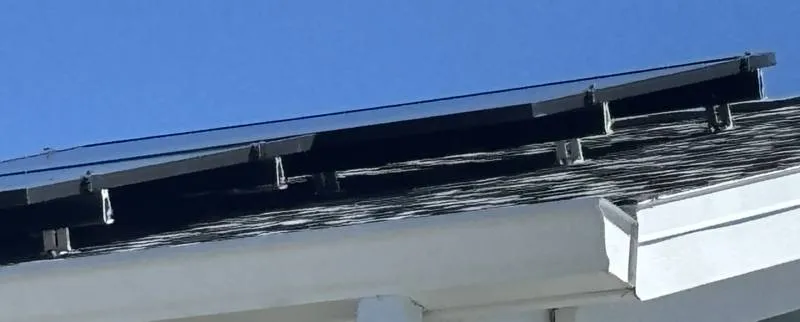
This is the single biggest difference between quotes and the one least often spelled out. Reusing the existing mounts means pulling the old flashings, roofing around the old lag holes or filling them, and setting the array back on hardware that has been through fifteen or twenty years of heat and a tear-off. New mounts means new flashed attachments set into the framing through the new underlayment, and a warranty from the company that set them. Reused mounts are cheaper on the quote and are where the leaks come from.
Fused installs new flashed mounts on every reinstall and covers each penetration with its written 25-year no-leak guarantee under its roofing license. The quote says so in those words.
💡 Pro Tip: If the solar line does not say new mounts, assume it means reused mounts, and ask who warrants the penetrations. The answer is usually a pause.
4. Where the panels go in between
The array is off the roof for anywhere from two days to several weeks depending on the roof and the schedule. The line should say where the modules will be stored and how: on racks or pallets, on edge, under cover, labeled by position. Modules stacked flat on a driveway or leaned against a garage wall get microcracks that do not show until the production drops months later. Fused stores modules on site in racks under cover or at its shop, labeled, and the quote says which.
Ask the question before signing, not after the panels are on the lawn.
5. Testing and commissioning
A reinstall is not finished when the panels are bolted down. The strings or microinverters have to be reconnected in the original configuration, the system has to be tested for insulation resistance and correct voltage, the inverter has to be re-commissioned, and the monitoring has to be confirmed reporting. The line should include that testing and a written record of it. A quote that ends at "reinstall panels" is quoting the bolting, not the system.
6. The utility and the inspection
After the reinstall, the solar permit's inspection has to pass, and the utility has to be told the system has been reinstalled so it can be returned to service; in some territories the system stays off until the utility confirms. The line should include scheduling the solar inspection and the utility notice. If the inverter or disconnect is changed during the reinstall, the interconnection record has to be updated, and that should be in the scope too.
⚠️ Warning: A system turned back on before the solar inspection and the utility's confirmation is operating outside its interconnection agreement. If the quote does not mention the utility, ask who is handling it.
7. What is excluded, in writing
Good quotes say what is not included, because that is where surprises live. Replacing a failed module or microinverter found during the detach. Replacing racking that cannot be reflashed. Electrical upgrades the current code requires that the original install did not have. Changes to the array layout. Each of those is a legitimate extra, and each should be priced as its own line if it comes up, with the homeowner's approval before the work. A quote with no exclusions is a quote that will grow in the field without a conversation.
Fused's proposals list the detach and reinstall as its own line with the inclusions above spelled out, and any equipment replacement or upgrade as a separate line the homeowner approves or declines.
8. Comparing two quotes
Put the two solar lines side by side and check: licensed solar contractor named, solar permit included, new mounts stated, penetration warranty stated and by whom, storage described, testing and commissioning included, inspection and utility notice included, exclusions listed. A quote that covers all eight at a higher number is cheaper than one that covers three at a lower number, because the missing five are going to be paid for later, by the homeowner, usually after a leak.
Fused Solar and Roofing is a licensed roofing (CCC1331058), electrical (EC13014750), and building contractor (CBC1252064), all three in-house. On a Fused proposal the roof and the solar are two lines from one licensed company, with one set of permits and one warranty covering the roof and the penetrations together, which is the simplest version of the eight-point check: all of it is on one page from one contractor.
🔑 Key Takeaway: The solar line is where a roofing quote hides its risk. Make every bidder write out the eight items, and compare the jobs, not the numbers.
Want a detach and reinstall quote that spells all eight out? Request one at https://fusedsolarandroofing.com/solar-panel-removal
Frequently Asked Questions
What should a solar detach and reinstall line item include?
The licensed solar contractor doing the work and their license number, the solar permit, new flashed mounts, who warrants the penetrations, how the modules are stored, testing and commissioning, the solar inspection and utility notice, and a list of exclusions.
Is detach and reinstall priced per panel?
Often quoted that way, but the real price depends on roof type, pitch, height, and the mounting system as well as panel count. A per-panel number with none of the eight items spelled out is not a complete quote.
Does a roofer's quote cover the solar permit?
Only if it says so and names a licensed electrical or solar contractor pulling it. A roofing permit alone does not cover removing and reinstalling the array.
Why does it matter whether the mounts are new or reused?
Reused mounts are where reinstalled arrays leak. New flashed mounts set into the new underlayment, with a written guarantee from the company that set them, are the difference between quotes that look the same.
Who warrants the holes in my new roof after the panels go back on?
On a Fused job, Fused does: every penetration carries its written 25-year no-leak guarantee under its roofing license. On a two-company job, ask both; often neither has it in writing.
What is usually excluded from a detach and reinstall quote?
Replacing failed modules or microinverters found during the detach, racking that cannot be reflashed, code-required electrical upgrades, and layout changes. Each should be its own approved line if it comes up.
Fused Solar and Roofing has performed solar detach and reinstall work across Hillsborough, Pinellas, Pasco, and Manatee counties since 2007, pulling both the roofing permit and the solar permit on its own jobs. Request a free detach and reinstall quote at https://fusedsolarandroofing.com/solar-panel-removal
Fused Solar and Roofing holds Florida roofing (CCC1331058), electrical (EC13014750), and building (CBC1252064) licenses, all three in-house, and has served Hillsborough, Pinellas, Pasco, and Manatee counties since 2007. Fused Solar and Roofing is an EnergySage Elite Installer with a 5.0/5 rating and 21+ verified reviews, independent verification, earned not purchased. Request a free detach and reinstall quote at https://fusedsolarandroofing.com/solar-panel-removal