
Selling a House With Solar in Tampa Bay: Seller Guide
You are selling a home that already has solar on the roof, and you want that system to be a plus for buyers, not a problem. A solar system that is working, documented, and sitting on a sound roof is usually easier to sell than one that raises questions, and a little preparation before you list can answer most buyer questions before they are even asked. Fused Solar and Roofing is a licensed roofing (CCC1331058), electrical (EC13014750), and building contractor (CBC1252064) — all three in-house.

1. Solar can help a sale or complicate it
When a buyer sees solar on a Tampa Bay home, they usually react in one of two ways. Either they view it as a positive feature they want to understand, or they see it as something unfamiliar that might create extra work or risk. Your goal as the seller is to make the system feel simple, documented, and under control so it falls firmly into the first category.
Solar can help a sale when buyers can see that the system is on, producing, and cared for. Clear paperwork, recent photos, and a straightforward explanation of how the system is set up all reduce uncertainty. When buyers can see that you have taken the time to prepare, they can focus on whether the house is right for them instead of worrying about what might be hiding under the panels or inside the electrical equipment.
Solar complicates a sale when basic questions do not have clear answers. If no one is sure whether the system works, if there is no paperwork, or if the roof condition around the array is unclear, buyers and their inspectors are left to guess. That uncertainty often leads to more questions, more back-and-forth, and more things to negotiate over during inspection and contract periods. The good news is that most of this can be handled before you ever put the sign in the yard, with some focused preparation and a professional look at the system and roof.
📌 Key Takeaway: A solar system that is working, documented, and sitting on a sound roof is easier to sell. Uncertainty about any of those gives buyers something to negotiate over.
2. Know what kind of solar arrangement you have
Before you talk to buyers or agents about your solar, you need to be clear on how you own or use the system. Not every solar array is set up the same way, and the type of arrangement you have will affect what happens when you sell the house and how you explain it to a buyer. Getting this straight early saves confusion later in the process.
Some homeowners own their solar system outright. In that case, the panels, inverter, and related equipment are simply part of the property. When you sell, the focus is on whether the system is working and documented. You still want records and a recent service report, but there is no outside company involved in the ownership of the equipment itself.
Other homeowners have a financed system. In that case, there is a loan tied to the solar equipment, and you make payments to a lender. The panels and equipment are on your roof, but there is also a financing agreement in the background. When you plan to sell, it is important to understand where that loan stands and what options exist when ownership of the house changes. Because those details are specific to your agreement, you should contact your lender early in the selling process so you know what steps are involved and what choices you have as you move toward closing on a sale.
Some systems are leased or otherwise owned by a third party. In those setups, a company owns the equipment and you have an agreement to use the system or buy power from it. If you are in this situation, it is especially important to reach out to the leasing or third-party company as soon as you know you want to sell. They can explain what happens when the property changes hands and what steps they require. You do not need to have every answer ready for the first showing, but you do need a clear understanding of who owns what and who needs to be contacted when a buyer is interested in the home.
The main point is simple: know your arrangement and know who is involved. That way, when a buyer or their agent asks about the solar, you can give a calm, direct explanation instead of saying you are not sure. That confidence helps keep the conversation about the house itself, not about confusion over the solar setup.
Selling a home with solar? Fused Solar and Roofing inspects and services solar systems before listing across Hillsborough, Pinellas, Pasco, and Manatee counties. Request a diagnostic visit at https://fusedsolarandroofing.com/solar-repair
3. The questions buyers and inspectors ask
Once your home is on the market, you can expect a short list of repeat questions about the solar system. Buyers and inspectors tend to focus on the same core issues. If you prepare for these in advance, the conversations go more smoothly and you avoid scrambling for answers in the middle of a contract period when time feels tight and emotions can run higher than they need to.
The first question is straightforward: does the system work, and how much does it produce? Buyers want to know whether the system is currently operating, not just whether it worked at some point in the past. Being able to show that it is on, that it has been producing, and that there is a history of production gives them a clear picture. If your monitoring is active, screenshots or reports are helpful. If monitoring has not been working, a service visit before listing can often restore it so you have recent data to share instead of guessing from memory or old bills.
Next, buyers and inspectors often ask who installed the system and whether that company is still in business. They want to know if there is a known name attached to the installation and whether there is anyone they can call with questions. If the original installer is no longer operating, it is important to have the name of a current service company that has inspected the system recently and can support it going forward. That way, the conversation does not stall just because the original installer is unavailable.
Another common question is about paperwork and warranty documents. Buyers want to see the original purchase or installation contract, layout or design documents, equipment manuals, and any warranty paperwork you have. They are not necessarily reading every line, but seeing that these documents exist and are organized gives them confidence that the system was installed as a planned project, not as an afterthought. It also reassures them that they will not be starting from zero if they ever need to look something up in the future.
The condition of the roof under and around the panels is another major focus. Inspectors know that the array covers part of the roof surface, and they will ask what that area looks like and whether anyone has checked it recently. Buyers do not want to inherit a surprise roof project hidden by panels that are hard to move. Having a recent service report that includes photos of the visible roof areas around the array and a clear explanation of what could and could not be seen goes a long way toward answering this concern in a calm, factual way.
Finally, buyers ask who can service the system after the sale. They want to know that there is a company they can call if they have questions, need maintenance, or decide to make changes in the future. Being able to hand them a recent inspection report from a local company that services systems of all brands, along with contact information, gives them a clear path forward instead of leaving them to search on their own right after closing when they are already busy moving into a new home.
💡 Pro Tip: Answer buyer questions before they are asked. A folder with the paperwork, a recent service report, and production history does most of that work for you.
4. Gather the paperwork
One of the simplest ways to make your solar system easier to sell is to gather all of the related paperwork into one place before you list. Think of it as creating a solar file for the next owner. When buyers and inspectors ask for documents, you can hand them a neat folder instead of saying you will look for things later. This small step sends a clear message that the system has been taken seriously and that you are prepared to pass it on responsibly.
Start with the purchase or installation contract. This document shows what was installed, when it was installed, and by whom. If you have a separate proposal or scope-of-work document that outlines the size of the system and the planned layout, include that as well. These pieces give buyers a snapshot of the project as it was designed and help them understand that the system was planned as a complete installation, not pieced together casually over time.
Next, locate any system layout or design documents you received. These are often simple drawings or diagrams that show where the panels are placed on the roof and how the components connect. They help inspectors and buyers visualize the system and understand how it fits with the rest of the house. If you have digital copies, consider printing them so they are easy to review during showings and inspections without needing to log in to anything on the spot.
Then, collect equipment manuals and warranty documents. These usually come from the manufacturers and cover the panels, inverter, and other major components. Even if buyers never read them in detail, having them available shows that you kept track of the original materials that came with the system. Place them in the same folder or binder so everything is together and easy to find. If you have digital versions, consider saving them to a labeled folder that you can share by email as well as leaving printed copies at the house.
If you have had any service visits or maintenance done on the system, include those reports too. Service records show that the system has been inspected and cared for over time. A recent report from a pre-listing service visit is especially useful, because it gives buyers a current picture of the system's condition instead of leaving them to rely on older information or assumptions. Place this report near the front of the folder so it is easy to spot and review quickly during an inspection period.
Finally, gather information related to monitoring and production history. If you use a monitoring app or web portal, make sure you know how to log in and how to access basic production history. You do not need to give buyers your login while you are still the owner, but you should be ready to show them simple graphs or reports that demonstrate that the system has been producing. When the sale moves forward, you can arrange for the monitoring account to be handed over so the new owner can track production themselves. Having this information ready reassures buyers that the system is active and that they will be able to keep an eye on it after closing.
5. Why a pre-listing service visit matters
A pre-listing service visit is one of the most practical steps you can take when selling a home with solar. It is almost always better for you, as the seller, to find any issues with the system before a buyer's inspector does. When you discover problems early, you control the timing, you decide how to respond, and you can present buyers with clear information instead of being surprised halfway through a contract period when emotions and schedules are already tight.
During a pre-listing service visit, a licensed technician checks the system, documents what they see, and gives you a written report. That report, along with photographs, becomes something you can share with buyers and their inspectors. Instead of guessing about the condition of the solar, you can hand over recent, third-party documentation that shows the system has been looked at by a professional. This shifts the conversation from "We think it is fine" to "Here is what was checked and when."
If monitoring has stopped working or has not been checked in a while, a pre-listing visit is also the time to address that. When monitoring is restored, you can show a clear record of recent production instead of relying on memory or utility bills. Buyers appreciate seeing that the system is currently producing and that someone has verified its operation close to the time of sale. It also makes it easier to hand off the monitoring access later because everything will already be organized and working when you are ready to transfer it to the new owner.
Any repair or adjustment that comes out of a service visit is licensed work. That matters for both safety and documentation. When a licensed company handles the diagnosis and any needed repairs, you have a clear paper trail you can show buyers. It also gives buyers a current contact for future service, which is often one of their main questions when they see solar on a home they are considering. Fused Solar and Roofing services systems of all brands, including systems whose original installer is no longer in business, so you are not limited to one brand or one installer when it comes to getting a professional look at your system before you sell.
Fused Solar and Roofing is a licensed roofing (CCC1331058), electrical (EC13014750), and building contractor (CBC1252064) — all three in-house.
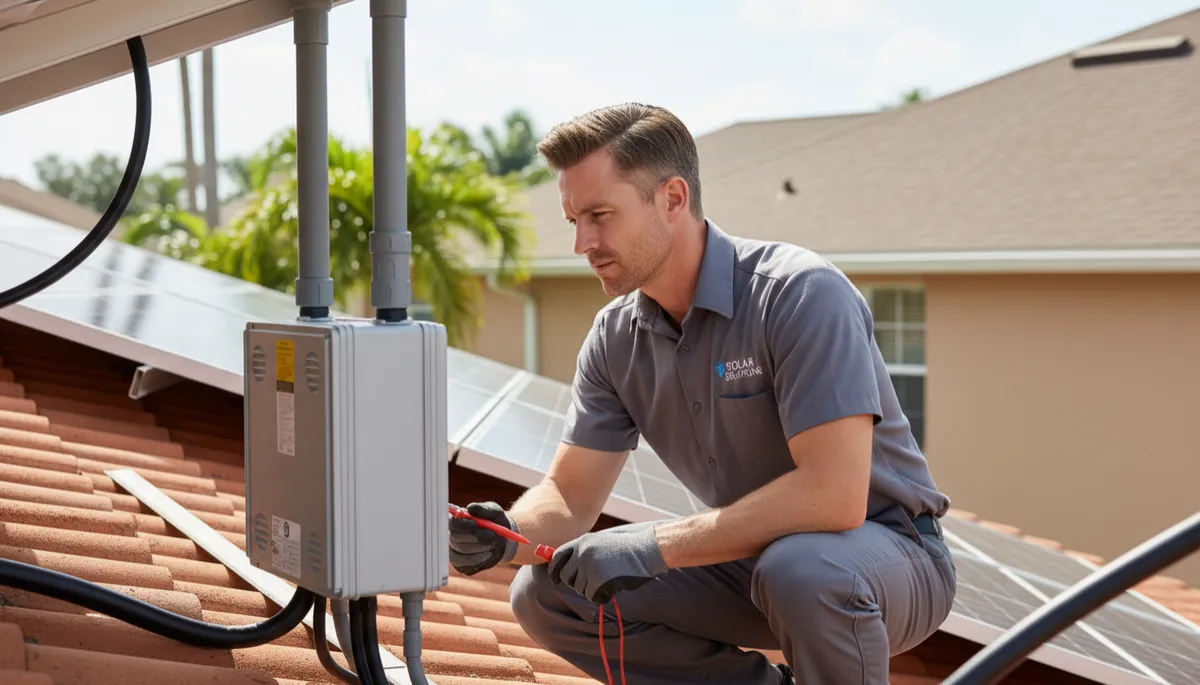
Close-up of a licensed solar technician in uniform inspecting a rooftop solar inverter and...
A documented pre-listing service visit gives buyers clear, recent information about the solar system.
6. What a pre-listing service visit involves
A pre-listing service visit is a focused check of your solar system and the roof areas that can be seen around it. The goal is to confirm whether the system is operating, document its visible condition, and identify any issues that might come up during a buyer's inspection. Knowing what actually happens during the visit can make the process feel straightforward instead of mysterious or stressful as you prepare to sell your home.
A licensed technician starts by inspecting the main components of the system that are accessible. This includes the inverter, which is the piece of equipment that converts the power from the panels into power your home can use, as well as the disconnect and the breaker that tie the system into your home's electrical panel. The technician checks the visible wiring and conduit for signs of damage or wear and confirms that everything appears properly secured and intact. This part of the visit focuses on safety, function, and obvious issues that could concern a buyer or inspector later on.
The technician also looks at the array itself, meaning the panels and how they are mounted. They check the visible hardware, the general condition of the panels, and how the wiring is managed on and around the array. At the same time, they review the roof surface that can be seen around the panels. They look for signs of damage, loose materials, or other concerns in those visible areas. This helps create a clear picture of how the solar and roof are working together where they are exposed to view. It is important to understand, though, that the roof and connections directly under the panels cannot be fully seen without removing panels, and panel removal is a separate task that is not part of a standard inspection visit.
During the visit, the technician checks whether the system is producing at the time of inspection. They also confirm whether monitoring is working and, if possible, help restore it if it has stopped communicating. This gives you a clear answer when buyers ask whether the system is on and how they will be able to track its performance. Having current monitoring in place also makes it easier to provide simple production history for the months leading up to the sale, which many buyers find reassuring when they see solar on a home they are considering seriously.
After the physical inspection, you receive photographs and a detailed written report. The report explains what was checked, notes any issues found, and documents the condition of visible components and roof areas around the array. If the technician identifies any problems or concerns, those are clearly outlined, and any repair is scoped and quoted based on the findings. This gives you a clear set of options so you can decide what to address before listing and what to simply document and share with buyers. Fused Solar and Roofing is an EnergySage Elite Installer with a 5.0/5 rating and 21+ verified reviews — independent verification, earned not purchased.
📌 Key Takeaway: Fused Solar and Roofing inspects, documents, and services solar systems of all brands for homeowners preparing to sell, under electrical license EC13014750, including systems whose original installer is no longer in business.
7. The roof under the panels
The roof under and around the solar panels is often one of the first topics buyers bring up when they see a home with solar. They understand that panels cover part of the roof surface and that moving them later is a separate job. Buyers want to know whether they are inheriting a roof that is in good condition or a hidden project that will require extra steps because of the array. Addressing this clearly and calmly is a key part of making your solar system feel like an asset instead of a question mark during the sale.
If the roof is in good condition, your pre-listing service report helps you show that. The technician's photos and notes about the visible roof areas around the array give buyers and inspectors something concrete to review. While the roof directly under the panels cannot be fully seen without removing panels, a clean report on the surrounding areas and connections that can be viewed is still valuable. It shows that a professional has looked at the roof where they can, and that there are no obvious signs of trouble in those exposed zones at the time of inspection. This often eases buyer concerns and keeps the focus on the overall home rather than on what might be hidden under the array.
If the roof is nearing replacement, a pre-listing visit helps you understand that before you list. With that information, you have a choice. One option is to replace the roof before listing. In that case, the project includes a detach and reinstall of the solar system. The system is shut down, the panels are removed, the roof is replaced, and then the panels are reinstalled, reconnected, and tested. This approach lets you present buyers with a fresh roof and a reinstalled system, along with documentation of the work. It can simplify conversations later because the roof project has already been handled under your direction, and the solar has been removed and reinstalled by trained crews as part of a single coordinated job.
The other option is to list the home with a clear picture of the roof's condition and be prepared for the question. In this case, you use the service report and any roofing evaluation you have to explain the current state of the roof and the solar. Buyers can see what a professional has observed and can make their own plans knowing that, at some point, a detach and reinstall may be part of a future roof project. This approach can work well when you prefer not to take on a roof project before selling but still want to be transparent and organized about what a future owner might need to plan for over time.
Fused Solar and Roofing's in-house electrical and roofing crews handle the entire detach and reinstall process as one job under one company. That means the same team coordinates shutting down the system, removing the panels, completing the roof work, and then reinstalling, reconnecting, and testing the array. Whether you decide to replace the roof before listing or simply want a clear understanding of your options, having a single company that manages both the roof and the solar can make planning easier. The key is that you choose the path that fits your situation, with clear information in hand and no pressure to take one route over the other solely for the sake of the solar system.
⚠️ Warning: Do not have panels moved, disconnected, or removed by anyone not trained on solar to show the roof or prepare the house for sale. Panels can produce electricity whenever they are in sunlight.
8. Handing the system over to the buyer
As you move toward closing, it helps to think about how you will hand the solar system over to the new owner. The goal is to leave them with a clear understanding of what they are getting, how to monitor it, and who to call if they have questions. A thoughtful handoff can make the transition smoother for everyone and reduce the chance that you will be fielding solar questions after you have already moved on to your next home.
Start by leaving the paperwork, service report, and manuals in an obvious place in the home. Many sellers choose a kitchen drawer, a cabinet near the electrical panel, or a labeled binder on the counter. Make sure the folder includes the purchase or installation contract, layout or design documents, equipment manuals, warranty documents you have, and any service reports, especially the pre-listing inspection. Buyers will appreciate having everything in one place instead of wondering whether important documents are missing or scattered in different boxes from the move.
Next, arrange for the monitoring account to be handed over. This may mean updating login information, changing contact details, or working with the monitoring platform to transfer access to the new owner. The exact process depends on the platform you use, but the aim is the same: when the buyer moves in, they should be able to open the app or website and see their system's production without needing to start from scratch. Coordinate this timing so that you maintain appropriate control while you are still the owner and then complete the handoff as part of the closing process or shortly after, in a way that feels comfortable and secure for both sides.
It is also important to show the buyer where the equipment and disconnect are located. During a walkthrough or final visit, point out the inverter, the disconnect switch, and the breaker in the main electrical panel. Explain in simple terms which equipment belongs to the solar system so they are not guessing later. This does not need to be a technical lesson; it is just a practical orientation so they know what is what when they look at the side of the house or open the electrical panel after moving in.
Finally, give the buyer the name of a company that can service the system. If you have used a local company for inspections and maintenance, include their contact information in the folder and mention them during conversations with the buyer or their agent. Knowing who to call if they have questions or need future work helps the new owner feel supported. It also reinforces the message that the system has been cared for and that there is a clear path for ongoing service after the sale is complete.
Frequently Asked Questions
1. Should I have my solar system inspected before I list my house?
Having your solar system inspected before you list is a practical step that gives you more control over the selling process. A pre-listing service visit lets a licensed technician check the inverter, disconnect, breaker, visible wiring, conduit, array, and the roof surface around the panels. You receive photographs and a written report that you can share with buyers and their inspectors. If there are issues, you learn about them on your timeline instead of being surprised during a buyer's inspection. This helps you make calm decisions about any repairs and present clear documentation when questions come up.
2. What happens to my solar if it is financed or leased when I sell?
If your solar system is financed or leased, there is another party involved beyond you and the buyer. In a financed setup, you make payments to a lender for the system. In a leased or third-party arrangement, a company owns the equipment and you have an agreement to use it or buy power from it. Because each agreement is different, the most important step is to contact your lender or leasing company early in the selling process. They can explain what options exist when the property changes hands and what steps they require. Knowing this ahead of time helps you answer buyer questions calmly and plan your sale without last-minute surprises related to the solar arrangement.
3. What solar paperwork should I have ready for buyers?
Buyers appreciate having a complete set of solar documents ready to review. You should gather the purchase or installation contract, any system layout or design documents, equipment manuals, and warranty documents you have. Include any service reports, especially a recent pre-listing inspection, so buyers can see the current condition of the system. If you use monitoring, be ready to show how to access it and, if possible, provide simple production history. Putting these items together in a single folder or binder makes it easy to hand everything over during showings, inspections, and closing.
4. My solar monitoring has not worked in a while. Does that matter when I sell?
Monitoring that is not working can raise questions for buyers, because it makes it harder to show how the system has been performing. During a pre-listing service visit, a technician can check whether the system is producing and often help restore monitoring so it starts reporting again. Once monitoring is working, you can generate simple graphs or reports that show recent production. This gives buyers more confidence that the system is active and that they will be able to track it themselves after closing. While you can still sell a home if monitoring has been down, addressing it before listing usually makes conversations with buyers smoother and more straightforward.
5. Should I replace my roof before selling if it has solar on it?
Whether to replace your roof before selling is a personal decision based on its condition and your plans. A pre-listing service visit and a roofing evaluation can help you understand the current state of the roof around the array. If you decide to replace the roof before listing, the project will include a detach and reinstall of the solar system: shutting it down, removing the panels, replacing the roof, and then reinstalling, reconnecting, and testing the array. If you do not replace the roof before selling, you can still move forward with a clear description of the roof's condition, supported by documentation, and be prepared to discuss how a future detach and reinstall could fit into a buyer's long-term plans for the home.
6. My original solar installer is out of business. Who can inspect my system before I sell?
If your original installer is no longer in business, you can still have your system inspected and serviced before you sell. Look for a licensed company that works on systems of all brands and is comfortable stepping in after another installer. They can perform a pre-listing service visit, check the inverter, disconnect, breaker, visible wiring, conduit, array, and surrounding roof areas, and provide a written report with photos. Fused Solar and Roofing services solar systems of all brands, including those whose original installer is no longer operating, so you are not limited just because the company that installed your system is no longer available.
Fused Solar and Roofing is a licensed electrical contractor (EC13014750) servicing solar systems of all brands across Hillsborough, Pinellas, Pasco, and Manatee counties, including systems whose original installer is no longer in business. Request a diagnostic visit at https://fusedsolarandroofing.com/solar-repair
Is your solar system producing what it should? Request a diagnostic visit at https://fusedsolarandroofing.com/solar-repair
