
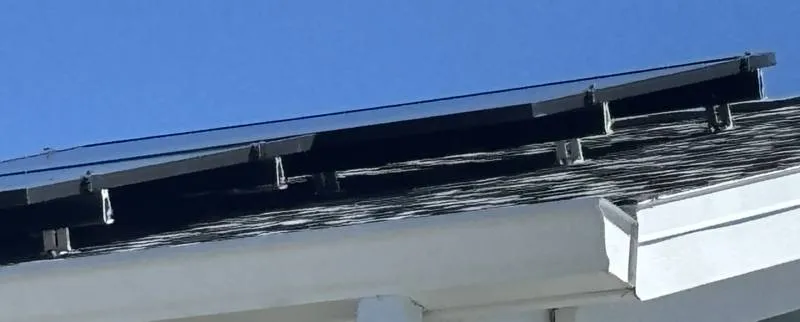
My Roofer Won't Touch the Solar Panels: What To Do Next
When a roofer in Tampa Bay quotes a new roof and then says the solar company has to take the panels off first, the roofer is not being difficult. Removing and reinstalling a solar array changes the electrical system and the structural attachments, which needs an electrical or solar license and its own permit, and most roofers hold neither. The homeowner is left to find a second company, coordinate two schedules, and hope the two warranties meet in the middle. The way around that is a contractor licensed for both halves, which is what Fused Solar and Roofing is. Fused Solar and Roofing is a licensed roofing (CCC1331058), electrical (EC13014750), and building contractor (CBC1252064), all three in-house.
1. Why the roofer says it
A roofing license covers the roof covering, the underlayment, the flashings, and the deck. It does not cover disconnecting a photovoltaic system, removing the modules and rails, or reattaching the mounts and re-energizing the array. In Florida that work falls under an electrical or solar contractor's license, and the permit office issues it as a separate solar or electrical permit with its own inspection. A roofer who touches the panels without that license is working outside it, and a roofer who knows that will not.
There is also the practical problem. Panels are heavy, glass-faced, and wired together at several hundred volts DC when the sun is up. A crew that does not do solar every day does not have the tools, the shutdown procedure, or the insurance for it, and a cracked module or a damaged connector is an expensive thing to explain. So the roofer quotes the roof and tells the homeowner to call the solar company.
🔑 Key Takeaway: The roofer is right that the solar is a separate licensed job. The question is whether you want two companies on your roof or one company licensed for both.
2. What happens when you call the solar company
If the company that installed the system is still in business and still does service work, it will usually quote a detach and reinstall: a crew to remove the array before the roofer arrives and a second trip to reinstall it after the roof is done. The homeowner then holds two contracts, two schedules, and two sets of inspections, and the two companies have to agree on timing to the day so the panels are not sitting in the garage for weeks.
In Tampa Bay the installer is often not available. A large share of the systems installed between 2012 and 2019 were sold by companies that have since closed or left Florida, and the ones still operating may not take detach and reinstall work on systems they did not sell. That leaves the homeowner calling around for a third company while the roofer waits.
The handoff is where things go wrong. When the solar company removes the mounts and the roofer flashes over the holes, then the solar company drills new holes into the new roof, three sets of hands have been in the same square foot of roof, and if it leaks a year later each company points at the other two.
3. The one-company alternative
Fused Solar and Roofing holds a roofing license, an electrical license, and a building license, so it pulls the roofing permit and the solar permit itself and performs both halves of the job under its own inspections. The array comes off, the roof goes on with new flashed mounts set into the new leak barrier, and the array goes back on the same mounts, with one contract, one schedule, and one warranty covering the roof and the penetrations together.
Fused also does this for homeowners who already have a roofer they want to keep. In that arrangement Fused handles the solar permit, the detach, and the reinstall, and coordinates directly with the roofer on the mount locations and the timing, so the homeowner is not the go-between. Fused works with roofing companies across the region on exactly this basis.
Who is allowed to do each part of a detach and reinstall, and why, is covered in our guide at https://fusedsolarandroofing.com/post/who-can-remove-reinstall-solar-florida
4. What the detach and reinstall includes
A proper detach and reinstall is more than lifting panels off and setting them back. The system is shut down and locked out, the modules are removed, labeled, and stored on racks or pallets, the rails and mounts come off, and the roofer has a clear deck. After the roof is on, new flashed mounts are installed into the rafters or trusses through the new underlayment, the rails and modules go back in the same layout, the wiring is reconnected and tested, and the system is re-commissioned and inspected under the solar permit before it is turned back on.
Fused replaces the mounts rather than reusing the old ones, because a mount that has been through fifteen years of thermal cycling and a tear-off is not the mount to trust for the next twenty-five, and because new mounts set into new flashing are what the no-leak guarantee is written on. Every solar roof penetration Fused makes carries its written 25-year no-leak guarantee under its roofing license.
💡 Pro Tip: Ask whoever quotes the reinstall whether the mounts are new or reused, and who warrants the penetrations. A reinstall on old mounts with the roofer's flashing around them has no one standing behind the holes.
5. What it costs and how it is quoted
Detach and reinstall is priced by the size of the array, the roof type, the height and pitch, and the age and type of the mounting system, so Fused quotes it after seeing the roof rather than from a per-panel number over the phone. Tile and metal roofs cost more to reinstall on than shingle because the mounts and flashings are different, and a two-story steep-pitch roof adds staging and fall protection.
When Fused does the roof as well, the detach and reinstall appears as its own line on the proposal next to the roof, so the homeowner sees what each part costs. When a homeowner's insurance is paying for the roof after a storm, the detach and reinstall can be submitted as part of the claim, and Fused can meet the adjuster at the house to document it.
6. Timing the two jobs
The detach happens the day before or the morning of the tear-off, so the panels are off the roof for the shortest possible time. The roof goes on over one to three days depending on size and material. The reinstall is scheduled as soon as the roofing inspection passes, usually within a few days, and the solar inspection follows the reinstall. The system is off from the detach until the solar inspection passes and, where the utility requires it, until the utility confirms the system can be returned to service.
With one company, that sequence is one calendar. With two, every date depends on the other company's crew, and a rain delay on the roof pushes the reinstall, which pushes the inspection, which pushes the day the system comes back on. The production the homeowner loses while the panels sit in the garage is real money in a Florida summer.
⚠️ Warning: Do not let anyone store your panels face-down on a driveway or stacked flat on each other. Modules are stored on edge or on a rack, labeled by position, under cover. A cracked cell from bad storage shows up as a production loss months later, and by then nobody remembers who stacked them.
7. If your roofer is already under contract
A homeowner who has already signed with a roofer and then hears about the solar does not have to start over. Fused quotes the detach and reinstall as a standalone job, pulls the solar permit, and coordinates with the roofer directly: when the detach will happen, where the mounts will go, what the roofer should and should not do around the array's footprint, and when the roof will be ready for the reinstall. The roofer does the roof; Fused does the solar; the homeowner has one contact for each and does not have to translate between them.
Fused also inspects the roof the roofer has installed before the reinstall goes on it, because the mounts are going through that roof and Fused is guaranteeing the penetrations.
8. Why homeowners bring this to Fused
Fused Solar and Roofing is a licensed roofing (CCC1331058), electrical (EC13014750), and building contractor (CBC1252064), all three in-house. On a detach and reinstall that means one permit holder for the roof and one for the solar, and they are the same company, so there is no seam in the warranty where the roofer's work ends and the solar company's begins. Fused has done this work across Tampa Bay since 2007, including on systems installed by companies that no longer exist, and it is the company that will still be here to service both the roof and the solar in year ten.
🔑 Key Takeaway: When the roofer says to call the solar company, call one that is also a roofer. One contract, one schedule, one set of permits, and one company responsible if anything ever leaks.
Roofer waiting on you to deal with the panels? Request a free detach and reinstall quote at https://fusedsolarandroofing.com/solar-panel-removal
Frequently Asked Questions
Why won't my roofer remove my solar panels?
Removing and reinstalling a solar array changes the electrical system and the structural attachments, which requires an electrical or solar contractor's license and its own permit. Most roofers hold a roofing license only, so they quote the roof and tell the homeowner the solar is a separate job.
Who is allowed to remove solar panels for a roof replacement in Florida?
A Florida electrical or solar contractor pulls the solar permit and does the detach and reinstall; a roofing contractor pulls the roofing permit and does the roof. Fused Solar and Roofing holds both licenses and does both halves on its own permits.
Can I keep my roofer and have Fused do the solar?
Yes. Fused quotes the detach and reinstall as a standalone job, pulls the solar permit, and coordinates the timing and mount locations directly with your roofer.
How much does it cost to remove and reinstall solar panels for a new roof?
It depends on the number of panels, the roof type, the height and pitch, and the mounting system, so Fused quotes it after seeing the roof. Tile, metal, and two-story steep roofs cost more than single-story shingle. When Fused does the roof too, the detach and reinstall is its own line on the proposal.
How long will my solar be off during a re-roof?
From the detach, the day before or the morning of the tear-off, until the solar inspection passes after the reinstall. With one company doing both jobs that is usually one to two weeks; with two companies it depends on both schedules lining up.
Does Fused reuse the old mounts?
No. Fused installs new flashed mounts into the new roof and leak barrier and reinstalls the array on them. Every solar roof penetration Fused makes carries its written 25-year no-leak guarantee.
Fused Solar and Roofing has performed solar detach and reinstall work across Hillsborough, Pinellas, Pasco, and Manatee counties since 2007, pulling both the roofing permit and the solar permit on its own jobs. Request a free detach and reinstall quote at https://fusedsolarandroofing.com/solar-panel-removal
Fused Solar and Roofing holds Florida roofing (CCC1331058), electrical (EC13014750), and building (CBC1252064) licenses, all three in-house, and has served Hillsborough, Pinellas, Pasco, and Manatee counties since 2007. Fused Solar and Roofing is an EnergySage Elite Installer with a 5.0/5 rating and 21+ verified reviews, independent verification, earned not purchased. Request a free detach and reinstall quote at https://fusedsolarandroofing.com/solar-panel-removal