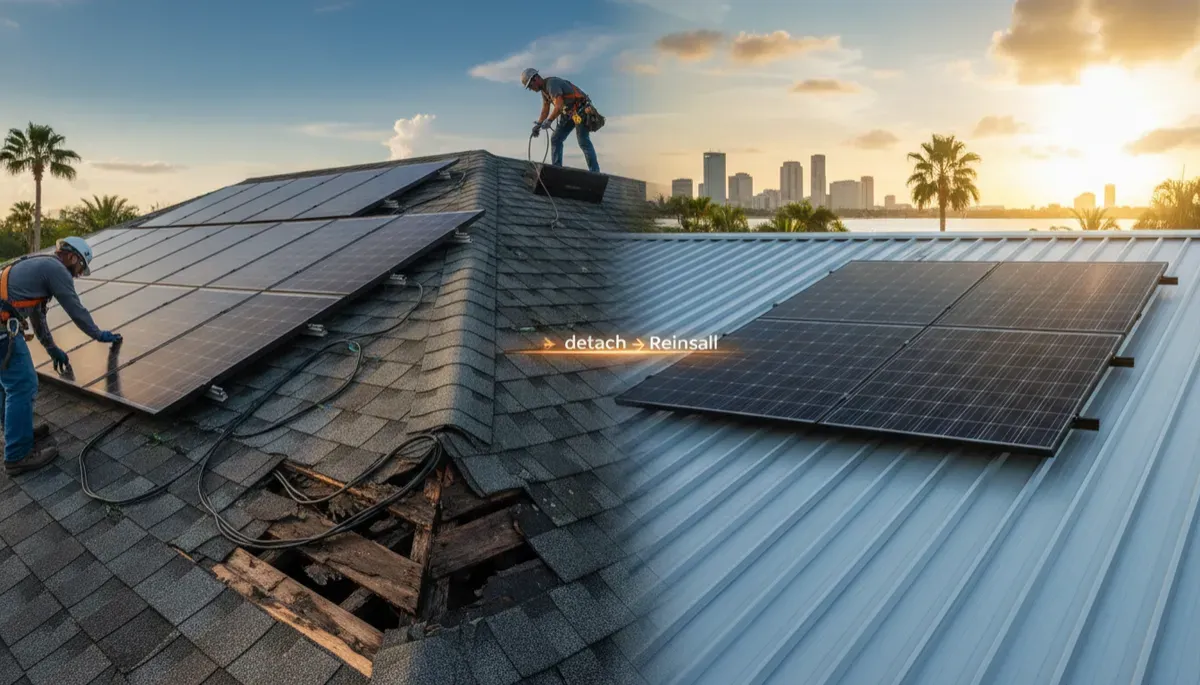
Metal Roof Over Asphalt Shingles: Detach & Reinstall Tampa
Your asphalt roof is aging, but your solar panels are still producing power. Do you wait and risk leaks, or replace the roof and deal with the panels now? For Tampa homeowners, this is a common—and critical—decision point. The wrong move can cost you thousands in damage, void warranties, and put your family’s safety at risk. The right move sets you up with a 50+ year roof and a clean, code-compliant solar system that works better together.
In Tampa’s harsh mix of heat, UV, humidity, and storms, pairing a durable metal roof with properly detached and reinstalled solar is one of the smartest upgrades you can make. This guide walks you through why metal beats asphalt here, why you can’t simply “work around” solar panels, what a safe detach & reinstall process looks like, realistic Tampa cost ranges, timelines, and how licensed, permitted work protects your home, your investment, and your peace of mind.
1. The Asphalt Roof Problem in Tampa’s Climate
Standard asphalt shingle roofs are often marketed as lasting 25–30 years. In Tampa Bay, the reality is very different. Under intense UV exposure, daily temperature swings, salt-laden coastal air, and frequent thunderstorms, most asphalt systems here realistically last about 15–20 years—and many fail even sooner if ventilation or installation were less than ideal. Shingles dry out, curl, and lose granules, exposing the underlying mat to rapid deterioration.
Common warning signs your asphalt roof is nearing the end of its life include missing or cracked shingles, dark streaking, exposed nail heads, sagging areas, and granules collecting in your gutters. Around solar arrays, these issues can be harder to see, which is why many Tampa homeowners are surprised by leaks that appear suddenly during a heavy storm or tropical system. Water can travel under shingles and around penetrations long before you see a stain on your ceiling.
Tampa’s climate accelerates all of this. The combination of extreme UV radiation, high humidity, and salt spray near the bay and Gulf is punishing on asphalt-based products. Add in high winds and wind-driven rain from summer storms and hurricanes, and you have the perfect recipe for premature roof failure. If you stay with asphalt, you are likely looking at another full replacement in 10–15 years, often in the $8,000–$12,000+ range for a typical home—before you even factor in solar work or any structural repairs from hidden leaks.
2. Why Metal Roofing Is Built for Florida Homes
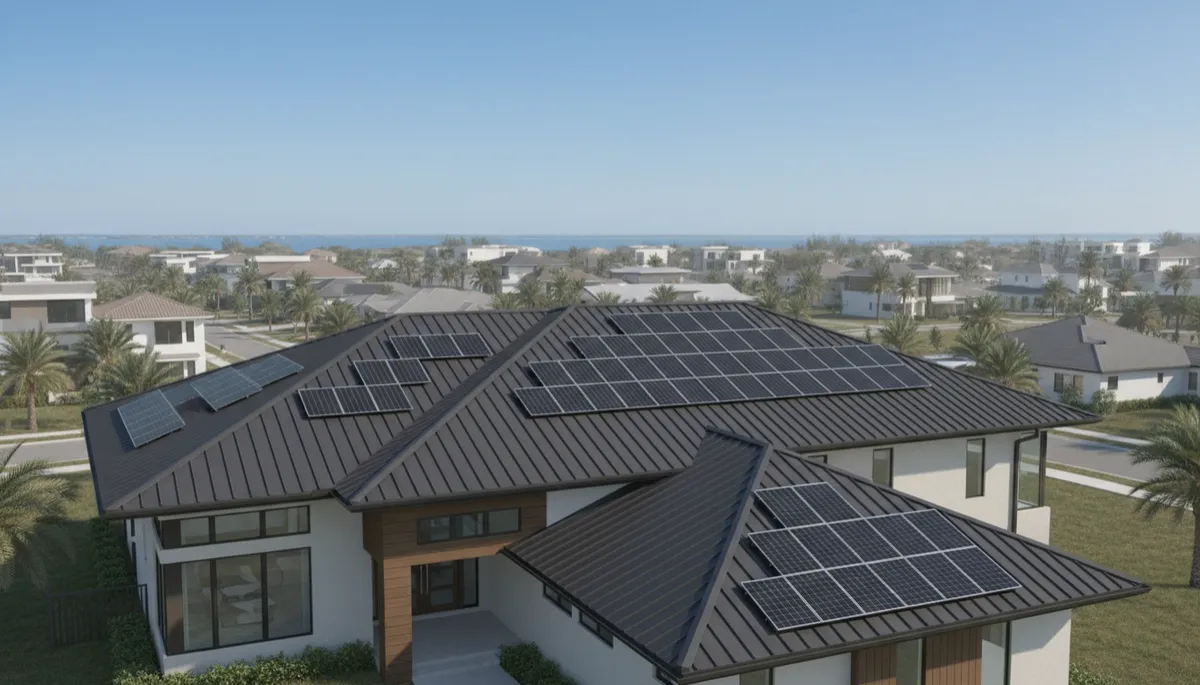
By contrast, a properly installed metal roof is designed to be a once-in-a-lifetime upgrade in Florida. Quality standing seam and high-end metal systems commonly carry a 50+ year service life, with manufacturer warranties often in the 30–50 year range. That means one roof can easily outlast your current solar array and likely the next one you install decades from now, eliminating the cycle of tearing off shingles every time you upgrade panels or inverters.
Metal roofing also excels where Tampa homeowners need it most: wind and storm resistance. Many Florida-rated metal systems are engineered and tested for winds of 140+ mph, meeting or exceeding stringent Florida Building Code requirements for coastal and hurricane-prone areas. Panels are mechanically fastened and interlocked, dramatically reducing the risk of blow-offs and wind-driven water intrusion compared to loose or aging shingles. In a region where tropical storms and hurricanes are a recurring reality, this is not a luxury—it’s a safety feature for your family and your home’s structure.
For coastal neighborhoods, metal’s salt spray corrosion resistance is another major advantage. Aluminum and coated steel systems are specifically formulated to handle the corrosive environment near Tampa Bay and the Gulf of Mexico, where unprotected metals and asphalt components break down far more quickly. Combined with high-performance underlayments and proper flashing, a metal roof forms a robust, long-term barrier against moisture and salt intrusion into your roof deck and framing.
Metal roofing also improves energy efficiency. Reflective coatings can significantly reduce heat absorption, keeping your attic and living spaces cooler and lowering your air conditioning load during Tampa’s long, hot seasons. This pairs extremely well with solar; your panels operate more efficiently on a cooler roof, and your home’s overall energy use drops. Many Florida insurers recognize these performance and safety benefits, offering insurance discounts for qualifying metal roofs, which helps offset the higher upfront cost. Considering that Tampa metal roof installations typically range from about $16,500–$24,000 for a 1,500 sq ft premium system and higher for larger or more complex homes, those long-term savings and avoided future replacements are a key part of the return on investment.
3. Why Detach & Reinstall Solar Is Necessary—Not Optional
When you convert from asphalt to metal, one fact is non-negotiable: you cannot install a new metal roof over existing solar panels. The panels, racking, wiring, and roof penetrations must be safely disconnected, removed, and later reinstalled on the new system. Any contractor suggesting they can “work around” your solar or slip metal under the existing array is not only cutting corners—they are creating serious safety, code, and warranty issues that could cost you dearly later on.
Attempting to leave solar in place forces roofers to guess what is happening under the panels. They cannot properly install underlayment, flashing, or fasteners in those areas, and they cannot inspect for existing water damage. From a safety standpoint, working around live electrical equipment on a roof is inherently dangerous. Tampa’s permitting authorities and inspectors expect solar to be de-energized and removed before a full roof replacement. Anything else risks electric shock, fire hazards, and structural damage if water continues to penetrate around old mounts or compromised shingles.
There are also warranty implications. Both your solar equipment warranty and your roof warranty typically require that all work be performed by licensed professionals, under permit, following manufacturer specifications. If panels are left in place while roofers improvise around them, manufacturers can deny future claims for leaks, corrosion, or performance issues. Inspectors in Tampa are increasingly strict about these details. They will not sign off on shortcuts that violate the Florida Building Code, National Electrical Code, or City of Tampa solar and roofing requirements. A proper detach & reinstall is not an upsell—it is the only safe, insurable, and warrantable way to complete an asphalt-to-metal conversion with solar.
💡 Fused Solar and Roofing is proud to offer safe solar detach and roof readiness assessments before your metal upgrade. Schedule your free assessment at tampasolarmaintenance.com
4. Step-by-Step: Detach, Replace with Metal, and Reinstall Solar
A professional asphalt to metal roof conversion with solar detach & reinstall in Tampa follows a clear, safety-focused sequence. Here is how a well-managed project should proceed from start to finish:
Step 1: Permits and Inspections – The process begins with obtaining the necessary roofing and electrical permits through the City of Tampa. For solar, this includes engineered plans that meet the Florida Building Code and National Electrical Code, stamped by a Professional Engineer where required. Inspections are scheduled at key stages—after roof dry-in, after solar rough-in, and at final completion—to verify everything meets code and manufacturer specifications.
Step 2: Solar Disconnect and Safe Removal – A licensed electrician safely shuts down the solar system, disconnects it from your main electrical service, and verifies that all circuits are de-energized. Panels, racking, and wiring are carefully removed, labeled, and documented so reinstallation is accurate and efficient. This step protects workers and your equipment from accidental damage or shock.
Step 3: Panel Storage and Protection – Solar modules are stored on-site in a secure, shaded area or transported to a protected storage location. Proper padding, stacking, and weather protection prevent glass breakage, frame warping, or connector damage. This is your investment—treating it like fragile cargo is essential to avoid unnecessary replacement costs.
Step 4: Asphalt Roof Removal – The roofing crew removes all asphalt shingles, underlayment, and flashing down to the roof deck. In Tampa, this tear-off typically runs about $1–$5 per square foot according to recent cost data, depending on layers and complexity. Debris is collected and hauled away in dumpsters, keeping your property clean and safe throughout the process.
Step 5: Roof Deck Inspection – With the old roof off, the deck is thoroughly inspected for hidden damage: rot, delamination, mold, nail pops, and structural issues around rafters and trusses. Any compromised sheathing or framing is replaced or reinforced. This is a critical quality and safety checkpoint; skipping it or rushing through can leave serious problems buried under your new roof.
Step 6: Metal Roof Installation with Proper Flashing – Next, high-performance underlayment is installed, followed by the new metal panels, trim, and flashing. Penetrations for vents, skylights, and future solar mounts are carefully detailed to prevent leaks. In Tampa, premium standing seam systems for a 1,500–2,000 sq ft roof commonly fall in the $16,500–$32,000 range depending on material and complexity, which aligns with recent local estimates from multiple roofing sources.
Step 7: Solar Panel Reinstallation on Metal Roof – Once the metal roof is complete and inspected, the solar mounting system is installed using hardware engineered specifically for metal roofing. This often means fewer roof penetrations and cleaner water shedding than on asphalt. Panels are re-mounted in their original configuration or optimized for better performance if shading or layout improvements are possible.
Step 8: Electrical Reconnection and Testing – A licensed electrician reconnects the system, verifies grounding and rapid shutdown compliance, and performs full functional testing. Final electrical and building inspections are completed, and your utility is notified so your system can be officially re-energized. Only after this step is your new roof and solar system fully back online, safely and legally.
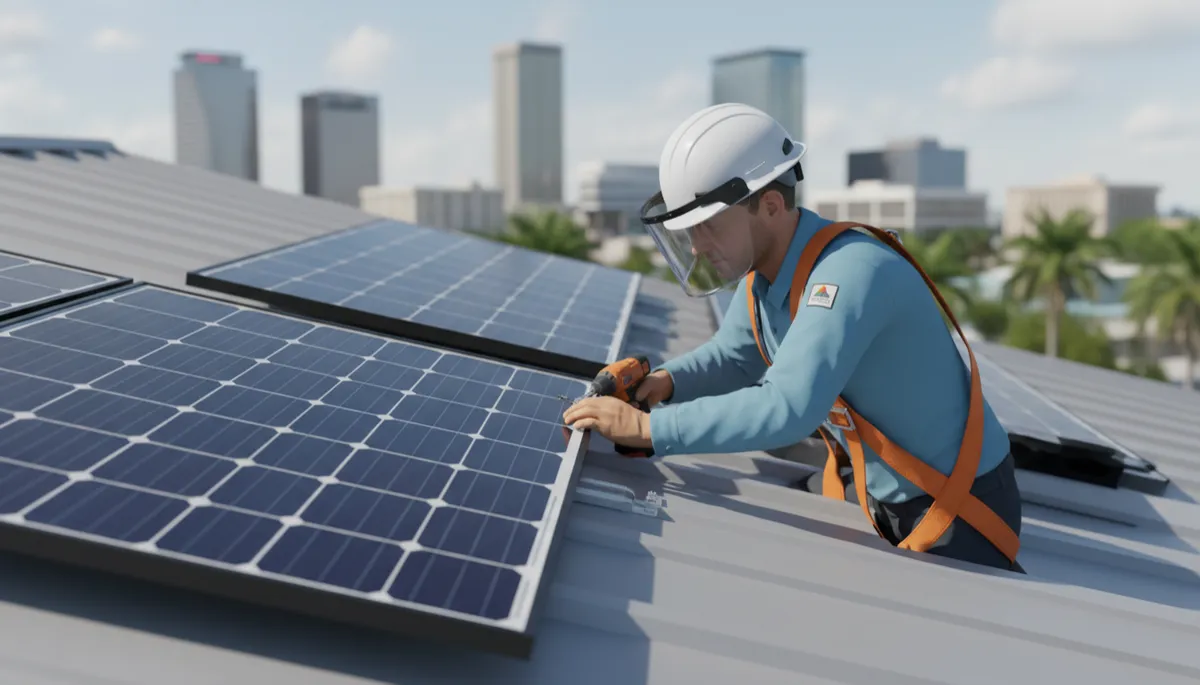
Coordinated roofing and electrical work keeps your solar downtime and risk to a minimum.
5. Cost Breakdown: A Realistic Tampa Scenario
Every home is different, but it is important to go into an asphalt-to-metal conversion with solar detach & reinstall knowing realistic, Tampa-specific cost ranges. For a typical home with about 1,500 sq ft of roof area and an existing solar array, you can expect the following approximate ranges:
Solar removal: $1,500–$2,500 for safe disconnect, removal, labeling, and storage of panels, racking, and wiring.
Asphalt roof removal and disposal: $1,500–$2,500, consistent with Tampa tear-off pricing of roughly $1–$2 per square foot for many homes.
Metal roof installation (1,500 sq ft): $10,000–$15,000 for a quality system in this size range, assuming a relatively straightforward roof geometry. More complex roofs or premium materials can run higher, in line with regional averages of roughly $10–$20 per square foot installed.
Solar reinstallation: $3,000–$5,000 to reinstall racking with metal-compatible hardware, remount panels, and re-run wiring as needed.
Permits and electrical: $1,000–$2,000 for roofing and electrical permits, inspections, and any required engineering or utility coordination.
In total, most Tampa homeowners should plan on an all-in project cost of roughly $17,000–$27,000 for this scope. This range reflects a complete, code-compliant solution that includes safe solar handling, full tear-off, high-quality metal installation, and professional reactivation of your solar system. It is essential to compare this against the alternative: staying with asphalt and facing another full replacement in 10–15 years, plus the added cost and disruption of moving solar again at that time. Over a 40–50 year horizon, a single, well-executed metal roof often pays for itself through avoided replacements, lower maintenance, improved energy efficiency, and potential insurance savings.
6. Project Timeline: What to Expect from Start to Finish
A safe, properly permitted asphalt-to-metal conversion with solar detach & reinstall is not an overnight job—but it is also not an endless construction project. In Tampa, most homeowners can expect a total duration of about 4–6 weeks from signed contract to final solar reactivation, depending on permitting and weather conditions. Here is how that typically breaks down:
Permitting: 2–4 weeks for roofing and solar/electrical permits to be reviewed and approved through the City of Tampa’s process, including any required engineering stamps and documentation.
On-site work: 5–7 days for solar removal, asphalt tear-off, deck repairs if needed, metal roof installation, and solar re-mount. Larger or more complex roofs may take slightly longer, especially if significant structural repairs are discovered after tear-off.
Electrical inspection and activation: 3–5 days for final inspections, utility coordination, and system re-energization once all work passes code checks.
During portions of this window—particularly while permits are pending—your roof and solar remain fully operational. Once on-site work begins, a well-coordinated contractor minimizes your solar downtime and keeps your home protected at every stage, never leaving your roof exposed overnight or during forecasted storms. Clear communication about schedule, inspections, and weather contingencies is a hallmark of a professional, safety-conscious team.
7. Hidden Roof Damage: What We Often Find Under Asphalt Shingles
One of the biggest advantages of doing this project the right way—full tear-off and thorough inspection—is the opportunity to uncover and correct hidden roof damage before it becomes a major structural or health issue. Under aging asphalt shingles in Tampa, it is common to find soft or rotted decking, mold growth from chronic moisture, rusted fasteners, and even compromised trusses or rafters, especially near roof penetrations and low-slope areas where water tends to sit longer after storms.
Around solar mounts, the risk is even higher. Penetrations that were not flashed perfectly, or that have shifted slightly over time with thermal movement, can allow water to track into the roof assembly. Because panels shade the area, shingles under them often dry out more slowly, trapping moisture and accelerating decay. You may have no visible leaks inside your home yet, but structural wood can already be deteriorating. Left unaddressed, this can lead to sagging, costly framing repairs, and even safety concerns during high wind events.
When hidden damage is discovered, there will be additional costs for materials and labor to replace decking or reinforce framing. A transparent contractor will explain these findings, show you photos, and provide clear, itemized pricing before proceeding. While nobody enjoys surprise repairs, addressing them during a roof replacement is the safest and most cost-effective time to do so. Once the damaged areas are corrected and your new metal roof is installed, you benefit from a much more robust system that resists future leaks, sheds water efficiently, and protects your structure for decades to come.
💡 Fused Solar and Roofing is proud to offer comprehensive roof and solar damage inspections to identify issues before they spread or cause costly repairs. Book your inspection at tampasolarmaintenance.com
8. Warranty & Insurance Protection: Why Doing It Right Matters
A key part of the value of a metal roof plus solar system is the warranty coverage that stands behind your investment. Quality metal roof manufacturers commonly offer 30–50 year warranties on materials and finish, while most reputable solar panel manufacturers provide 25–30 year performance and product warranties. Your roofing contractor may also include a separate labor warranty on the roof installation, and your solar installer should stand behind their workmanship on the array and electrical components.
These warranties, however, are only as strong as the installation practices behind them. Manufacturers routinely require that work be performed by licensed contractors, under proper permits, following their published installation manuals. Cutting corners on detach & reinstall, skipping permits, or allowing unqualified crews to handle electrical work can void coverage. That means if a leak develops around a solar mount or a panel fails prematurely, you could be left paying out of pocket for repairs or replacements that would otherwise have been covered.
Insurance is another critical consideration. Homeowners insurance policies in Florida typically require that major roof and electrical work be permitted and inspected to remain fully covered. If a claim arises after a hurricane or severe storm and the adjuster discovers unpermitted modifications, makeshift roof penetrations, or non-compliant wiring associated with your solar system, they can reduce or deny coverage. A documented, code-compliant metal roof and solar installation, on the other hand, strengthens your position with insurers and may even qualify you for premium discounts due to improved wind resistance and fire safety.
When you work with a company that stands behind both roofing and solar, you gain an added layer of protection: a single point of accountability. Instead of one contractor blaming another when something goes wrong, you have a unified team responsible for the entire roof and solar system working together, backed by written warranties on materials and workmanship.
9. Why You Need a Licensed Contractor for Roof & Solar Work
Converting from an asphalt roof to metal while handling live solar equipment is not a DIY project and not a job for unlicensed crews. In Tampa and across Florida, only licensed contractors can pull the necessary permits, coordinate inspections, and legally perform this type of work. That is not red tape—it is a safety and quality safeguard designed to protect homeowners from substandard construction and dangerous electrical practices.
Metal roofing itself requires specialized training. Proper panel layout, fastening patterns, flashing details, and integration with underlayments and ventilation systems are all critical to long-term performance. Mistakes here may not show up immediately, but they can lead to leaks, panel blow-offs, or premature corrosion down the line. Solar reinstallation is equally technical. Only a licensed electrician should be disconnecting and reconnecting your system, verifying grounding, overcurrent protection, and rapid shutdown compliance per the National Electrical Code and local Tampa requirements.
A properly licensed contractor will also understand and apply the latest building codes and structural standards, including wind uplift requirements, load calculations, and attachment methods for both the roof and solar racking. This is especially important in hurricane-prone regions like Tampa Bay, where codes are updated regularly in response to storm performance data. Choosing a company that holds dedicated roofing, electrical, and building licenses means you are working with professionals who are accountable to state boards and must carry appropriate insurance and bonding.
10. FAQ: Metal Roofs, Solar Panels, and Tampa Homes
Q: Is metal roofing noisy when it rains?
In a properly installed residential system, no. Modern metal roofs are installed over solid decking with underlayment and typically attic insulation beneath. This assembly absorbs sound effectively. Many Tampa homeowners report that rain on a metal roof is no louder than on their previous asphalt roof—and often quieter during heavy storms because the metal system is more rigid and better sealed.
Q: Will my solar production change with a metal roof?
In most cases, production stays the same or improves slightly. Metal roofs can run cooler than dark asphalt shingles, which helps solar modules operate more efficiently. During the detach & reinstall process, there is also an opportunity to optimize panel layout for shading and orientation, which can further enhance output. Any downtime during construction is temporary and planned around weather and permitting.
Q: How much can I save on insurance with a metal roof?
Savings vary by carrier and policy, but many Florida insurers offer discounts for qualifying metal roofs due to their superior wind and fire performance. Some homeowners see meaningful reductions in annual premiums, which helps offset the higher upfront cost of metal. The exact amount depends on your insurer, roof design, and documentation of code-compliant installation, so it is wise to discuss the upgrade with your agent before and after the project.
Q: What if the roof inspection finds major damage?
If significant rot, structural issues, or mold are discovered after tear-off, your contractor should document everything with photos and provide a clear, written change order for repairs. While this adds cost, addressing serious damage is non-negotiable from a safety and code perspective. The upside is that once repaired and covered by a new metal roof, you dramatically reduce the risk of recurring problems and emergency repairs in future storms.
Q: Can I do this in phases?
In most situations, the safest and most cost-effective approach is a single, coordinated project: detach solar, replace the roof, and reinstall solar. Trying to split the work into phases—such as installing metal only on part of the roof now and moving solar later—usually increases labor costs, extends downtime, and complicates permitting. A well-planned, all-in project minimizes disruptions and ensures every component is designed to work together from day one.
💡 Fused Solar and Roofing is proud to offer annual metal roof and solar performance maintenance plans tailored to Tampa's climate and your home's specific needs. Start your free consultation at tampasolarmaintenance.com
11. Take the Next Step: Get a Safe, Long-Lasting Roof & Solar Solution
If your asphalt roof is aging and you already have solar—or you are planning to add solar soon—now is the right time to look at a metal roof over asphalt shingles replacement with a professional solar detach & reinstall. Done correctly, this is a one-time upgrade that protects your home for 50+ years, keeps your solar investment safe and productive, and aligns with Tampa’s strict building and electrical codes. Cutting corners may look cheaper on paper, but it exposes you to leaks, warranty headaches, and potential insurance issues down the road.
Schedule your free metal roof + solar detach assessment today. Call (813) 686-9896 or email [email protected] to speak with a licensed professional who understands both roofing and solar in Tampa’s unique climate. We handle all permits, inspections, and warranties from start to finish, so you can upgrade with confidence, knowing your home, your family, and your investment are protected for the long term. Upgrade to a 50+ year roof today and put your solar panels on the solid, storm-ready foundation they deserve.
Fused Solar and Roofing is a licensed roofing (CCC1331058), electrical (EC13014750), and building contractor (CBC1252064), all three in-house, serving Hillsborough, Pinellas, Pasco, and Manatee counties since 2007. Fused Solar and Roofing is an EnergySage Elite Installer with a 5.0/5 rating and 21+ verified reviews, independent verification, earned not purchased.
Need a new roof, with or without solar on it? Request a roofing quote at https://fusedsolarandroofing.com/roofing
