What Changes on a Solar System From Year One to Year Ten
Year One to Year Ten: What Changes on a Solar System
Most solar content focuses on installation day and the first electric bill afterward. This overview from Fused Solar and Roofing looks at the full first decade instead: what is normal in Tampa Bay, when real decisions show up, and how to recognize the few moments that actually need attention. Fused Solar and Roofing is a licensed roofing (CCC1331058), electrical (EC13014750), and building contractor (CBC1252064) — all three in-house.
1. Year one: learning what normal looks like for your house
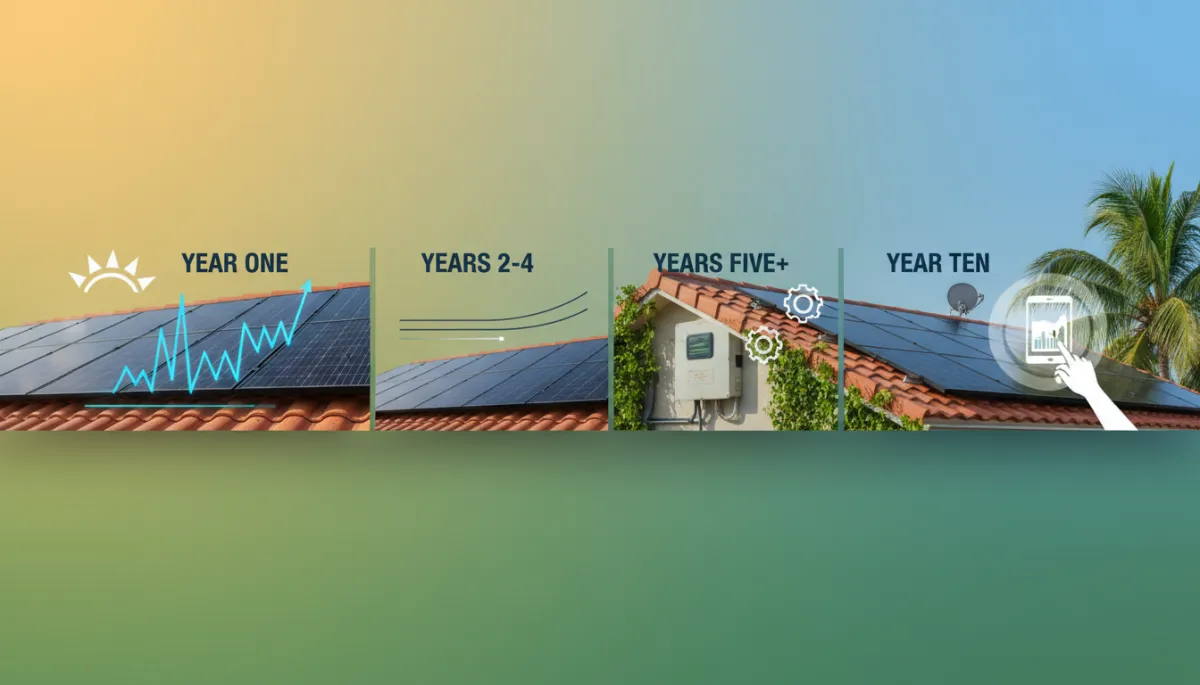
The first year with a solar system in Tampa Bay is about learning patterns, not chasing every number. Your monitoring app will show daily and monthly swings that are driven by weather, clouds, and seasons. Winter days are cooler and panels run efficiently, but the sun is lower and days are shorter. Summer brings long days and high sun angles, but the heat on the panels reduces efficiency even as the system sees more total sunlight. Until you see all four seasons once, it is difficult to know whether any given month is unusually high, unusually low, or simply part of the normal local pattern for Hillsborough, Pinellas, Pasco, or Manatee County. The practical goal of year one is to collect a complete set of monthly production figures and get comfortable reading your monitoring app so you can recognize that pattern in later years. Once that baseline exists, later changes stand out clearly without guesswork or anxiety.
💡 Pro Tip: Save your first full year of monthly production figures somewhere you will still have them in ten years. That baseline is what every later year gets compared against.
2. Years two through four: the quiet stretch
For most Tampa Bay homeowners, years two through four are uneventful. The system has settled in, you have a full year of data to compare against, and the monitoring app looks familiar. In this period, your job is simple: glance at production from time to time, especially when a season changes, and confirm that this year’s numbers look similar to last year’s for the same month. Normal soiling from dust and pollen typically costs only a few percent of annual production and is often washed away by regular rain, while localized bird droppings, tree sap, or heavy pollen can affect specific panels more noticeably. If the overall system curve looks the same year over year, small day-to-day differences are usually just weather. Many owners in Hillsborough, Pinellas, Pasco, and Manatee counties go through these middle years with no service visits at all, beyond any checkups they choose to schedule for peace of mind.
3. What actually degrades, and what does not
A solar system is a mix of components that age in different ways. The panels themselves are designed to lose a small amount of output each year in a slow, predictable way. This gradual decline is normal and is addressed in the panel manufacturer’s performance warranty, which commonly runs about twenty-five years as a typical warranty term. When you compare year three to year one, or year eight to year one, a small difference in annual production is expected and is not a sign that something is wrong by itself. In contrast, the electronics in the system, especially the inverter and any optimizers or similar devices, tend to fail more abruptly when they do fail. Instead of a gentle slope over many years, you see a clear step down in the monitoring data, often on a particular day or week, sometimes affecting a single string or group of panels. From a technician’s point of view, the shape of the change in your data is the key: a slow, steady, slight decline points toward normal panel aging, while a sudden drop suggests an electrical fault, a tripped breaker, a failed inverter, or a communication issue. This distinction is what allows a service department to decide whether you are simply seeing age, or whether a visit is appropriate.
📌 Key Takeaway: Panels lose a small amount of output each year by design, and manufacturers warranty that. A sudden drop is something else entirely, and the difference matters.
4. Years five through seven: the first real decisions
Years five through seven are when many Tampa Bay homeowners encounter their first real decisions about a solar system. By this point, the system has run through multiple hurricane seasons, summer heat waves, and the normal wear of outdoor equipment. The panels are still following their gradual, predictable path, but other questions may appear: Is the monitoring still connected reliably? Has a tree grown enough to shade part of the array? Has there been any roof work nearby that might affect wiring or attachments? This is also the window when some inverters, depending on brand and design, begin to age into the range where a replacement in the coming years is realistic. The decisions in this period are usually not urgent; they are about recognizing that some components are moving from early life into midlife and that planning ahead will make any eventual service simpler. For many systems in Hillsborough, Pinellas, Pasco, and Manatee counties, the right move here is a calm, scheduled diagnostic visit every so often, rather than waiting for something to fail suddenly.
Not sure where your system is in its life? Fused Solar and Roofing inspects and services solar systems across Hillsborough, Pinellas, Pasco, and Manatee counties. Request a diagnostic visit at https://fusedsolarandroofing.com/fused-solar-roofing-service-department
5. The inverter enters the conversation
In most residential systems, the inverter becomes a consideration before the panels or racking do, and that is normal. The inverter is the workhorse that converts the direct current from your panels into alternating current for your home and the grid. It runs every sunny day, manages safety functions, and often provides the data that feeds your monitoring app. Over time, heat, humidity, and simple run hours in the Tampa Bay climate add up. Knowing the inverter’s age and model allows you to turn a possible surprise into a plan. Instead of wondering if a mid-decade outage means the whole system is failing, a technician can look at the installation date, compare it to typical inverter lifecycles, and help you decide whether you are likely looking at a repair, a replacement, or a communication issue. For a homeowner, the practical step is straightforward: keep the inverter paperwork and label information, and note the installation date. When production changes, that single detail gives a service department like Fused Solar and Roofing a clear starting point for troubleshooting without guesswork.
6. The roof enters the conversation
The roof under your array has its own timeline, and it is usually shorter than the array’s. A roof and solar array installed together in Hillsborough, Pinellas, Pasco, or Manatee County age as a pair, and the planning question becomes simple: at what point will the roof need replacement while the panels still have many productive years left? When solar is added to an existing roof, the runway is shorter because the roof has already used up part of its life before the first panel was installed. In both cases, the key fact is the roof’s age and material. A planned roof replacement with a detach and reinstall of the array is straightforward work for a company that handles both trades. Fused Solar and Roofing is a licensed roofing (CCC1331058), electrical (EC13014750), and building contractor (CBC1252064) — all three in-house, which means the roof and solar scopes can be coordinated calmly instead of under pressure from a leak. Knowing the roof’s age today lets you schedule that combined project at a time that works for you, rather than reacting to an unexpected roofing issue with panels in the way.
⚠️ Warning: The roof under your array has its own clock, and it is usually shorter than the array's. Knowing the roof's age is the single most useful thing you can know about your solar system.
7. Year ten and beyond: what an older system looks like
By the time a system reaches year ten and beyond, it usually looks calm from the outside: the panels are still on the roof, the monitoring app still shows production that follows the familiar seasonal curve, and the system continues to offset a portion of your usage. Under the surface, a few changes are common. Many systems are on their second inverter by this stage, especially in hot, humid climates like Tampa Bay, while the panels continue aging along their gradual, predictable path. Some arrays have already gone through a roof replacement with a detach and reinstall, particularly where solar was added to an older roof. In other cases, the original installer may no longer be in business, and a service department like Fused Solar and Roofing steps in to support an existing system. None of this makes the system less of an asset; it simply reflects that any long-lived equipment will see component changes over time. Older systems are worth maintaining when the components are sound, because the panels continue to produce useful energy even after the initial excitement of installation has long passed. Fused Solar and Roofing is an EnergySage Elite Installer with a 5.0/5 rating and 21+ verified reviews — independent verification, earned not purchased.
8. The single habit that makes all of this easier
Across the entire first decade, one simple habit makes everything else easier: look at your monitoring app occasionally and keep your paperwork. You do not need to track every sunny afternoon in Hillsborough, Pinellas, Pasco, or Manatee County. Instead, check in once in a while to confirm that this month looks like the same month last year and the year before. If you see a clear change that does not match weather or season, that is the time to call for a diagnostic visit. Keeping the original contract, panel and inverter model information, and the date of installation in one place turns that call into a focused conversation instead of a reconstruction project. Nearly every issue described in this overview—whether an inverter concern, a roof decision, or an unusual change in production—is easier, less disruptive, and more straightforward when it is caught early. Over ten years, your real job as the homeowner is not to operate the equipment; it is simply to notice when something changes and to reach out calmly when it does.
📌 Key Takeaway: Fused Solar and Roofing services solar systems of all brands under licenses CCC1331058 and EC13014750, including systems whose original installer is no longer in business.
Frequently Asked Questions for Tampa Bay Homeowners
1. How long does a solar system typically last in Tampa Bay?
A solar system is made of parts that age at different speeds, so “how long it lasts” is really about how long each part stays useful. Panels are designed to produce for a long time with only gradual, predictable decline, and manufacturers commonly back that performance with warranties around twenty-five years as a typical term, not a hard stop. The racking that holds the panels is simple and tends to age with the roof it is attached to. Electronics such as inverters and communication hardware usually reach their own service or replacement point earlier and may be changed out while the panels remain in place. In Tampa Bay’s heat, humidity, and storms, a well-installed system that is monitored and serviced when needed generally remains a working asset for many years beyond its first decade, with individual components being maintained or replaced as they reach their own timelines.
2. Does solar production decline over time, and by how much?
Yes, solar panel output declines over time, but the key point is that the decline is small and gradual when everything is working normally. Panel manufacturers design and test for this and describe it in a performance warranty that lays out how much output they expect the panels to retain over many years. In Tampa Bay, you would expect to see a gentle slope in annual production when you compare year one to year ten, not a sharp drop from one month to the next. Normal soiling, such as dust or light pollen, typically costs only a few percent of annual production and is often helped by regular rain, while localized bird droppings, tree sap, or heavy pollen can have a larger effect on specific panels until addressed. If your monitoring shows a sudden, noticeable step down rather than a slow curve, that points to an issue beyond normal aging and is a good reason to call a service department like Fused Solar and Roofing for a diagnostic visit.
3. What maintenance is needed in the first few years?
For most Tampa Bay systems, the first few years require very little hands-on maintenance from the homeowner. Your main tasks are to keep an eye on the monitoring app, confirm that production follows the expected seasonal pattern, and visually check from the ground that the array looks intact after major storms. Normal rain usually handles routine dust, and any detailed inspection or cleaning at roof level should be left to qualified professionals for safety and warranty reasons. If you notice that the monitoring app has gone offline, that production numbers do not match the same month in prior years, or that anything looks out of place on the roof from the ground, that is the time to contact a company like Fused Solar and Roofing for a closer look. In many cases, early-year service is limited to verifying connections, confirming that the inverter is operating correctly, and making sure communication equipment is reporting accurately.
4. When does a solar system usually need its first real service visit?
The timing of a first real service visit in Tampa Bay depends on the specific equipment, installation details, and local conditions, but many systems run through the first several years with no issues beyond monitoring questions. Service visits often begin when something changes noticeably: the monitoring app stops reporting, a clear production drop appears that is not explained by weather, or the inverter shows a fault indicator. For many homeowners, this happens sometime in the midlife years of the system, when the inverter and communication hardware have accumulated a significant number of operating hours. The important point is that a service visit is triggered by a change, not by the calendar alone. If your system in Hillsborough, Pinellas, Pasco, or Manatee County continues to match prior years’ production curves and shows no faults, it is reasonable to continue monitoring calmly and schedule a diagnostic visit when you or your installer see a specific reason to do so.
5. Is an older solar system still worth keeping?
An older solar system in Tampa Bay is often still worth keeping when its components are sound. Even after a decade or more, panels that have aged gradually and predictably continue to produce useful energy, and many systems simply move onto a second inverter while the original racking and panels remain in place. Some arrays have already gone through a roof replacement with a detach and reinstall, and others are supported by a service company like Fused Solar and Roofing after the original installer has left the market. In each case, the decision to keep an older system comes down to the health of the panels, the condition of the roof and racking, and the state of the electronics, not just the calendar age. When those parts are functioning properly, maintaining and servicing an older system is a practical way to continue receiving value from equipment that has already proven itself over many Florida summers and storms.
6. What should I watch for year to year as a Tampa Bay homeowner?
Year to year, the most useful things to watch are simple: your monitoring app, the roof from the ground, and any changes in your surroundings. Compare each month’s production to the same month in prior years for your home in Hillsborough, Pinellas, Pasco, or Manatee County, and look for patterns rather than single days. A slow, slight change over many years is expected; a sudden step down, a flat line on a sunny week, or a monitoring outage that does not resolve is worth a call. After major storms, take a ground-level look to confirm that the array appears intact and that no obvious debris is lodged around it. Also be aware of trees or new structures that may introduce shade over time. When you notice something different, having your system paperwork, installation date, and inverter information handy allows Fused Solar and Roofing or another qualified contractor to respond efficiently and keep the system on track.
Fused Solar and Roofing is a licensed electrical contractor (EC13014750) servicing solar systems of all brands across Hillsborough, Pinellas, Pasco, and Manatee counties, including systems whose original installer is no longer in business. Request a diagnostic visit at https://fusedsolarandroofing.com/fused-solar-roofing-service-department
Is your solar system producing what it should? Request a diagnostic visit at https://fusedsolarandroofing.com/fused-solar-roofing-service-department