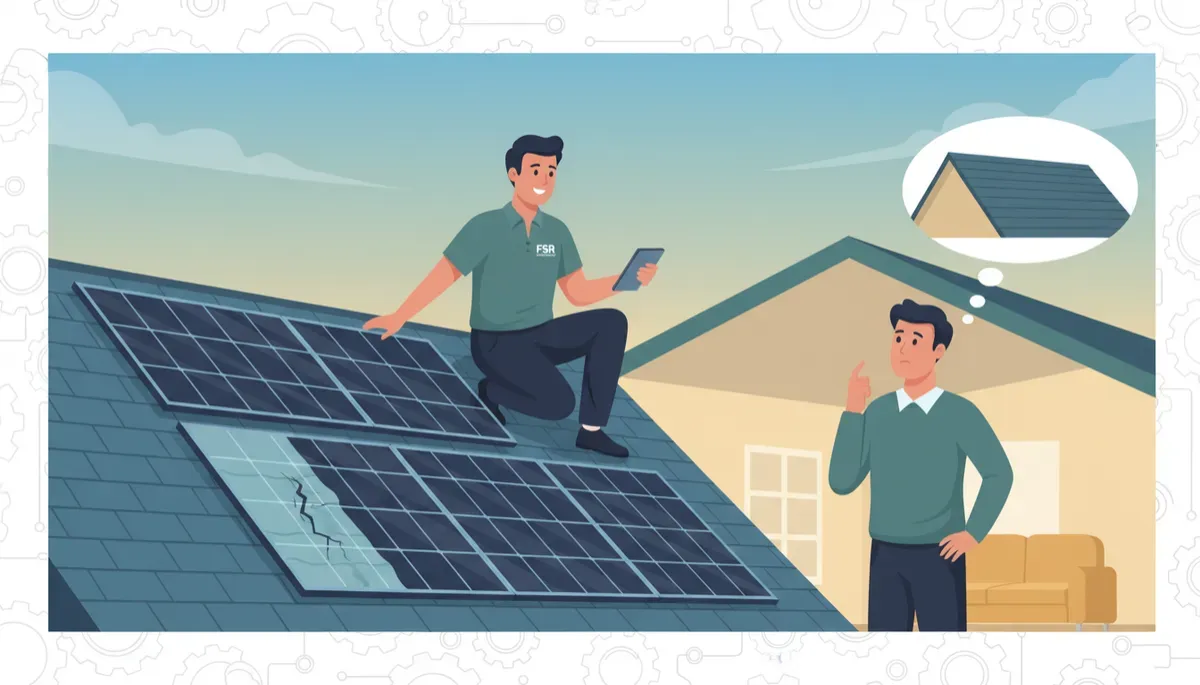
When Solar Service Becomes a Roof Job in Tampa Bay
You called about the solar, and the answer turned out to be the roof. Fused Solar and Roofing is a licensed roofing (CCC1331058), electrical (EC13014750), and building contractor (CBC1252064) — all three in-house. This article explains why that situation is so common in Tampa Bay, how technicians separate roof issues from solar issues, what can be repaired with panels in place, and what happens when a detach and reinstall becomes the practical next step.
1. Why the roof shows up in a solar service call
In Tampa Bay, many solar arrays were installed on roofs that already had a decade or more of service on them. Asphalt shingle, tile, and metal roofs in Florida work hard: high heat, daily UV exposure, and seasonal storms all accelerate aging. The Florida Building Code recognizes this environment with specific requirements for underlayment, fasteners, and roof assemblies, and those assemblies still have a finite service life. Solar panels, by contrast, are designed to operate for decades, so it is common for the roof to reach its later years while the solar equipment is still in its middle years.
The other factor is visibility. Homeowners in Hillsborough, Pinellas, Pasco, and Manatee counties see the exposed parts of the roof from the yard or driveway, but the section under a solar array is rarely in anyone’s line of sight. Small cracks in tiles, brittle underlayment, or soft decking under the panels can develop for years without being noticed. The first time anyone looks closely at that covered area is often during a solar service visit prompted by a leak, a production change, or a repair request. It feels like the roof issue appeared out of nowhere, but in many cases the service call is simply the first detailed inspection the covered roof has had in a long time.
2. How a technician tells a solar problem from a roof problem
When a technician from Fused Solar and Roofing arrives for a service call in Tampa Bay, the first step is to separate electrical behavior from building behavior. For a production concern, that means checking monitoring data, inverter status, string performance, and connections at accessible points. If one string is down while others are normal, or if an inverter is in a fault state, the likely cause is within the solar system itself. If production is steady but a homeowner reports staining on a ceiling, the focus shifts toward the roof and penetrations rather than the electronics alone.
For leaks, technicians look at the path of water, not just the nearest piece of solar hardware. Water can travel along underlayment, decking, or trusses before showing up at a ceiling spot. The inspection includes roof surfaces above the leak, flashing around vents and skylights, field shingles or tiles, and the solar mounting points. On the roof, the technician looks for cracked tiles, lifted shingles, worn underlayment at exposed edges, rusted fasteners, and sealant that has aged out. Inside the attic, signs such as darkened wood, nail staining, or localized moisture help pinpoint whether the leak is tied to a specific penetration or to the general condition of the roof assembly. By combining electrical testing with roof and attic inspection, the technician can explain whether the core issue is a solar component, the roof itself, or both working together at the same location.
📌 Key Takeaway: A leak near an array is not automatically caused by the array. The mounting hardware is one of several things a roof does at that spot, and only inspection tells you which one failed.
3. What can and cannot be repaired with the array in place
Once the problem area is identified, the next question is what can be reached without removing panels. With the array in place, crews can often address localized issues at the edges of the system or in open spaces between rows. Examples include replacing a few damaged shingles or tiles at an exposed edge, improving flashing at a single accessible penetration, or sealing and reinforcing a limited area between panel rows where hands and tools can safely reach. These are targeted repairs in open zones where the crew can see and work on the roofing materials directly without disturbing the racking above them more than necessary.
What generally cannot be done with the array in place is any repair that requires continuous access under the footprint of the panels. Replacing underlayment over a broad area, repairing or replacing roof decking, and addressing widespread age-related wear beneath the racking all require clear, unobstructed roof surface. Panels, rails, and attachments physically block access to the roofing layers underneath. This is not a question of effort or willingness; it is a matter of what a technician can safely reach and properly rebuild while the array is mounted. In practice, that means small, reachable repairs may be possible around the system, but any substantial roof work under the array usually requires removing the solar equipment first.
⚠️ Warning: Roof repairs made around panels rather than under them are limited by what the crew can reach. Ask specifically what was accessed and what was not.
4. What detach and reinstall actually means
When the roof work needed is under the array, the conversation turns to detach and reinstall. In plain terms, detach and reinstall means the solar system is safely shut down, electrically isolated, and removed so the roofing crew has a clear deck to work on. Technicians disconnect the system from the inverter and service equipment, label and separate conductors, and systematically remove panels, racking, and associated hardware. Depending on site conditions, equipment is stored on site in a protected area or transported off site for safekeeping while the roof work is completed.
With the roof cleared, the roofing scope proceeds according to the applicable Florida Building Code edition and local permitting rules: underlayment, decking repairs if required, and new roof covering are installed as specified in the roofing contract and approved plans. After inspections for the roof are passed, the solar team returns to reinstall the racking and panels on new flashing and attachment points, dress and secure the wiring to current standards, and recommission the system. Electrical and roofing scopes both involve permits and inspections, and the system is tested to confirm that it is operating correctly before it is placed back into normal service.
Roof and solar both due? Fused Solar and Roofing handles detach and reinstall alongside roof replacement across Hillsborough, Pinellas, Pasco, and Manatee counties. Request an assessment at https://fusedsolarandroofing.com/solar-repair
5. Why doing the roof first changes the math on everything else
When a roof is approaching the end of its service life, every repair and every solar removal becomes part of a larger arithmetic problem. If a homeowner authorizes a roof repair under an array that will soon be replaced, the materials and labor that go into that repair are temporary by definition; they are removed when the full reroof happens. Similarly, if panels are detached and reinstalled for a localized repair today, and the roof then needs full replacement in the near term, the array will be detached and reinstalled again for the reroof. Each detach and reinstall is its own labor cycle, with its own planning, permitting, and scheduling effort, even when the panels themselves are reused where appropriate.
Thinking about sequencing does not mean a homeowner must proceed immediately with a reroof, but it does mean looking at the remaining roof life honestly. A roof with many serviceable years left may justify a targeted repair and a single detach and reinstall. A roof with limited remaining life may lead a homeowner in Tampa Bay to conclude that combining roof replacement and solar detach and reinstall into one coordinated project is more efficient over the long term. The goal is not to create urgency, but to give the homeowner the information needed to compare one larger, well-planned project against multiple smaller projects that repeat some of the same work.
💡 Pro Tip: If your roof has less than about five years of life left, ask about detach and reinstall pricing before you authorize a repair. The repair may not be worth doing twice.
6. The awkward conversation: your roof is older than your solar
For many homeowners, the hardest part of a service visit is hearing that a roof issue is driving the problem they called about. A homeowner in Hillsborough, Pinellas, Pasco, or Manatee county might pick up the phone over a minor production change or a small stain on the ceiling, expecting a quick solar adjustment, not a discussion about underlayment life, decking condition, or reroof options. It is an unwelcome answer, and a professional contractor should acknowledge that directly rather than glossing over it. The roof may have been in place long before the solar array was installed, but that history is not always top of mind until the inspection reveals it.
In that moment, the role of Fused Solar and Roofing is to explain findings clearly and lay out the options, not to push a larger project. That includes documenting what was seen, distinguishing between urgent issues and developing ones, and outlining possible paths: a targeted repair where appropriate, a detach and reinstall paired with roof work, or continued monitoring if conditions allow. When the conversation is grounded in photographs, inspection notes, and code requirements rather than pressure, homeowners are better equipped to decide what fits their budget, risk tolerance, and timing.
7. What the coordinated version looks like
A coordinated project brings the roof work and solar work into one plan. In Tampa Bay, that typically starts with an assessment that covers both the roof assembly and the solar system: age and condition of the roof covering and underlayment, deck condition where visible, system layout, electrical configuration, and access. From there, a combined scope is designed so that the detach and reinstall is scheduled in step with the reroof, and both are permitted under the appropriate roofing and electrical categories. Fused Solar and Roofing is a licensed roofing (CCC1331058), electrical (EC13014750), and building contractor (CBC1252064) — all three in-house. Fused Solar and Roofing is an EnergySage Elite Installer with a 5.0/5 rating and 21+ verified reviews — independent verification, earned not purchased.
In practice, a coordinated project means a single contractor plans when the system is taken offline, when the panels are removed, when the roof work proceeds, and when the array is reinstalled and recommissioned. Permits and inspections for both scopes are managed together, and the homeowner has one point of contact for questions about sequencing, code compliance, and system status. This does not eliminate the complexity of combining two trades, but it does keep responsibility and communication in a single place, which can be especially helpful when a future question arises about how the roof and solar interact at a particular location.
📌 Key Takeaway: Fused Solar and Roofing holds roofing (CCC1331058) and electrical (EC13014750) licenses, so the roof and the array are one project with one contractor rather than two schedules that have to be coordinated.
8. What to do if you are not ready yet
Not every homeowner is ready to move forward with a reroof or a detach and reinstall as soon as the issue is identified. If the roof still has usable life and the findings do not point to an active, uncontrolled problem, choosing to wait can be a reasonable decision. In that case, the most useful next step is to establish a clear baseline. Ask for photographs of the roof around and under the array where accessible, attic photos of any staining or moisture, and a written description of the observed conditions. Keeping this documentation with your home records creates a reference point for future inspections, insurance conversations, or eventual project planning.
While you wait, monitoring is important. Inside the home, watch for changes in ceiling staining, new spots, or expansion of existing marks, and note the dates when you see them. From the ground, check for visible changes on the accessible parts of the roof, such as missing shingles, slipped tiles, or debris accumulation that might affect drainage. For the solar system, keep an eye on your monitoring portal for unexpected production changes and report anything unusual promptly so it can be evaluated. When you are ready to revisit the roof and solar together, the earlier documentation and notes will give the next technician a clearer picture of how the situation has developed over time, which can lead to better-informed recommendations and a smoother project.
Frequently Asked Questions about Roof Work and Solar in Tampa Bay
1. Can my roof be replaced without removing the solar panels?
In most residential situations in Tampa Bay, a full roof replacement under a solar array requires removing the panels and racking so the roofing crew can access the underlayment, decking, and roof covering. The Florida Building Code expects roof assemblies to be installed as complete systems, and that is difficult to achieve when large sections are covered by solar equipment. Limited repairs at the edges or between rows may be possible with the array in place, but when the scope is a reroof, the practical and code-compliant approach is to detach the solar equipment, complete the roof work on a clear surface, and then reinstall the array on the new roof.
2. What does “detach and reinstall” mean for my solar system?
Detach and reinstall refers to the process of taking a solar array offline, removing it so roof work can proceed, and then reinstalling and recommissioning it afterward. For a homeowner in Hillsborough, Pinellas, Pasco, or Manatee county, that means a licensed contractor like Fused Solar and Roofing will shut down the system safely, disconnect it from the electrical service, label and separate wiring, remove panels and racking, and store them securely. After the roofing work and inspections are complete, the contractor reinstalls racking and panels with appropriate flashing, reconnects the wiring to meet current standards, and tests the system to confirm that it is operating correctly again. Both the roofing and electrical scopes are permitted and inspected as part of this process.
3. Should the same company handle both the roof and the solar work?
Using one company for both the roof and the solar work can simplify planning and responsibility, especially in a market like Tampa Bay where permitting, inspections, and scheduling must be coordinated. When a single contractor holds the appropriate roofing and electrical licenses, that contractor can design the sequence, obtain the necessary permits, manage inspections, and explain how the roof and solar scopes interact. If separate contractors are used, the project can still be completed, but responsibilities are divided: one party is accountable for the roof assembly, another for the solar system, and the homeowner often becomes the coordinator between them. Regardless of which path you choose, it is important to confirm that each contractor is properly licensed for the part of the work they are performing and to understand how their workmanship and manufacturer-related responsibilities are defined in writing.
4. How long will my solar system be offline during a detach and reinstall?
The time a solar system remains offline during a detach and reinstall in Tampa Bay depends on several factors, including system size, roof size and complexity, roof type, permitting requirements, and the timing of inspections. Larger arrays and more complex roofs typically require more time to remove and reinstall equipment and to complete roofing work in between. Local building departments in Hillsborough, Pinellas, Pasco, and Manatee counties also influence the schedule through permit review and inspection availability. Because of these variables, your contractor should provide a project-specific schedule that explains when the system will be shut down, when roof work is expected to occur, when inspections are planned, and when the system is expected to be turned back on.
5. Will my existing panels be reused, or will they be replaced?
In many detach and reinstall projects in Tampa Bay, the intent is to reuse existing panels when their condition, age, and performance support doing so, but the final decision is based on inspection rather than assumption. During the planning phase, Fused Solar and Roofing evaluates panel condition, racking hardware, wiring, and connectors. Some components, such as certain types of wiring or roof attachments, may be updated to meet current code or manufacturer requirements even when panels are reused. In other cases, damage, age, or changes in system design may lead to recommendations for partial or full replacement. Homeowners should expect a clear explanation of which components are planned for reuse, which are expected to be replaced, and why those recommendations are being made.
6. What happens if I replace the roof and have a different company handle the panels?
Some homeowners in Hillsborough, Pinellas, Pasco, and Manatee counties choose to have one contractor handle the roof and a different contractor handle the solar detach and reinstall. This approach is allowed, but it divides responsibility. The roofing contractor is responsible for the roof assembly, and the solar contractor is responsible for the array and its electrical connections. If a leak or performance issue arises later in an area where the roof and solar interact, it can take more investigation to determine which scope is involved, and each contractor will look to their own work when evaluating the situation. Manufacturer and workmanship warranty terms also vary, so it is important to read both contractors’ documents carefully, understand what each covers, and keep detailed records of the work performed and the sequence in which it occurred.
Fused Solar and Roofing is a licensed electrical contractor (EC13014750) servicing solar systems of all brands across Hillsborough, Pinellas, Pasco, and Manatee counties, including systems whose original installer is no longer in business. Request a diagnostic visit at https://fusedsolarandroofing.com/solar-repair
Is your solar system producing what it should? Request a diagnostic visit at https://fusedsolarandroofing.com/solar-repair
