What Solar Costs to Own in Tampa Bay After the Install
What Solar Actually Costs to Own After the Install
Solar is often presented as a one-time purchase: you install the system, turn it on, and let it run. In practice, ownership is closer to a long-lived appliance with a predictable maintenance profile, especially in Tampa Bay’s sun, heat, and storms. Fused Solar and Roofing is a licensed roofing (CCC1331058), electrical (EC13014750), and building contractor (CBC1252064) — all three in-house. This article lays out what typically happens over the life of a residential system so you can plan for the real, but manageable, costs of owning solar rather than being surprised by them.
1. Solar is low maintenance, not no maintenance
Once a solar array is installed on a home in Hillsborough, Pinellas, Pasco, or Manatee County, it generally runs quietly in the background. There are no belts to tighten, no fuel to buy, and no filters for a homeowner to change. That does not mean, however, that nothing ever needs attention. Over a twenty-plus year span, components age, communication hardware changes, roofs wear out, and Florida’s environment leaves its mark. Thinking of solar as “low maintenance” sets a more accurate expectation: most years you will do very little, but there are specific points in the life of the system when decisions and service visits make sense.
2. The costs that are genuinely near zero
The part of a solar system most people picture first—the panels themselves—has almost no ongoing ownership cost. Modern photovoltaic modules have no moving parts, are sealed against the weather, and are designed to sit in full sun for decades. For many Tampa Bay homeowners, the panels will run year after year without any panel-specific maintenance beyond occasional visual checks from the ground and routine monitoring of system output through an app or web portal. When a system is well designed, the racking and mounting hardware that holds the panels to the roof is also essentially passive. Once properly installed and flashed, these attachments rarely need adjustment or replacement during the life of the array, apart from work associated with future roof projects or storm-related damage. A correctly engineered and permitted system can operate for long stretches with no intervention at all, which is why many owners go several years without thinking about their array beyond reviewing their electric bill.
📌 Key Takeaway: The panels themselves are the part least likely to cost you anything. Almost every ownership cost on a solar system is something other than the modules.
3. Routine maintenance: what it is actually for
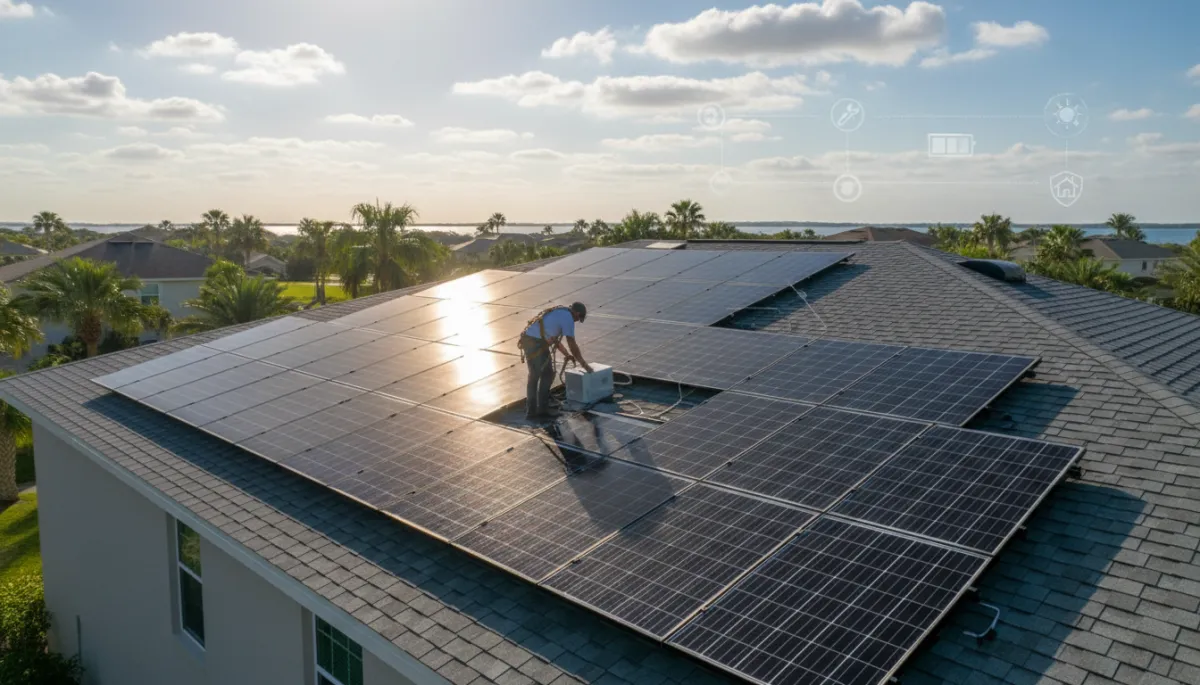
Routine maintenance on a residential solar system is less about “tuning” the panels and more about verifying that everything supporting them is still doing its job. In Tampa Bay, a periodic professional inspection typically focuses on wiring connections, roof penetrations, conduit runs, and the condition of the inverter and disconnects. The goal is to catch small issues—such as a loose conduit strap, a weathered seal around a roof penetration, or early signs of corrosion—before they become larger repairs. Cleaning is sometimes part of maintenance, but in Florida’s climate normal rainfall does much of the work. Most homeowners only need targeted cleaning where there is localized buildup from bird droppings, tree sap, or heavy pollen that affects specific panels. A routine visit also gives a licensed contractor a chance to compare current production to expected output for the Tampa Bay area, confirm that monitoring is still reporting correctly, and document the system’s condition for future warranty or insurance needs. For many owners, this kind of scheduled checkup every so often is the main maintenance touchpoint for years at a time.
4. The inverter is the one most owners will face
If there is one component most Tampa Bay homeowners can expect to address at least once, it is the inverter. The inverter is the box that converts the direct current (DC) from the panels into alternating current (AC) your home can use. Industry-wide, inverters have a shorter typical service life than the panels themselves, often on the order of a decade or more, depending on product type, installation environment, and usage. That difference is normal and not a sign that something was done wrong. In Florida, heat is part of the equation: even when installed correctly, an inverter mounted outdoors or in a hot garage spends its life working in elevated temperatures, which gradually ages electronic components. Over time, owners may see error codes, reduced output, or complete failure that calls for repair or replacement by a licensed electrical contractor. From an ownership-cost standpoint, it helps to think of the inverter as similar to a major appliance: it should provide many years of service, but it is reasonable to expect that it will not last as long as the roof or the panels.
💡 Pro Tip: Note your inverter's manufacture date now and put it somewhere you will find it later. Knowing its age turns a surprise into a planned expense.
Wondering where your system stands? Fused Solar and Roofing inspects and services solar systems across Hillsborough, Pinellas, Pasco, and Manatee counties. Request a diagnostic visit at https://fusedsolarandroofing.com/fused-solar-roofing-service-department
5. The roof underneath is the biggest one, and it is not a solar cost
The largest single cost most homeowners will encounter while owning solar is not actually part of the solar system at all—it is the roof. Every roof in Tampa Bay eventually reaches the end of its service life, with or without panels on it. When that time comes, the presence of an array adds one specific line item: the need to detach the solar equipment before roof work and reinstall it afterward. That detach and reinstall is the true “solar cost” in the roof equation. The underlying reroof is a cost you would have faced whether or not you ever went solar. Fused Solar and Roofing is a licensed roofing (CCC1331058), electrical (EC13014750), and building contractor (CBC1252064) — all three in-house, which allows the company to look at the roof and array as a single system rather than as separate projects. From a planning perspective, the key is timing. When a homeowner installs solar on a roof that still has many years of life left, the likely outcome is one cycle of detach, reroof, and reinstall over the life of the array. Installing solar on a roof that is already near the end of its life can result in two roof projects within the same general period: one before solar and another during the array’s life. Aligning roof replacement and solar installation, or at least understanding where your roof is in its lifespan, is what keeps ownership costs predictable instead of fragmented.
⚠️ Warning: The largest cost associated with owning solar is usually the roof, and it is a cost you would have had anyway. What solar adds is the detach and reinstall on top of it.
6. Monitoring, communication, and the things that quietly stop working
Not every ownership cost shows up as a dramatic failure. Some of the most common service calls Fused Solar and Roofing sees in Hillsborough, Pinellas, Pasco, and Manatee counties involve monitoring and communication hardware that has quietly stopped reporting while the system continues to produce power. Examples include a gateway that no longer talks to a home’s new Wi‑Fi router, a cellular modem whose service has expired, or a monitoring account tied to an installer that is no longer in business. In these situations, the solar array may still be generating energy, but the homeowner has lost visibility into performance and alerts. Restoring that visibility can involve reconfiguring network settings, replacing aging communication devices, or migrating monitoring to a new platform when supported. These are typically smaller, discrete service items, but they matter because they are how you notice other issues. A homeowner who cannot see production data is less likely to catch a string that has gone down or an inverter that is underperforming. Building an occasional check of the monitoring app into your routine—much like glancing at a thermostat—helps ensure that quiet failures are addressed before they linger for months or years.
7. Wildlife, debris, and the Florida-specific items
Florida adds a few ownership considerations that do not show up as often in other regions. In Tampa Bay, one of the most common is wildlife nesting under arrays. Birds and small animals are drawn to the shade and shelter between the panels and the roof. Over time, nesting material can trap debris, restrict airflow, and create messes that are difficult to clean without removing panels. Many homeowners choose to install wildlife exclusion—such as professionally attached mesh or barriers around the array perimeter—to prevent this from becoming a recurring issue. Coastal installations face another local factor: salt air. While modern equipment is tested for corrosion resistance, salt in the air can accelerate wear on exposed metal hardware and electrical enclosures, especially within a few miles of the Gulf. Periodic inspections help identify early signs of corrosion so components can be addressed before they compromise performance or safety. Heavy pollen seasons and storm debris are also part of life in Hillsborough, Pinellas, Pasco, and Manatee counties. Normal soiling typically costs only a few percent of annual production, but localized buildup from bird droppings, tree sap, or concentrated pollen can affect specific panels more noticeably. After major storms, a visual check from the ground to look for branches, displaced panels, or damaged conduit, followed by a professional inspection when something looks off, is a practical way to keep Florida-specific issues from turning into surprises.
📌 Key Takeaway: Fused Solar and Roofing services solar systems of all brands under electrical license EC13014750 and roofing license CCC1331058, so the array and the roof are evaluated together.
8. Thinking about it as a twenty-five year asset
Most modern solar panels are sold with manufacturer warranties in the twenty-five year range for power output, and many Tampa Bay homeowners reasonably think of their system on that same time horizon. Over that span, a typical ownership picture might include long stretches of doing nothing beyond checking an app, one or more service visits for routine inspections or wildlife exclusion, at least one inverter repair or replacement, a roof project with a detach and reinstall of the array, and occasional attention to monitoring or communication hardware. None of these items, taken individually, makes solar a high-maintenance asset. What matters is that you recognize them as normal parts of a long-lived system rather than as unexpected problems. Fused Solar and Roofing is an EnergySage Elite Installer with a 5.0/5 rating and 21+ verified reviews — independent verification, earned not purchased. For homeowners in Hillsborough, Pinellas, Pasco, and Manatee counties, the most practical mindset is to treat solar like any other major component of the home: understand the likely touchpoints over twenty-five years, set reasonable expectations, and plan for them. The goal is not zero costs; it is no surprises.
Tampa Bay solar ownership FAQ
1. Do solar panels in Tampa Bay require maintenance?
Solar panels themselves require very little maintenance in Tampa Bay because they have no moving parts and are designed for decades of outdoor exposure. For most homeowners in Hillsborough, Pinellas, Pasco, and Manatee counties, routine ownership looks like periodically checking a monitoring app, visually inspecting the array from the ground after major storms, and scheduling professional inspections from time to time to confirm wiring, roof attachments, and inverters remain in good condition. Normal rainfall usually keeps panels acceptably clean, and targeted cleaning is only needed where there is localized buildup from bird droppings, tree sap, or heavy pollen. When maintenance is needed, it is usually focused on the supporting equipment and roof, not the panels themselves.
2. What typically fails first on a solar system in this area?
Across many residential systems in Tampa Bay, the first component most owners address is the inverter rather than the panels. Inverters work continuously to convert DC power from the array into AC power for the home, and industry experience shows that they generally have a shorter service life than the modules, often in the range of a decade or more depending on the product and installation conditions. Florida’s heat adds to that workload, especially for inverters mounted outdoors or in hot garages. In addition to inverters, communication hardware such as monitoring gateways or cellular modems can age out or lose connectivity before the panels show any issues. Panels, by contrast, typically remain the most durable part of the system.
3. Do solar panels in Florida need to be cleaned regularly?
In much of Florida, including Tampa Bay, normal rainfall does a good job of keeping solar panels reasonably clean, so most homeowners do not need frequent, scheduled cleanings. Normal soiling typically costs only a few percent of annual production, and many systems operate within expected ranges without any cleaning at all. The situations that do call for attention are localized: bird droppings on specific panels, sticky tree sap, heavy pollen accumulation in certain seasons, or debris left after storms. In those cases, a professional cleaning can help restore output on the affected modules. Homeowners should avoid climbing on roofs or handling equipment themselves; instead, they can monitor production through their app and schedule service if they notice a sustained drop that does not match weather conditions.
4. What happens when my solar panel warranty period ends?
Most modern solar panels carry manufacturer power-output warranties in the twenty-five year range, which means the manufacturer is stating how much power the panels should still produce relative to their original rating at the end of that period. When that warranty expires, the panels do not suddenly stop working; many continue producing energy beyond the warranty term, just at a gradually reduced output compared to their first year. The practical change for a Tampa Bay homeowner is that manufacturer-backed coverage for defects or underperformance may no longer apply, so any future panel issues become an out-of-warranty repair decision. At that point, owners often weigh the age and condition of the overall system, including the roof and inverter, to decide whether to replace individual components, keep running the existing array, or plan for a full system upgrade in the future.
5. Is an older solar system worth maintaining, or should it be replaced?
Whether an older solar system in Tampa Bay is worth maintaining depends on a few practical factors: how the panels are performing, the condition of the inverter and wiring, and the state of the roof. If the array is still producing a useful amount of energy, the roof is in good condition, and any issues are limited to specific components like an inverter or monitoring hardware, many homeowners choose to maintain and repair rather than replace. Replacement starts to make more sense when multiple major elements are at or near the end of their useful life at the same time—for example, an aging roof, an older inverter, and panels that are well past their warranty period. In those cases, a comprehensive assessment from a contractor familiar with both roofing and solar can help compare the benefits of targeted repairs versus a full modernization of the system.
6. What should a Tampa Bay homeowner budget for over the life of a solar system?
Instead of thinking in terms of exact dollar amounts, it is more useful to think in terms of categories of cost over a twenty-plus year period. For a typical Tampa Bay homeowner, the main items to plan for are occasional professional inspections and targeted maintenance, at least one inverter repair or replacement during the life of the array, potential wildlife exclusion or debris-related cleanup, updates or replacements for monitoring and communication hardware, and a future roof project that will require detaching and reinstalling the array. The roof work itself is a cost you would face with or without solar; the solar-specific portion is the labor to remove and reinstall the system. By recognizing these categories early and understanding that they tend to occur at predictable points in the system’s life, you can treat solar as a long-lived home asset with planned touchpoints rather than as a source of unexpected expenses.
Fused Solar and Roofing is a licensed electrical contractor (EC13014750) servicing solar systems of all brands across Hillsborough, Pinellas, Pasco, and Manatee counties, including systems whose original installer is no longer in business. Request a diagnostic visit at https://fusedsolarandroofing.com/fused-solar-roofing-service-department
Is your solar system producing what it should? Request a diagnostic visit at https://fusedsolarandroofing.com/fused-solar-roofing-service-department