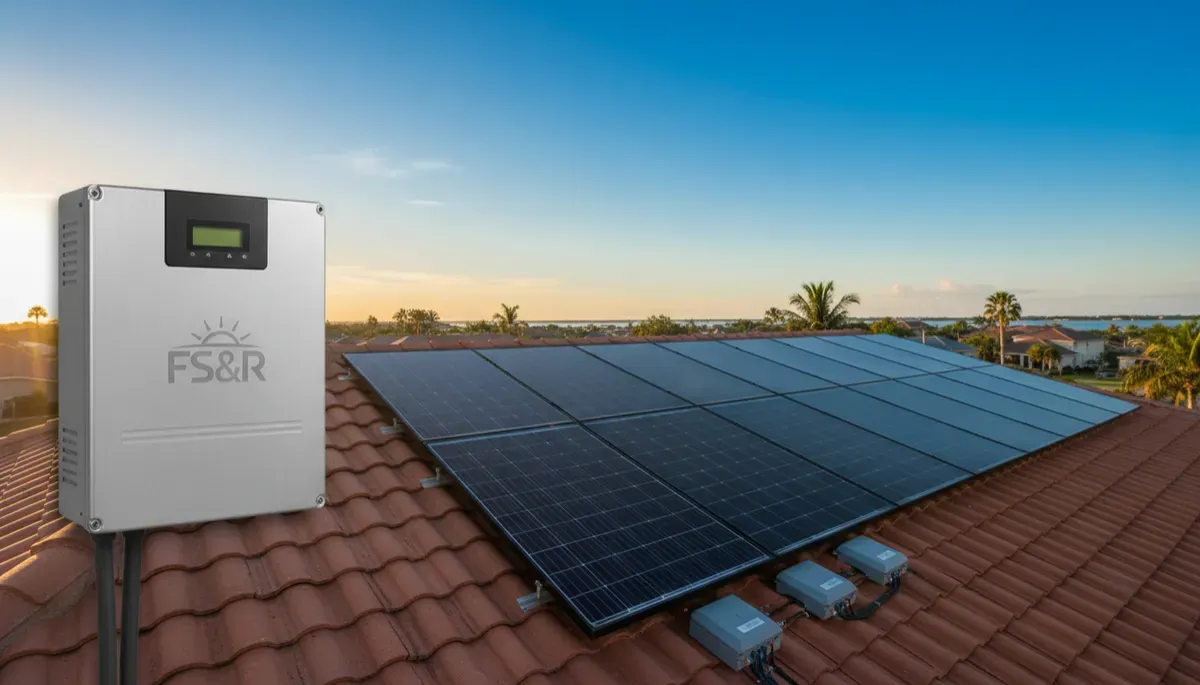
Solar Inverter Replacement in Tampa Bay: What to Expect
On a typical Tampa Bay home, the solar inverter is the part of the system most likely to need replacing during the life of the panels. Fused Solar and Roofing is a licensed roofing (CCC1331058), electrical (EC13014750), and building contractor (CBC1252064) — all three in-house. Understanding what the inverter does, why it wears out first, and what replacement involves turns an unexpected outage into a straightforward maintenance decision instead of a surprise crisis.
1. What the inverter actually does
Your solar panels produce direct current (DC) power. Your home and the utility grid use alternating current (AC) power. The inverter is the electronic device that continuously converts that DC from the roof into AC that matches the grid’s voltage and frequency. It also manages safety functions, such as shutting down when the grid goes out, and reports production data to your monitoring app so you can see how much energy the system is producing at any given time.
In practice, the inverter is the “brains and heartbeat” of the solar system. It measures the DC from the panels, runs it through power electronics that rapidly switch on and off, shapes that switching into a clean AC waveform, and synchronizes with the grid so power can flow safely. If the inverter is down, the rest of the system may still be intact, but it cannot deliver usable power to your home or to your utility interconnection.
📌 Key Takeaway: Solar panels are typically warrantied for twenty-five years. Inverters generally are not, which is why the inverter is the component most likely to need replacing during the life of your system.
2. Why the inverter is the first thing to go
A solar panel is mostly a passive device. Once it is mounted and wired, it sits in the sun and converts light into DC electricity. It has no moving parts, and in normal operation there are no internal components heating up and cooling down every minute of the day. That is one reason panel manufacturers are comfortable offering long product warranties, often on the order of twenty-five years, as a general industry figure for the panel hardware itself.
An inverter is different. It is a box full of active electronics: power transistors, control boards, sensors, and in many designs, capacitors and cooling components such as fans or heat sinks. Every day, these parts ramp up in the morning, work hardest in the middle of the day, and ramp down at night. That constant electrical and thermal cycling slowly wears components down. Capacitors dry out over time, fans can wear, and semiconductor devices experience stress from heat and switching. This is normal physics, not a defect, and it is why inverters have a typical service life measured in a general range of around 10 to 20 years, depending on design, environment, and how hard they are worked.
Because of this, it is realistic for a Tampa Bay homeowner to expect that the inverter will likely need attention or replacement at least once during the life of the panels. Planning for that eventual maintenance event is part of owning a residential solar system, just as planning for a future air conditioning replacement is part of owning a home in Florida.
💡 Pro Tip: Find your inverter's manufacture date on its nameplate label. Knowing how old it is tells you whether a fault is likely age-related or something else.
3. What Florida heat does to inverter life
Heat is one of the main factors that shortens the life of electronic components. In Tampa Bay, inverters often operate in high ambient temperatures, with summer afternoons regularly in the 90s and significant humidity. If the inverter enclosure is mounted in direct sun, especially on a west-facing wall, the internal temperature can climb well above the surrounding air. Over time, that extra heat accelerates the aging of capacitors and other sensitive parts and can reduce the upper end of the inverter’s service-life range compared with the same model installed in a cooler location.
Duty cycle matters as well. An inverter that spends most days operating near its maximum rated output is working harder than one that runs comfortably below its limits. In Tampa Bay, long sunny days and high irradiance mean the inverter may spend many hours each day at elevated power levels. By contrast, an inverter installed in a shaded garage or utility room, with good airflow and protection from direct sun, typically experiences less temperature stress than an outdoor unit in full afternoon sun. The equipment is designed for outdoor use, but installation location and ventilation are practical levers for managing its operating conditions.
When Fused Solar and Roofing evaluates an existing system in Hillsborough, Pinellas, Pasco, or Manatee County, part of the assessment is simply looking at where the inverter is mounted and how much heat load it likely sees. That context helps explain why one inverter may reach the end of its life sooner than another of the same age installed under gentler conditions.
Inverter showing errors? Fused Solar and Roofing diagnoses and replaces inverters across Hillsborough, Pinellas, Pasco, and Manatee counties. Request service at https://fusedsolarandroofing.com/solar-repair
4. String inverters, microinverters, and optimizers: how failure differs
Residential systems in Tampa Bay are typically built around one of three architectures: a central or “string” inverter on the wall, microinverters mounted under each panel, or DC optimizers paired with a central inverter. The basic job is the same — converting DC to AC and managing safety — but the way failures show up is different in each design. With a traditional string inverter, most or all of the roof array feeds into a single box. If that inverter fails completely, production from the entire string, or multiple strings, drops to zero because there is no longer any device converting DC to AC for the grid connection.
With microinverters, each panel has its own small inverter. A failure usually affects only the panel attached to that microinverter. The rest of the array keeps producing, and the monitoring system shows one module underperforming or offline. DC optimizers sit behind each panel and feed a central inverter; a failed optimizer typically shows as a single panel underperforming, while a failed central inverter still takes down the whole array’s AC output. Understanding which architecture you have helps set expectations for what a failure will look like in your monitoring app and at the utility meter.
💡 Pro Tip: If your system uses microinverters or optimizers, a single failure shows up as one panel underperforming rather than the whole array going dark. Module-level monitoring makes that easy to spot.
5. What inverter failure looks like before it fails completely
In many cases, an inverter does not go from “working perfectly” to “dead” in one step. There is often a period of intermittent faults or reduced output that shows up in the monitoring data. A Tampa Bay homeowner who checks their monitoring portal occasionally may notice patterns such as the system turning off during the hottest part of clear afternoons, repeated error codes on the inverter display, or one string or panel group producing significantly less than others under the same conditions. These are signs that the inverter or one of its associated components may be approaching the end of its useful life.
From a data perspective, a failing string inverter often shows whole-system production that looks normal on cooler mornings and evenings but dips or cuts out during peak sun, with fault events logged in the monitoring history. A failing microinverter or optimizer shows as one module with consistently lower or zero output compared with neighboring modules on the same roof plane and orientation. Normal soiling or shade may reduce production a bit, but that typically costs only a few percent of annual output and does not cause sudden, repeated dropouts or complete flat lines in the data for specific times of day.
⚠️ Warning: An inverter that is hot to the touch, making unusual noise, showing scorch marks, or displaying a persistent fault code should be reported to a licensed electrical contractor rather than reset or ignored.
6. The replacement decision: same model, newer model, or different architecture
When an inverter reaches the end of its life, the homeowner faces a practical decision: replace it with the same model if available, move to a current-generation unit from the same manufacturer, or consider changing architectures. If the original model is still produced and compatible with current codes and utility interconnection rules, a like-for-like swap may be straightforward. In other cases, the exact model may be discontinued, and the manufacturer will point to a newer equivalent that offers similar power ratings, updated electronics, and revised monitoring options. That newer unit may require adjustments to mounting, wiring, or communication hardware but generally stays within the same overall system design.
Changing architecture — for example, moving from a central string inverter to a microinverter or optimizer-based layout during a major retrofit — is a more involved conversation. Compatibility with existing panels, any module-level electronics already on the roof, the current monitoring platform, and the utility’s interconnection approval all affect what is practical. In some Tampa Bay homes, a targeted inverter replacement is the right answer; in others, especially if the system is older or being expanded, a more comprehensive redesign is worth discussing. This is less of a catalog choice and more of a design decision that should be made with a licensed contractor who understands both the electrical requirements and local permitting expectations.
📌 Key Takeaway: Fused Solar and Roofing replaces inverters of all brands under electrical license EC13014750, including systems installed by companies that are no longer in business.
7. Why inverter replacement is licensed electrical work
Replacing an inverter is not just swapping one box for another. It involves working on circuits that connect to both the solar array and the main electrical service, coordinating with the utility interconnection, and ensuring the updated equipment meets current electrical code and manufacturer requirements. In Florida, this is licensed electrical work. Fused Solar and Roofing is a licensed roofing (CCC1331058), electrical (EC13014750), and building contractor (CBC1252064) — all three in-house. A licensed electrical contractor will evaluate conductor sizes, overcurrent protection, grounding and bonding, rapid-shutdown requirements, labeling, and communication wiring as part of the replacement, not only the physical mounting of the unit on the wall.
In many Tampa Bay jurisdictions, inverter replacement also requires a permit and inspection so the local building department can verify that the work complies with the Florida Building Code and National Electrical Code. This protects the homeowner, the utility, and anyone who may work on the system in the future. Homeowners can verify any contractor’s license status at MyFloridaLicense.com before authorizing work. Treating inverter replacement as a code-compliant electrical project, rather than a simple appliance swap, is the right way to maintain safety and preserve the value of the solar investment.
8. Planning ahead instead of reacting
The most practical way to handle inverter replacement is to plan for it. Knowing the inverter’s manufacture date, typical service-life range, and installation conditions gives a Tampa Bay homeowner a realistic expectation of when a replacement is likely. That way, when monitoring data starts to show unusual behavior or the unit approaches the end of its expected life, you already understand that this is a normal maintenance event, not a sign that the entire solar investment has failed. Planning also means budgeting time for permitting and inspection and deciding in advance whether you are comfortable with a like-for-like replacement or want to discuss updated technology options with a contractor.
An inverter replacement is also a natural checkpoint to look at the roof beneath and around the array. If the shingles or other roofing materials are nearing the end of their life, coordinating roof work and inverter work in a single project can be more efficient than addressing them separately a few years apart. Fused Solar and Roofing works with homeowners in Hillsborough, Pinellas, Pasco, and Manatee counties to align electrical service, solar performance, and roof condition into a clear plan. Fused Solar and Roofing is an EnergySage Elite Installer with a 5.0/5 rating and 21+ verified reviews — independent verification, earned not purchased. Treating inverter replacement as a predictable part of system ownership, rather than a surprise, keeps your solar installation productive and easier to manage over the long term.
Tampa Bay solar inverter FAQ
1. How long does a solar inverter typically last in Tampa Bay?
Most residential solar inverters have a general industry service-life range of about 10 to 20 years, but the actual lifespan in Tampa Bay depends on the specific product, how hard it is worked, and how hot its operating environment is. A wall-mounted inverter on a west-facing exterior wall in Hillsborough, Pinellas, Pasco, or Manatee County will usually experience more thermal stress than one in a shaded garage with good airflow, which can shorten the upper end of that range. Rather than expecting a precise year, it is more accurate to view the inverter as a major component that will likely need replacement once, and possibly more than once, during the life of the solar panels, which are typically warrantied for a longer period than the inverter hardware.
2. Is my inverter covered under warranty, and for how long?
Inverter warranty terms are set by the manufacturer and the contract you signed with your installer, so there is no single answer for all Tampa Bay systems. Many residential inverters come with a manufacturer product warranty in the general range of several years to around a decade, and some offer optional extended coverage. That warranty is separate from the typical twenty-five-year manufacturer warranty that often applies to panels. To find your exact coverage, check your installation paperwork or the manufacturer’s documentation and warranty registration, and review any extended warranty or service agreement you may have purchased. Fused Solar and Roofing can help you identify the make, model, and serial number and provide documentation you may need when you contact the manufacturer or original installer, but only the manufacturer or warranty provider can confirm what is covered in your specific case.
3. How can I tell if the inverter is failing versus something else in the system?
From a homeowner’s perspective in Tampa Bay, the first step is to compare your monitoring data with the inverter’s display, if it has one, and with your utility meter. If the monitoring app shows zero or very low production on clear, sunny days across the entire array, and the inverter display is showing an error code or is completely blank, the inverter is a likely suspect. If only one panel or one string is underperforming while others look normal, the issue may be with a specific microinverter, optimizer, or string rather than the main inverter hardware. Other causes, such as a tripped breaker, utility outage, or communication problem, can produce similar symptoms, which is why a licensed electrical contractor should perform the actual diagnosis. Your role is simply to observe the monitoring data and the inverter’s visible status indicators from a safe distance and report what you see when you request service.
4. If one microinverter fails, does my whole solar array go down?
No. In a microinverter system, each panel has its own small inverter, so a failure typically affects only that individual panel. The rest of the array continues to operate normally, and your monitoring portal will usually show one module with zero or reduced output while neighboring modules on the same roof plane perform as expected. In Tampa Bay homes with this architecture, a single failed microinverter reduces total system production but does not take the entire system offline, which is one reason some homeowners prefer this design. A licensed contractor can confirm the diagnosis, access the roof safely, and replace the affected microinverter while preserving the rest of the system.
5. Do I have to replace my failed inverter with the same brand or model?
You do not always have to replace a failed inverter with the exact same brand or model, but compatibility and practicality matter. If your system uses brand-specific components, such as proprietary optimizers or a closed monitoring platform, staying with the same manufacturer often simplifies integration and keeps your existing monitoring and rapid-shutdown features working as designed. If your system uses more generic components, or if the original brand is no longer available or supported, a licensed electrical contractor can propose a compatible inverter from another manufacturer that meets current code and utility interconnection requirements. In Tampa Bay, Fused Solar and Roofing routinely evaluates factors such as panel voltage and current, existing wiring, breaker sizes, and permitting rules before recommending whether a same-brand replacement, a current-generation alternative, or a broader redesign makes the most sense.
6. Does inverter replacement in Florida require a permit?
In many Florida jurisdictions, including parts of Hillsborough, Pinellas, Pasco, and Manatee counties, replacing a solar inverter is treated as an electrical alteration that requires a permit and inspection, even if the rest of the system remains unchanged. Local building departments use the permit process to confirm that the new equipment meets current code, that conductor sizes and overcurrent protection are appropriate, and that labeling and rapid-shutdown requirements are satisfied. A licensed electrical contractor will know the specific rules for your city or county and will include permitting and inspection in the scope of work.
Fused Solar and Roofing is a licensed electrical contractor (EC13014750) servicing solar systems of all brands across Hillsborough, Pinellas, Pasco, and Manatee counties, including systems whose original installer is no longer in business. Request a diagnostic visit at https://fusedsolarandroofing.com/solar-repair
Is your solar system producing what it should? Request a diagnostic visit at https://fusedsolarandroofing.com/solar-repair
