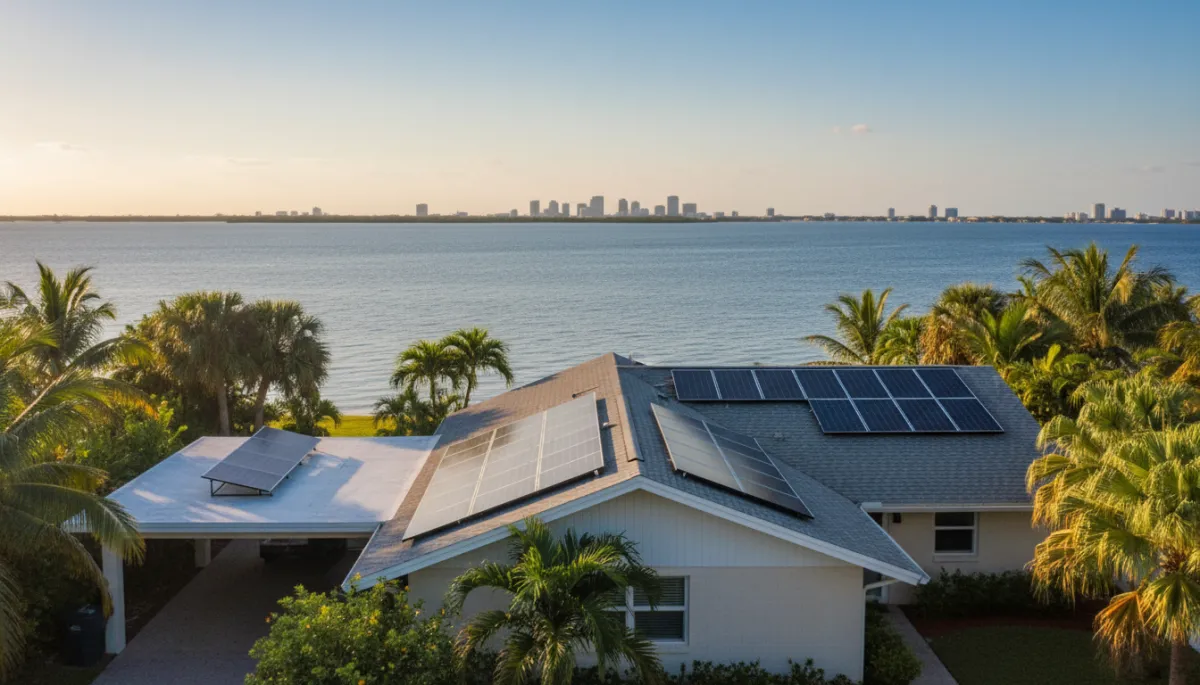
Solar Installation in St. Petersburg: Homeowner Guide
As a St. Petersburg homeowner thinking about solar, you are looking at a house on a peninsula where salt air, roof shape, and the age of the home’s electrical service all shape what a good installation looks like. St. Petersburg sits between open water and the bay, so homes see coastal weather from more than one direction, and many were built long before anyone planned on solar, batteries, or electric vehicles. Fused Solar and Roofing is a licensed roofing (CCC1331058), electrical (EC13014750), and building contractor (CBC1252064) — all three in-house. This combination of location and housing stock means a careful, local approach matters more here than a one-size-fits-all solar package.
1. Solar on a peninsula
St. Petersburg homes sit close to the water on both sides of the peninsula. Some are just a few blocks from open shoreline, others are tucked farther inland, but almost all of them live with air that has spent time over the bay or the gulf. That shapes how roofs age, how metal on the house weathers, and how exposed any equipment mounted outside will be over the years. A solar system adds more of that outdoor equipment, so the coastal setting needs to be part of the plan from the start, not an afterthought.
The housing itself is a mix. You see older bungalows with raised porches, mid-century block homes with simple rooflines, and newer construction with more complex layouts. Each of these behaves a little differently when you add solar. An older bungalow might have a steeper front roof and a smaller, lower rear section. A block home might have broad, simple planes that are easier to work with but an older electrical system. Newer homes can have multiple roof levels, decorative hips and ridges, and additions that were built later by different contractors. The age and style of the house influence where panels fit, how wiring can be run, and how much work is needed at the electrical panel to connect everything safely and cleanly.
Because of that variety, a solar plan that suits one St. Petersburg home may not suit the one next door. A neighbor’s system might face a particular direction with very little shade, while your best roof area might be on a different side or partly shaded by mature trees. One home may have a recently updated electrical service and a newer roof, while another still has original equipment and a roof that is closer to the end of its useful life. A careful look at your specific house — not just your address or a satellite view — is what turns “solar in St. Petersburg” into “solar for your St. Petersburg home.”
2. Salt air and the equipment outside your house
Living on a peninsula means living with salt in the air. Over time, that salt works on outdoor metal — railings, light fixtures, door hardware, and anything else that sits outside season after season. A solar system adds more outdoor components: mounting hardware on the roof, conduit runs, an exterior disconnect, and usually an inverter or related equipment on a wall. Homes that sit closer to the water tend to see this effect more quickly than homes farther inland, but every home in St. Petersburg has some level of exposure. The goal is not to avoid outdoor equipment — that is part of any solar installation — but to plan for it thoughtfully so it holds up well and can be inspected and maintained over its life.
What matters most in this setting is that the hardware is appropriate for a coastal environment, that equipment is placed sensibly, and that the system is not simply ignored once it is turned on. Sensible placement might mean choosing a wall that sees less direct spray and less standing water, routing conduit so it is protected and tidy, and avoiding locations where yard work or daily activity will constantly bump or stress the equipment. It also means thinking ahead about how someone will reach the system later for cleaning, inspection, or service without having to disturb the rest of the house or landscaping more than necessary. Regular visual checks and periodic professional inspections help catch early signs of corrosion or wear before they turn into bigger issues.
Fused Solar and Roofing services solar systems of all brands, so a homeowner is not left without support if corrosion shows up years later. Even if your system was installed by someone else, having a local company that understands St. Petersburg’s coastal conditions and is willing to inspect, document, and service existing systems gives you a practical path forward. The goal is not perfection — salt air will always be part of life on a peninsula — but a system that is built, placed, and cared for with that reality in mind.
Thinking about solar in St. Petersburg? Fused Solar and Roofing designs and installs solar across Hillsborough, Pinellas, Pasco, and Manatee counties. Request a free solar quote at https://fusedsolarandroofing.com/new-solar-installation
📌 Key Takeaway: A solar system puts metal hardware outside on a peninsula. Where the equipment goes and how it is maintained matters more here than it does inland.
3. Mid-century homes and the electrical panel
Many St. Petersburg homes were built when household electrical use was far lower than it is today. A typical home might have been wired for basic lighting, a few kitchen appliances, and window units rather than today’s mix of air conditioning, electronics, and potential future loads like an electric vehicle charger or home battery. Over the decades, some of these homes have had their electrical service updated, while others still have equipment that reflects the expectations of an earlier time. You cannot always tell from the street which is which — it takes a closer look at the panel and service equipment to know what you are working with.
Solar connects through the electrical panel, and if you ever add a battery or an EV charger later, those will connect through it as well. That is why the panel is checked during the quote visit. The technician is not just counting open spaces; they are looking at the panel’s condition, layout, and how it ties into the rest of the home’s wiring. In some homes, the panel and service are already set up in a way that makes adding solar straightforward. In others, it may make sense to plan electrical work as part of the project so the system is safe, cleanly integrated, and ready for future additions. This is not about labeling any particular panel type as unsafe or declaring that it must be replaced — it is about understanding what you have and how best to connect new equipment to it.
Fused Solar and Roofing does this work under its own electrical license, so the same company that designs your solar system is also responsible for the electrical connection that makes it work. That keeps communication simple for you as the homeowner — one team looking at the whole picture instead of separate contractors each focusing on a small piece. It also means that when you ask, “Is my panel okay for this?” you are speaking directly with the people who will be doing the work, not a middleman relaying information from somewhere else.
4. Flat and low-slope roof sections
A lot of St. Petersburg homes have flat or low-slope roof sections, often over additions, carports, or Florida rooms. These areas can look like attractive spots for solar — they are often open, with fewer vents and obstacles than the main roof. But they are also roofed and built differently from a sloped shingle or tile roof. Water moves across them in a different way, and the underlying structure may have been designed for a different purpose than the main living space. That means you cannot assume that any flat or low-slope area is automatically the best place for panels just because it looks open from above.
Whether panels can go on these sections depends on the roof’s construction and condition. The installer needs to understand how that part of the house was framed, how the roof covering is put together, and how it is currently performing. A carport roof that has seen a lot of ponding or patching, for example, may not be the right candidate for mounting new equipment until the underlying issues are addressed. By contrast, a well-built and well-maintained low-slope section might work very well if it has the right exposure and enough space for a clean layout. These are judgment calls that come from seeing the roof up close, not from guessing off a map.
This is why roof shape and roof type are assessed during the quote visit. The technician will look at each roof section, not just the “main” roof, and consider which areas make sense structurally, electrically, and from a weather-exposure standpoint. If a flat or low-slope section is not a good candidate, they will explain why and show you what they are seeing so the decision is clear. The goal is a layout that respects how your roof is built and how it will age in coastal conditions, not just the one that adds the most panels on paper.
💡 Pro Tip: If your home has a flat or low-slope section, mention it when you call. It changes how the site visit is planned.
5. What the design process looks like
A good solar design for a St. Petersburg home starts with your actual electricity bills, not a generic estimate. Those bills show how you use power across the year — how much you use, and how that use changes between cooler and hotter months. That information shapes the size and layout of the system in a way that a simple “average home” guess cannot. It also helps you and the installer talk in concrete terms about what you want the system to do for you, rather than relying on broad promises or assumptions that may not match your household.
During the quote visit, the technician looks closely at the roof, its orientation, and any shading from nearby trees or structures. They note which roof planes see the most direct sun and which spend more time in shade. They also assess the roof’s condition, including any signs of aging, repairs, or areas that may need attention before panels go on. At the same time, they examine the electrical panel and map out where equipment would go — the inverter, disconnect, and conduit runs — with an eye toward both function and exposure. A location that is technically possible but heavily exposed to wind-driven rain or salt spray may not be the best long-term choice when another, more sheltered spot is available.
Once this information is gathered, you receive a written quote that lays out the proposed equipment, the panel layout, the condition of the roof as observed, and what is warrantied. This document is your roadmap — it shows how the system will sit on your home, what work is included, and how the company stands behind that work. You should be able to look at it and understand not only the high-level idea but also the practical details: which roof planes are used, where the conduit will run, and what kind of work (if any) is planned at the electrical panel or roof before the array is installed. Clear documentation up front reduces surprises later and gives you something concrete to refer back to if questions come up during or after the project. Fused Solar and Roofing mounts every solar array on K2 Systems hurricane-rated flashed mounting.
Beyond the physical design, there is also paperwork. Fused Solar and Roofing submits the utility interconnection application, and the interconnection agreement itself is between you as the homeowner and the utility. Permitting and inspections are handled as part of the project, and requirements vary from one jurisdiction to another. You do not have to navigate those steps on your own or guess which forms apply — they are built into the process from the beginning. Fused Solar and Roofing is an EnergySage Elite Installer with a 5.0/5 rating and 21+ verified reviews — independent verification, earned not purchased. That outside confirmation of quality and service adds another layer of reassurance as you move through design, installation, and follow-up.
6. Roof and solar as one project
In a coastal city, roofs work hard. If your roof is nearing replacement, it is important to think about timing before you put panels on it. Installing solar on a roof that will need major work in the near future usually means paying once to put the system up and again to have it removed and reinstalled when the roof is finally replaced. That is disruptive and adds cost that could have been avoided with a bit of planning. When the roof and the solar are treated as one project, you can align the timelines so the new roof and the new array start their lives together, with the mounting and waterproofing done in a coordinated way.
Fused Solar and Roofing installs the roof and the solar with its own in-house crews, so it is one project under one company. That means the same organization is responsible for the surface you are protecting and the array you are adding. If questions come up later about a roof detail near the panels, or about how a particular penetration was handled, you are not left trying to sort out which contractor should answer — it is all under one roof, so to speak. Fused Solar and Roofing is a licensed roofing (CCC1331058), electrical (EC13014750), and building contractor (CBC1252064) — all three in-house. This structure is well suited to a coastal market like St. Petersburg, where roofing and solar are tightly linked in practice, not just on paper. Fused Solar and Roofing installs a self-adhered leak barrier over the entire roof deck, not just at the eaves and valleys. Fused Solar and Roofing provides a written 25-year no-leak guarantee on every roof penetration it makes for solar.
⚠️ Warning: Putting panels on a roof that is near replacement means paying to remove and reinstall them later. Ask about the roof before you sign anything.
7. Storm season and what it means for your system
A coastal city like St. Petersburg sees storms. Any rooftop system here needs to be designed and installed with that reality in mind. A properly mounted array is built to stay put, with attention to how it is attached and how water moves around the mounting points. When roof and solar are planned together, the mounting and waterproofing can be integrated in a way that supports both day-to-day performance and storm-season resilience. That is part of why local experience matters — installers who work here regularly are used to thinking about how a system will behave not only on clear days but also when the weather turns rough.
After a significant storm, it is worth having your system looked at rather than assuming it is fine simply because it is still producing power. Wind, driven rain, and debris can affect wiring, mounting hardware, or the roof around the array in ways that are not obvious from the ground. A professional inspection can confirm that everything is still secure, watertight, and operating as intended — or, if something has shifted or been damaged, identify it early so it can be addressed before it leads to larger problems. This is especially important in a coastal environment, where small openings or disturbed sealants can invite water and salt into places they do not belong.
Fused Solar and Roofing inspects and documents systems after storms with photographs and a written report. That documentation gives you a clear record of the system’s condition, what was checked, and what — if anything — needs attention. It also provides a baseline for future comparisons if another storm comes through later. Knowing that there is a structured way to have your system evaluated after severe weather can make storm season feel more manageable — you are not left guessing about what happened on the roof while you were inside riding it out.
📌 Key Takeaway: Fused Solar and Roofing designs, installs, and services solar in St. Petersburg under roofing license CCC1331058 and electrical license EC13014750, with a written 25-year no-leak guarantee on every solar roof penetration.
8. Is your St. Petersburg home a good fit
Not every home on the peninsula is an ideal match for solar, and it is important to be honest about that from the start. A home with a sound roof, good unshaded exposure, and meaningful electricity use is a strong candidate. If your main roof planes see clear sun for much of the day, your roof is in solid condition, and your household uses enough power for a system to make a difference, solar can be a practical long-term improvement. In that case, the design work focuses on fine-tuning layout, equipment placement, and integration with your electrical system so the array fits the house well and serves your goals.
On the other hand, some situations point the other way. A heavily shaded lot, where mature trees block most of the useful roof area, may limit what solar can do. A roof that needs extensive work — and that you are not ready to address yet — can make it unwise to add panels right now. Very low electricity use can also change the equation, because there is less usage for the system to offset. In these cases, the most responsible answer may be that solar is not the right move at this time, or that other work should come first. A clear explanation of why, backed by photos and observations from the site visit, is more helpful than forcing a project that does not truly fit.
Fused Solar and Roofing will say so if a home is not a good fit. That may mean recommending roof work before solar, suggesting that you revisit the idea later if your usage changes, or confirming that shading makes the project impractical. The goal is not simply to put panels on every roof, but to match solar to the homes and homeowners it truly serves. For you as a St. Petersburg homeowner, that kind of straightforward guidance is what turns a complex decision into a clear next step — whether that step is moving ahead with a design or deciding, for now, to wait.
If your roof ever needs replacing with solar on it, who is allowed to remove and reinstall the panels, and why, is covered in our guide at https://fusedsolarandroofing.com/post/who-can-remove-reinstall-solar-florida
Frequently Asked Questions
1. Does salt air damage solar panels in St. Petersburg?
Salt in the air can work on outdoor metal and surfaces over time, and solar systems are no exception. The frames, mounting hardware, conduit, and exterior equipment all live in the same coastal environment as the rest of your home. The key is to use hardware suited to a coastal setting, place equipment sensibly to limit unnecessary exposure, and have the system inspected periodically instead of installing it and forgetting about it. With that approach, salt air becomes a factor to manage rather than a reason to avoid solar altogether.
2. Can solar go on a flat roof section?
Solar can sometimes go on flat or low-slope roof sections, but it depends on how that part of the roof is built and what condition it is in. These areas, often over additions, carports, or Florida rooms, are roofed differently from sloped sections and handle water in a different way. During the quote visit, the installer will look closely at that section to see whether it is structurally appropriate, how water drains, and whether the roof covering is in good enough shape to support mounting equipment. If it is a good candidate, it may provide a clean, open space for panels. If not, the design will focus on other parts of the roof that make more sense long term.
3. Do older St. Petersburg homes need an electrical panel upgrade for solar?
Some older homes need electrical work as part of a solar project and some do not. Many St. Petersburg houses were built when electrical demand was lower, and over the years some have had their service updated while others still have older equipment. Because solar — and any future battery or EV charger — connects through the panel, the installer checks the panel during the quote visit. If the existing setup can support the planned system, it may not require changes. If updates are advisable, those can be included in the project plan. Fused Solar and Roofing performs this work under its own electrical license, so you get a clear, project-specific answer rather than a blanket rule about older homes.
4. What happens to solar panels in a hurricane?
A properly mounted array is built to stay put, but no one can promise how any structure will perform in a given storm. After a significant storm, having the system inspected and documented is the sensible step, even if everything looks normal from the ground.
5. Should I replace my roof before installing solar?
If your roof is in good shape, you may not need to replace it before adding solar. If it is nearing replacement, it often makes sense to handle the roof and solar as one coordinated project. That way, you avoid paying to remove and reinstall the array when the roof is eventually replaced, and the mounting and waterproofing can be integrated from the start. During the quote visit, the technician will assess the roof’s condition and give you a clear recommendation so you can decide on timing with full information.
6. Who handles permits and the utility paperwork?
Permitting and inspections are handled as part of the project, and requirements vary from one jurisdiction to another. Fused Solar and Roofing submits the interconnection application, and the interconnection agreement is between the homeowner and the utility.
Fused Solar and Roofing has installed solar across Hillsborough, Pinellas, Pasco, and Manatee counties since 2007, with the roof and the solar handled by its own licensed in-house crews. Request a free solar quote at https://fusedsolarandroofing.com/new-solar-installation
Already have solar and need the roof replaced? Our guide to solar detach and reinstall in St. Petersburg is at https://fusedsolarandroofing.com/post/st-petersburg-solar-detach-reinstall. Replacing the roof and adding solar at the same time is covered at https://fusedsolarandroofing.com/post/new-roof-and-solar-st-petersburg-fl, and solar repair and service in St. Petersburg at https://fusedsolarandroofing.com/post/solar-repair-service-st-petersburg-fl.
Need the roof itself replaced, with or without solar on it? Our guide to roof replacement in St. Petersburg, the GAF system Fused installs, the warranty, and the local permit, is at https://fusedsolarandroofing.com/post/roof-replacement-st-petersburg-fl.
All of Fused's St. Petersburg services on one page, with prices, permits, and the utility: Solar and Roofing in St. Petersburg. The county-wide version of this guide is the Pinellas County overview.
Ready to find out what solar would look like on your St. Petersburg home? Request a free solar quote at https://fusedsolarandroofing.com/new-solar-installation