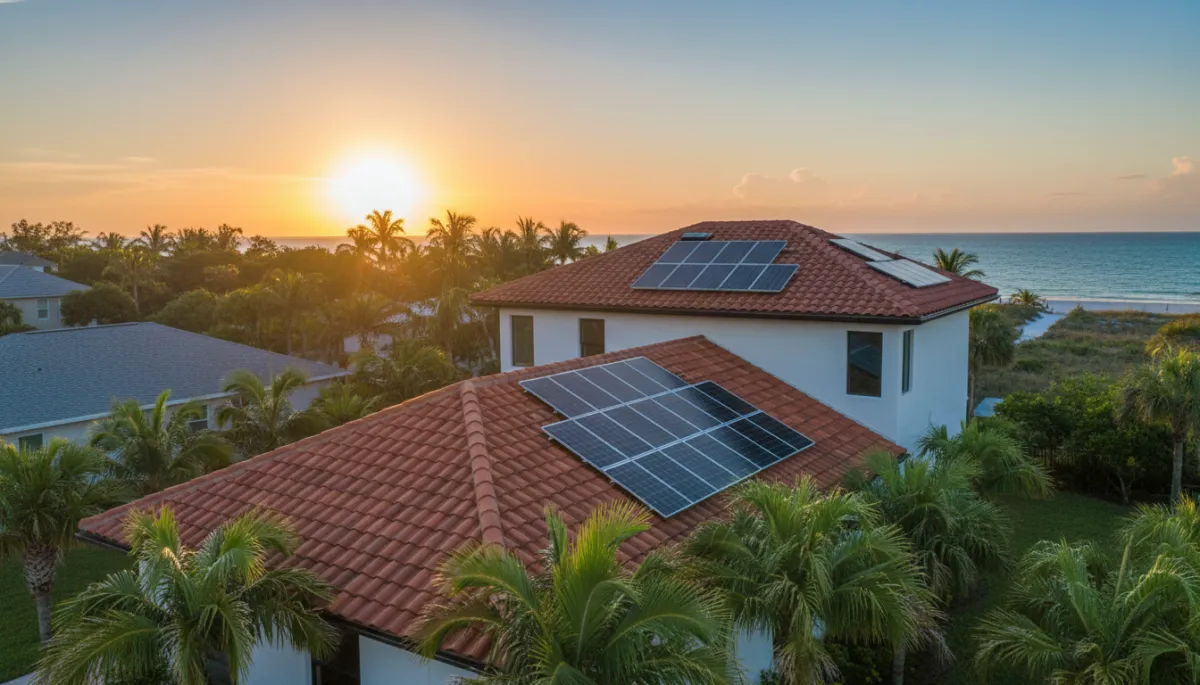
Solar Installation in Clearwater: A Homeowner's Guide
As a Clearwater homeowner thinking about solar, you are in a place that brings together two things most areas do not have at once: a large number of deed-restricted communities and homes that sit close to the water. That mix affects how a solar project is planned and installed, from the first conversation with your association to how equipment is placed on the roof. Fused Solar and Roofing is a licensed roofing (CCC1331058), electrical (EC13014750), and building contractor (CBC1252064) — all three in-house.
1. Two things that shape a Clearwater solar project
When you picture solar, you might think first about sunshine and electricity bills. In Clearwater, two other factors usually rise to the top before numbers are even discussed: community rules and coastal exposure. Together, they shape what is possible on your roof and how the project moves forward on a realistic timeline for your household.
Many Clearwater homes are in neighborhoods with recorded restrictions, architectural review boards, or homeowners associations. That can add a step between your decision to explore solar and the day work begins. Instead of being a barrier, it becomes something to plan for. A clear design, good documentation, and a calm approach with your association usually make this part go more smoothly for everyone involved. The key is understanding that your community has its own process and building that into your solar plans from the start, rather than treating it as an afterthought once you are excited about a proposal.
The second factor is Clearwater’s relationship with the water. Some homes are right on or near the beach, others sit along the Intracoastal, and many more are on the mainland but still close enough to feel the salt in the air on a breezy evening. That coastal environment is part of what people love about living here, and it is also part of how a solar system is designed and maintained. The closer a home is to the water, the more attention is paid to where outdoor components are placed and how the system is inspected over the years. Even on the mainland, wind-driven salt air can reach equipment and roofing, so a local installer who works this area every day designs with that in mind rather than relying on a one-size-fits-all layout from somewhere inland.
Those two elements—community rules and coastal conditions—sit alongside the usual questions about your roof, your electrical panel, and your energy use. When they are considered early, the project tends to feel straightforward. When they are ignored, you can end up with surprises, delays, or designs that look good on paper but do not match the realities of your home in Clearwater. The rest of this guide walks through how those pieces come together so you know what to expect before you ever sign a contract.
2. Solar and your HOA
In much of Clearwater, living in a deed-restricted community is simply part of homeownership. Your community may have recorded covenants, an architectural review committee, or an association board that looks at exterior changes. Solar falls into that category for many neighborhoods, which means there is usually some kind of process before work can begin on your roof. Understanding that process is one of the first practical steps for a Clearwater solar project, especially if you live in a subdivision or townhome community with shared standards for appearance and construction work.
Florida has long been considered a solar-friendly state for homeowners, and many people in deed-restricted communities do install solar on their homes. At the same time, each association has its own documents and its own way of handling exterior projects. Some may ask you to submit a form with drawings and equipment information. Others may want to see how the array will look from the street. A few may have specific guidelines on placement or appearance. These details are not obvious from the outside, so the practical step is to look at your own community’s documents and talk with your association before you get too far along with any installer’s proposal. That way, you know what your association expects from you, and you can share that with the company designing your system.
The pattern is usually the same: you ask your association what its process is, you gather what they say they need, and then you decide whether to move forward. Some associations ask for a submission or approval step before work starts. Others may simply want notice and a copy of the plans. Fused Solar and Roofing provides the system layout, equipment information, and documentation a homeowner needs to submit to their association, and the homeowner handles the submission and any communication with the association. If you have questions about what a particular restriction in your documents means or how it applies to you, that is something to take up directly with your association or your own attorney, rather than relying on an installer to interpret it for you. Keeping those roles clear tends to keep the project on solid ground for everyone involved.
📌 Key Takeaway: If you live in a deed-restricted community, read your own documents and ask your association about its process before you sign a solar contract.
3. The beach side and the mainland
Clearwater is really two worlds when it comes to housing. On one side, you have homes on or near the beach, with open exposure to the Gulf and the Intracoastal. On the other, you have a wide mix of mainland neighborhoods, from older homes with mature trees to newer subdivisions with more open roof lines. Both can be good candidates for solar, but they are not approached in exactly the same way. The main difference has to do with how close the home is to the water and how much salt air it sees day in and day out, especially for outdoor electrical equipment and roof components that sit in that environment for years at a time.
On the beach side, exposure to salt air is generally greater. That does not mean solar cannot be installed there; it simply means the design looks more closely at where outdoor equipment is placed, how wiring is routed, and how accessible the system will be for inspection and maintenance. For example, a technician may suggest placing certain components in more sheltered locations on the property when that is practical, rather than leaving everything in the most exposed spot by default. On the mainland, salt air is still part of the environment, but the level of exposure can vary from block to block depending on distance from open water, surrounding buildings, and landscaping. A site visit takes all of that into account rather than assuming every roof in Clearwater sees the same conditions as a beach-front property.
Living near the water also affects how often a system should be inspected. A solar array does not require daily attention, but in coastal areas it is sensible to have a regular schedule for a professional to look over the mounting, wiring, and roof connections, and to check for any early signs of wear that might not be obvious from the ground. That is true whether the system is brand new or has been on the roof for years. Fused Solar and Roofing services systems of all brands, not just the ones it installs, so if you already have solar on your home or buy a house that comes with an existing system, you still have a local company that can inspect, maintain, and document its condition over time. That kind of long-term support matters when you are planning to stay in your home and want the system to be looked after by people who know the area well.
Thinking about solar in Clearwater? Fused Solar and Roofing designs and installs solar across Hillsborough, Pinellas, Pasco, and Manatee counties. Request a free solar quote at https://fusedsolarandroofing.com/new-solar-installation
4. What the roof tells us
No matter where you live in Clearwater, your roof quietly decides most of your solar project. Its material, condition, orientation, and how much unshaded area it has during the middle of the day all come before the question of how many panels can fit. A roof with a wide, clear section facing the right direction will offer more options than one broken up by dormers, vents, and heavy tree cover. An older roof in tired condition will be treated differently from one that is in solid shape. These are not cosmetic issues; they determine whether the project makes sense for you now, and what kind of work, if any, should happen before panels go on top of the structure you already live under every day.
In parts of the Clearwater area, tile roofs are very common, while other neighborhoods are mostly shingle. Tile roofs are mounted differently from shingle roofs, with different hardware and a different installation sequence on site. That means the site visit, material planning, and crew schedule are all arranged with the roof type in mind. A company that does both roofing and solar looks at how the tile or shingle system is built, where the structural members are, and how to attach the array without compromising the roof. The goal is not just to place panels where they fit, but to do it in a way that respects the roofing system you already have and the way water moves across it in a typical Clearwater rainstorm.
Shade is another quiet but important factor. A roof can look open from the street, but a closer look at midday may show that nearby trees or taller buildings cast shadows across key areas when the sun is highest. During a quote visit, the technician is not only looking at the roof surface but also at what surrounds it and how that changes through the day. Sometimes that leads to shifting the array to a different plane of the roof than you might have expected. Other times it leads to an honest conversation that the roof simply does not have enough unshaded space to justify a system of meaningful size. In every case, the roof is examined first on every quote visit, because it is the foundation for the rest of the design and for the long-term health of the installation.
💡 Pro Tip: If you have a tile roof, say so when you call. Tile changes how the array is mounted and how the site visit is planned.
5. What the design process looks like
A solid solar design in Clearwater does not start with a generic estimate pulled from a map. It starts with your actual electricity bills and your actual roof. When you contact Fused Solar and Roofing, the first step is usually to gather recent bills so the team can see how much power you use across the seasons and what pattern your home follows. That gives a real baseline instead of a guess, and it also helps you think about how you actually live in the home—whether you are there most of the day, whether you use more power in certain months, and whether you are likely to see your usage change in the near future. All of that goes into designing a system that is tailored to your household rather than to a national average that does not match Clearwater’s patterns or your own habits.
From there, a technician visits your home. This is where the roof, electrical system, and property layout are looked at in person. The technician checks the roof orientation and shading, pays attention to how the roof planes line up, and notes any features that might affect where panels can be placed. They also look at your electrical panel, the existing wiring, and where outdoor equipment could go without being in the way of daily life or exposed more than necessary to coastal conditions. The idea is to match the technical needs of a solar system with the way you actually use your yard, driveway, and exterior walls, so that the finished project feels integrated rather than tacked on as an afterthought.
Once that information is gathered, you receive a written quote. This is more than a price; it is a package that shows the proposed equipment, the layout on your roof, notes on the roof’s condition, and what is warrantied. It is also the documentation your association will usually want to see if you live in a deed-restricted community. Having it in writing helps you review the project at your own pace, ask questions, and share it with your association or family members who are part of the decision. It also creates a clear record of what is being proposed, which becomes important later when permits, inspections, and utility steps are underway and everyone needs to be on the same page about what was planned from the start.
Fused Solar and Roofing mounts every solar array on K2 Systems hurricane-rated flashed mounting.
Behind the scenes, there are a few more steps that homeowners often appreciate knowing about in advance. Fused Solar and Roofing submits the utility interconnection application as part of the project. The interconnection agreement itself is between you, the homeowner, and the utility, but the application process is handled as part of the solar project so you are not left to navigate it on your own. Permitting and inspections are also handled as part of the project, and the exact requirements vary from one jurisdiction to another. Working with a contractor that does this every day means those differences are accounted for in the schedule and documentation, instead of becoming last-minute surprises that delay your installation date or final approval.
Fused Solar and Roofing is an EnergySage Elite Installer with a 5.0/5 rating and 21+ verified reviews — independent verification, earned not purchased. That outside perspective reflects how past customers experienced the same design and installation process you are considering now. For you as a Clearwater homeowner, it is another piece of information that the company you are inviting onto your roof has a track record that has been checked by a third party, not just by its own marketing. Combined with the local focus on Clearwater and surrounding counties, it means your project is handled by people who understand both the technical side of solar and the everyday realities of living and building here.
6. Roof and solar as one project
One of the most important questions in any Clearwater solar project is the condition of the roof under the array. If the roof is nearing replacement, putting panels on it can mean paying twice: once now to install the system, and again later to remove and reinstall it when the roof finally has to be replaced. That extra step can add cost and complexity years down the road. For that reason, it often makes sense to think of the roof and solar as a single project when the roof is not in its best years anymore. Replacing the roof first and then installing solar on top of it gives you a clean starting point and avoids opening up a finished solar installation just to get to worn-out roofing underneath it.
Fused Solar and Roofing installs a self-adhered leak barrier over the entire roof deck, not just at the eaves and valleys. That approach is part of treating the roof as the base of the whole project, not just as a surface to attach hardware to. When the same company is responsible for both the roofing and the solar, it can coordinate how the underlayment, flashing, and penetrations are planned so that water management is handled as a complete system. This is especially important in Clearwater’s climate, where heavy rain can arrive quickly and test every detail of a roof’s construction in a single afternoon. Having the roofing and solar crews under one roof makes it easier to plan those details together rather than trying to fit one trade’s work around another’s after the fact.
Fused Solar and Roofing provides a written 25-year no-leak guarantee on every roof penetration it makes for solar. That guarantee rests on the company’s control over both the roofing and solar sides of the job. Because the same organization installs the new roof covering, the underlayment, and the solar mounting, it can stand behind how those pieces fit together over the long term. You are not left trying to sort out which contractor is responsible for a detail where a solar attachment meets the roof; it is all one project under one company, with one set of records and one point of contact if you have questions years later about how something was built or how it is holding up after a strong storm season.
Fused Solar and Roofing is a licensed roofing (CCC1331058), electrical (EC13014750), and building contractor (CBC1252064) — all three in-house. That combination of licenses means the same organization is qualified to handle the structural, roofing, and electrical parts of your project, rather than piecing them together from unrelated subcontractors. For you, that translates into a smoother schedule, fewer handoffs, and a clearer sense of who is responsible for what. It also means that when questions do come up about how a detail on the roof relates to the electrical layout or how a structural element affects panel placement, they can be answered by one team that sees the entire project rather than by separate companies looking at only their own part of the work.
⚠️ Warning: Putting panels on a roof that is near replacement means paying to remove and reinstall them later. Ask about the roof before you sign anything.
7. After the install, and after a storm
When the installation is complete, there are still a few steps before your system begins producing power for your home. Once the utility process is finished and the final approvals are in place, the system is tested and turned on. A technician walks you through what normal operation looks like, both on any monitoring tools you may use and on the equipment itself. You learn what to expect on a typical day, what basic indicators to glance at from time to time, and when it makes sense to call for service rather than trying to troubleshoot something on your own. The goal is for you to feel comfortable with the system without having to become an expert in every technical detail of how it works inside the wiring and inverters.
Living in Clearwater also means thinking about storms. After a significant storm passes through, it can be tempting to assume that if the lights are on and there is no obvious damage visible from the ground, everything on the roof is fine. In many cases, that may be true, but it is still worth considering a professional inspection rather than relying on a quick glance from the driveway. Strong winds and wind-driven rain can stress mounting hardware, wiring, and roof penetrations in ways that are not obvious from below. An inspection after a major event provides peace of mind and a clear record of the system’s condition at that point in time, which can be helpful later if questions arise about performance or wear that developed gradually over several seasons.
Fused Solar and Roofing inspects and documents systems with photographs and a written report. That documentation shows what the roof, mounting, and electrical components looked like at the time of the visit, and notes any recommended maintenance or repairs. For homeowners, it becomes part of the home’s history, much like records of roof replacement or air conditioning service. If you ever sell the home, it can also reassure a buyer that the solar system has been looked after and is not an unknown quantity on the roof. Over time, periodic inspections help catch small issues before they become larger problems, which is especially valuable in a coastal climate where exposure and storms are part of normal life rather than rare exceptions.
📌 Key Takeaway: Fused Solar and Roofing designs, installs, and services solar in Clearwater under roofing license CCC1331058 and electrical license EC13014750, with a written 25-year no-leak guarantee on every solar roof penetration.
8. Is your Clearwater home a good fit
Not every home in Clearwater is an ideal match for solar, and it is important to be honest about that from the start. A strong candidate is usually a home with a sound roof, good unshaded exposure during the middle of the day, and meaningful electricity use. In that situation, a well-designed system can make practical sense and feel like a natural extension of the house. The design process described earlier helps clarify that picture by looking closely at your bills, your roof, and your site conditions. When those pieces line up, the project tends to move forward with fewer compromises and a clearer sense of what you are getting in return for the space and investment on your roof.
On the other hand, there are situations where solar may not be the right move right now. A heavily shaded lot where most of the roof is under trees for much of the day can limit how much useful production a system can offer. A roof that needs extensive work, but that the owner is not ready to address yet, can make it hard to justify installing panels on top of it. Very low electricity use can also change the conversation, because the project may not make practical sense if your usage is already minimal. In these cases, it is better to hear a clear explanation of why the fit is not strong than to be encouraged into a project that does not align with your home’s conditions or your goals as a homeowner.
Fused Solar and Roofing will say so if a home is not a good fit. That might mean recommending roof work before revisiting solar, explaining that shade limits what can be done on your property, or simply noting that your current electricity use is too low for a system to be practical at this time. In other cases, it might mean suggesting a different layout than you first imagined, or focusing on the parts of your roof that offer the best exposure instead of covering every available surface. The goal is to match the project to your home’s reality, not to force your home into a design that looks good on paper but does not make sense once all the local factors are taken into account.
Frequently Asked Questions
1. Can my HOA stop me from installing solar in Clearwater?
Florida has long been considered a solar-friendly state for homeowners, and many homeowners in restricted communities do install solar. At the same time, each association has its own documents and its own process, so the practical step is to read your own community’s documents and ask the association how it handles solar or other exterior changes. If you have questions about a specific restriction or how it applies to your situation, those questions belong with your association or with your own attorney, who can look at your documents and advise you directly.
2. What does my association need to see before I install solar?
Most associations that review solar projects want to see a clear layout of the array on the roof, basic equipment information, and sometimes notes about color, placement, or how visible the system will be from the street. The exact list varies from community to community, which is why it is important to ask your association what it expects before you move forward. Fused Solar and Roofing provides a written quote with the system layout, equipment details, and information about the roof’s condition and warranties. Homeowners typically use that documentation when they submit their request to the association, and they handle the submission and any follow-up communication directly with their board or architectural committee.
3. Does living near the beach affect a solar system?
Living near the beach generally means more exposure to salt air, which is part of everyday life along the Gulf and Intracoastal. That does not prevent solar from being installed, but it does influence where outdoor equipment is placed and how often the system should be inspected. A thoughtful design may locate certain components in more sheltered spots when practical, and a regular inspection schedule helps catch early signs of wear that might not be visible from the ground. Fused Solar and Roofing services systems of all brands, so whether your system was installed recently or years ago, you have local support for inspections, maintenance, and documentation over time.
4. Can solar go on a tile roof?
Yes, solar can be installed on a tile roof. In the Clearwater area, tile roofs are common in many neighborhoods, and they are mounted differently from shingle roofs. The hardware, attachment methods, and installation steps are adjusted so that the array is secured to the structure while respecting how the tile system is built. During a site visit, the technician looks closely at the tile, the underlying structure, and how water moves across the roof, and the project is planned with those details in mind. Letting the company know you have tile when you first call helps them plan the visit and the installation crew appropriately.
5. Should I replace my roof before installing solar?
If your roof is in good condition, it may be ready for solar without any major work. If it is nearing the point where replacement will be needed, it often makes sense to address the roof first so you do not have to pay to remove and reinstall panels later. During a quote visit, Fused Solar and Roofing evaluates the roof’s condition and talks with you about whether it is a solid base for a long-term solar installation or whether it should be replaced as part of the same project. When the roof and solar are handled together by one company, the underlayment, flashing, and mounting can be planned as a single system, which is especially valuable in Clearwater’s climate.
6. Who handles permits and the utility paperwork?
Permitting and inspections are handled as part of the project, and the specific requirements can vary from one jurisdiction to another. Fused Solar and Roofing submits the interconnection application to the utility as part of your installation. The interconnection agreement itself is between you, the homeowner, and the utility, but the application and coordination steps are built into the project so you are not left to manage them on your own.
Fused Solar and Roofing has installed solar across Hillsborough, Pinellas, Pasco, and Manatee counties since 2007, with the roof and the solar handled by its own licensed in-house crews. Request a free solar quote at https://fusedsolarandroofing.com/new-solar-installation
Ready to find out what solar would look like on your Clearwater home? Request a free solar quote at https://fusedsolarandroofing.com/new-solar-installation
Already have solar and need the roof replaced? Our guide to solar detach and reinstall in Clearwater is at https://fusedsolarandroofing.com/post/clearwater-solar-detach-reinstall. Replacing the roof and adding solar at the same time is covered at https://fusedsolarandroofing.com/post/new-roof-and-solar-clearwater-fl, and solar repair and service in Clearwater at https://fusedsolarandroofing.com/post/solar-repair-service-clearwater-fl.
Need the roof itself replaced, with or without solar on it? Our guide to roof replacement in Clearwater, the GAF system Fused installs, the warranty, and the local permit, is at https://fusedsolarandroofing.com/post/roof-replacement-clearwater-fl.
All of Fused's Clearwater services on one page, with prices, permits, and the utility: Solar and Roofing in Clearwater. The county-wide version of this guide is the Pinellas County overview.
If your roof ever needs replacing with solar on it, who is allowed to remove and reinstall the panels, and why, is covered in our guide at https://fusedsolarandroofing.com/post/who-can-remove-reinstall-solar-florida