Solar for High-Usage Tampa Bay Homes: Pools, EVs, Two ACs
The Tampa Bay homes that ask for solar most urgently are the ones with the biggest bills: a pool pump running six hours a day, two air handlers from May through October, an electric vehicle charging overnight, a second refrigerator in the garage. Those homes use two to three times the regional average, and a system sized to that load is larger, needs more roof, and often needs a look at the electrical panel first. Fused Solar and Roofing sizes it the same way as any other system, from twelve months of bills, and the result is simply a bigger number. Fused Solar and Roofing is a licensed roofing (CCC1331058), electrical (EC13014750), and building contractor (CBC1252064), all three in-house.
1. What high usage looks like on the bills
An average Tampa Bay home uses around 1,100 to 1,300 kilowatt-hours a month. A pool home with two air conditioners and an EV uses 2,000 to 3,500, with July and August at the top and a winter trough that is still above the regional average because the pool pump runs year-round. Twelve months of bills show the shape: how much is pool and constant, how much is seasonal cooling, and how much is the vehicle. Fused designs to the annual total after any planned changes, which on these homes is often another EV or a hot tub.
🔑 Key Takeaway: A high-usage home is sized from the same twelve months of bills as any other. The system is just larger, and the roof and the panel have to keep up.
2. What the system looks like
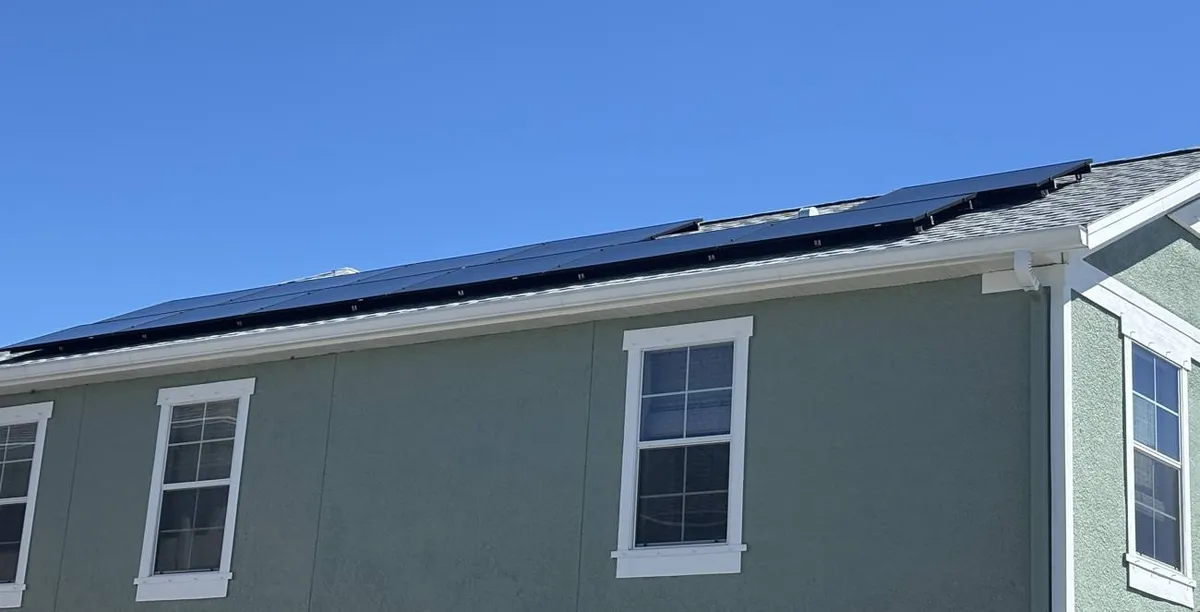
At 440 watts a panel, a home using 2,400 kilowatt-hours a month in Tampa Bay needs on the order of 35 to 40 panels, 15 to 18 kW, depending on roof orientation and shade. At $1.85 per watt installed on a single-story standard-pitch shingle roof that is roughly $28,000 to $33,000 before any adders; most high-usage homes in the region are two-story, so the two-story adder usually applies and is shown on its own line. Fused's JA Solar 440W bifacial panels keep the panel count down for the roof area, and REC is available as an upgrade.
The inverter is sized to the array and chosen for the roof, and on a system this size that is often two string inverters or a full microinverter set across several planes.
3. Does the roof hold it
Forty panels need roughly 800 square feet of usable, well-oriented roof after the code-required setbacks and pathways, and not every roof has it. The survey measures each plane, and the design uses the south and west planes first, then east, and leaves north off. If the roof cannot hold the full load, the system is the size the roof allows and the proposal says what share of usage it covers; a ground mount on an acreage lot is the alternative where there is land. A roof over twelve years old on a home about to carry forty panels should be inspected for its remaining life, because a detach and reinstall on a system this size is a large job to face early. Fused Solar and Roofing is a licensed roofing (CCC1331058), electrical (EC13014750), and building contractor (CBC1252064), all three in-house.
If your roof ever needs replacing with solar on it, who is allowed to remove and reinstall the panels, and why, is covered in our guide at https://fusedsolarandroofing.com/post/who-can-remove-reinstall-solar-florida
4. The electrical panel almost always comes up
A home with a pool pump, two air handlers, and an EV charger has a full 200-amp panel, and a 15 to 18 kW system needs a backfeed the panel may not have room or rating for under the code's 120 percent rule. The options are a supply-side connection, a subpanel, a larger main panel, or a smart panel such as SPAN that manages the loads; Fused chooses at the survey and prices it as its own line. On a high-usage home this line is expected, not a surprise, and it is on the proposal before signing.
💡 Pro Tip: If the EV charger is not installed yet, have it designed with the solar. The charger's circuit, the solar backfeed, and any panel work are one electrical permit and one inspection when they are planned together.
5. Where a battery fits
A battery on a high-usage home is sized for what the homeowner wants running in an outage, not for the whole house. The pool pump and the second air handler are the loads that drain a battery fastest, and most homeowners leave them off the backup circuit and keep the refrigerators, a bedroom AC or the main one, lighting, and the internet. One Tesla Powerwall 3 at $12,500 installed, or a FranklinWH configuration, handles that. A battery also changes the sizing arithmetic slightly, because afternoon production stored and used at night is production the home kept rather than exported, which can justify a few more panels.
⚠️ Warning: Do not size a battery to run the pool pump and both air conditioners through an outage. That is a whole-house system at several times the cost, and most homeowners who price it decide the pool can wait until the power is back.
6. The pool pump itself
The single biggest fixed load on these homes is the pool pump, and a variable-speed pump running longer at low speed uses a fraction of what a single-speed pump does for the same water turnover. Fused points this out at the survey because reducing the load by a third is cheaper than adding a third more panels. The same goes for an old air handler or a water heater; the system is sized to the usage after the easy reductions, not before.
7. Timeline and interconnection
A system this size follows the same path as any other: survey, proposal, permit, two to three days on the roof rather than one to two, inspection, and the utility's interconnection. Systems above 10 kW AC fall outside the utilities' simplest interconnection tier in some territories and take a different application, which Fused handles; the review may run longer. Six to ten weeks from contract to a producing system is the normal span, and the system stays off until the utility sets the meter.
8. Why high-usage homeowners bring the project to Fused
Because a 15 to 18 kW system on a two-story roof with a full electrical panel and an EV charger is three licensed trades on one house, and Fused holds all three. The survey sizes the system from the bills, finds the panel work, inspects the roof, and designs the EV circuit and the battery together, and the proposal shows each as its own line at a price the homeowner can read. Fused has installed systems of this size across Tampa Bay since 2007 and services every one of them.
🔑 Key Takeaway: Size from the bills, fix the big loads first, check the roof and the panel, keep the pool off the battery, and have one company licensed for all of it.
Big bill and a roof to match? Request a free site survey and solar quote at https://fusedsolarandroofing.com/solar-installation
Frequently Asked Questions
How many solar panels does a home with a pool need?
A Tampa Bay home using about 2,400 kWh a month needs roughly 35 to 40 panels of 440W, 15 to 18 kW, depending on roof orientation and shade. Fused sizes from twelve months of bills.
How much does a large solar system cost in Tampa Bay?
At $1.85 per watt installed, a 15 to 18 kW system is roughly $28,000 to $33,000 on a single-story standard-pitch shingle roof; two-story and steep-pitch adders are shown separately. Electrical panel work and a battery are their own lines.
Will my roof hold 40 solar panels?
It needs roughly 800 square feet of usable, well-oriented roof after code setbacks. The survey measures each plane; if the roof falls short, the system is sized to the roof or a ground mount is considered where there is land.
Do I need a new electrical panel for a large solar system?
Often. A full 200-amp panel may not take a 15 to 18 kW backfeed under the 120 percent rule. Fused chooses a supply-side connection, subpanel, larger panel, or smart panel at the survey and prices it as its own line.
Can a battery run my pool and AC during an outage?
Not practically. Those loads drain a battery fast; most homeowners back up refrigerators, one AC, lighting, and internet with one Powerwall 3 or a FranklinWH configuration and leave the pool pump off the backup.
Should I replace my pool pump before going solar?
If it is single-speed, yes. A variable-speed pump cuts the pool's electricity use by a large share, and reducing the load is cheaper than adding panels to cover it.
Fused Solar and Roofing has installed solar across Hillsborough, Pinellas, Pasco, and Manatee counties since 2007, with the roof and the solar handled by its own licensed in-house crews. Request a free solar quote at https://fusedsolarandroofing.com/solar-installation
Fused Solar and Roofing holds Florida roofing (CCC1331058), electrical (EC13014750), and building (CBC1252064) licenses, all three in-house, and has served Hillsborough, Pinellas, Pasco, and Manatee counties since 2007. Fused Solar and Roofing is an EnergySage Elite Installer with a 5.0/5 rating and 21+ verified reviews, independent verification, earned not purchased. Request a free site survey and solar quote at https://fusedsolarandroofing.com/solar-installation
