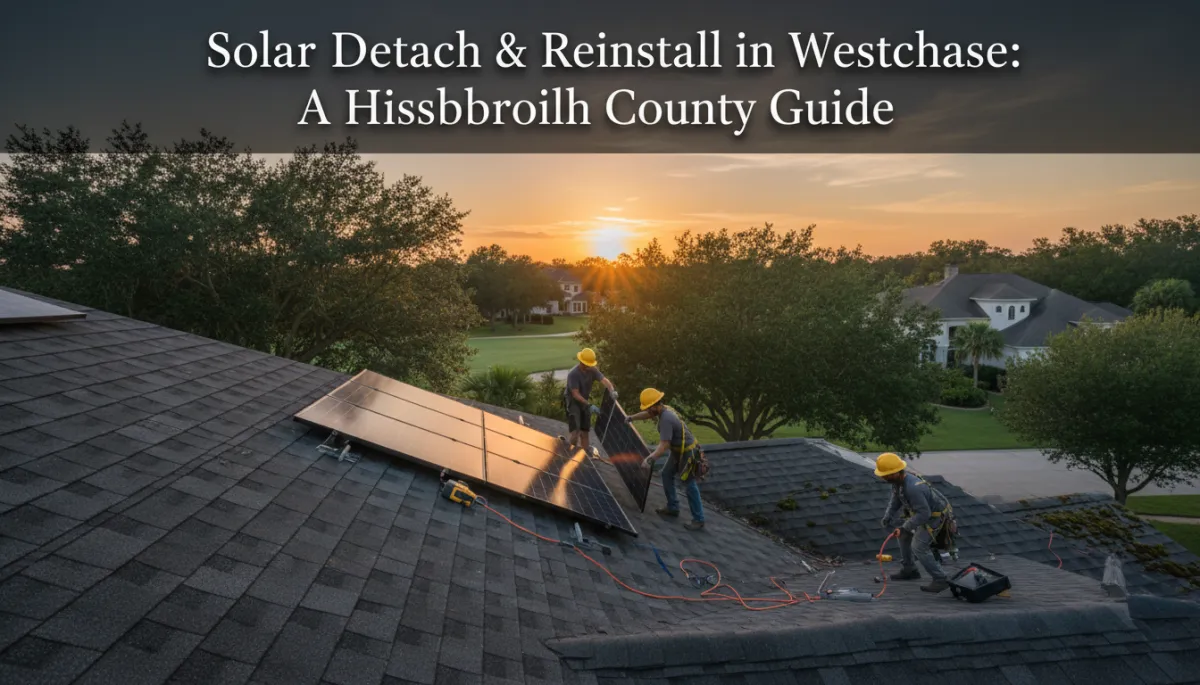
Solar Detach and Reinstall in Westchase, Tampa: A Guide
Westchase is one of west Hillsborough County’s most established master-planned communities, with neighborhoods built primarily from the mid-1990s through the early 2000s. That maturity shows in the tree canopy, landscaping, and, increasingly, in the roofs. Many original roofs have already reached, or are now beyond, their typical service life. At the same time, a large wave of rooftop solar was installed during the 2010–2015 boom, which means many arrays in Westchase are now 8–14+ years old and sitting on aging roofing systems that are ready for replacement. As a golf-course community with active HOA architectural standards, any roof or solar work must satisfy both Hillsborough County permitting and Westchase design review requirements. Detach and reinstall (D&R) work is no longer a simple “take it down and put it back” exercise—it is a coordinated roofing, electrical, and compliance project. We have been in business for 19 years serving Tampa Bay with roofing (CCC1331058) and electrical (EC13014750) licenses in-house. That matters when your new roof protects your solar for the next 25 years and has to meet County code, HOA design standards, and long-term performance expectations.
Maximize your investment with expert solar maintenance. Schedule a free solar panel cleaning and maintenance audit at https://tampasolarmaintenance.com
Why Local Roofs Age the Way They Do in Westchase
Westchase sits inland in west Hillsborough County—far enough from the bay to avoid the most aggressive salt spray exposure, but fully exposed to Tampa Bay’s heat, humidity, storm seasons, and UV cycling. Roofs here endure long, hot summers, frequent afternoon storms, and periodic tropical systems that drive wind and rain under aging flashing and through compromised underlayment. Over time, this cycle breaks down roofing materials, dries out sealants, and stresses fasteners and penetrations, including those used for solar mounting hardware. Mature tree canopy across much of Westchase adds another layer of complexity. Branches create shifting shade patterns that heat and cool different parts of the roof at different rates, increasing thermal movement in shingles, tiles, and fasteners. Leaves, pollen, and debris collect around and beneath solar arrays, in valleys, and at gutters, trapping moisture and slowing drying after storms. That localized moisture accelerates wear, especially on older roofs that already have reduced protective granules or brittle surfaces.
Homes built in Westchase’s earliest phases in the mid-1990s are now well past 25 years old. Many of those roofs have already been replaced once, often before solar was added. Now, some of those second-generation roofs are due for replacement while the solar systems installed 8–14+ years ago still have productive life left. That is where a carefully managed D&R becomes essential. Fused has 19 years of experience with Westchase's established housing stock, understanding how mature landscaping and HOA architectural standards affect both roofing material choices and D&R project planning. Knowing how these roofs age—and how tree canopy, drainage, and HOA rules interact—allows us to recommend the right timing, materials, and methods so the new roof and existing solar work together for the next 20–25 years.
Permitting and HOA Coordination in Westchase
Every detach and reinstall project in Westchase must satisfy two parallel sets of requirements: Hillsborough County permitting and Westchase HOA architectural review. Hillsborough County regulates both electrical and roofing scopes, requiring permits, inspections, and compliance with the current Florida Building Code and National Electrical Code. Roof-mounted solar D&R work is typically permitted under electrical trade permits, often paired with roofing permits when the roof itself is being repaired or replaced. For Westchase homeowners, that means a licensed electrical contractor must pull the solar-related permits—unlicensed installers cannot obtain permits, which means no inspections, no formal approval, and no documented protection for the homeowner. At the same time, the HOA’s architectural review committee must approve changes to roofing materials, colors, and any visible solar equipment in accordance with community design standards and public-view screening requirements.
Fused holds both roofing (CCC1331058) and electrical (EC13014750) licenses, handling County permitting in-house on one coordinated application. As a licensed contractor, we handle both electrical and roofing permits in-house. No delays between trades, no missed inspections, one County approval for the whole scope. While those permits move through HillsGovHub, HOA architectural review is coordinated during the planning stage so design approvals and County permitting track together. That includes confirming roof material and color selections, verifying conduit routing and equipment placement in relation to public-view standards, and ensuring that any required painting or concealment of exterior conduit is clearly defined. This integrated approach reduces the risk of last-minute changes, failed inspections, or HOA compliance issues once the D&R work is underway.
Who is allowed to do each part of a detach and reinstall, and why, is covered in our guide at https://fusedsolarandroofing.com/post/who-can-remove-reinstall-solar-florida
Solar Detach & Reinstall: Step-by-Step Process in Westchase
A well-managed solar D&R in Westchase follows a clear, documented sequence. This keeps the project on schedule, protects the roof and solar assets, and aligns with both County and HOA requirements. Our process is designed specifically around Westchase’s established housing stock, mature trees, and active design standards.
Step 1 — Audit. We begin with a site audit that covers the roof, solar array, wiring, electrical connections, and wear patterns specific to the home’s age and tree canopy exposure. For older phases, we look for prior roof replacement clues, decking condition, underlayment age, and any signs of moisture trapping around array penetrations. On the electrical side, we assess inverter age, mounting, conduit runs, labeling, and panel condition. This audit forms the basis for our written recommendations and scope of work.
Step 2 — Proposal. Based on the audit, we prepare a written proposal outlining the full D&R scope—array removal, staging, roof work, reinstallation, electrical reconnection, and inspections. We do not publish or quote generic dollar amounts because every project is different; pricing varies by roof size, pitch, material, array size and hardware condition. The proposal also identifies any recommended upgrades, such as new flashing systems or updated mounting hardware to meet current code and best practices.
Step 3 — Permitting and HOA Coordination. Once the proposal is accepted, we pull Hillsborough County permits for both electrical and roofing scopes as needed. In parallel, we coordinate HOA architectural review, submitting required documentation for roofing materials, colors, and visible solar components. Keeping these tracks aligned reduces idle time between approvals and helps ensure the schedule is realistic and predictable.
Step 4 — Disconnect. A licensed electrician de-energizes the solar system safely, following current electrical code and manufacturer requirements. This includes shutting down inverters, isolating circuits, locking out breakers, and confirming zero-voltage conditions at the array before physical removal begins. Proper documentation of this step is important for both safety and inspection.
Step 5 — Removal. The crew removes flashing, fasteners, racking, and panels carefully, documenting array layout and wiring paths for accurate reinstallation. Panels are staged safely on-site or in a controlled storage area, depending on project needs. Special attention is given to penetrations and existing flashing conditions so that any compromised areas are identified before roof work begins.
Step 6 — Roof Work. With the array removed, roofing work proceeds—ranging from localized repairs to full re-decking, underlayment replacement, and new roofing material installation. All work is matched to HOA-approved materials and colors. The licensed roofer operating under CCC1331058 coordinates closely with the licensed electrician under EC13014750. Because both licenses are held by the same company, there is no waiting on third-party schedules to complete roof details around solar penetrations or to verify attachment points for the new mounting layout.
Step 7 — Reinstallation. After roof work passes its checks, we reinstall the solar array with new or existing racking as appropriate, using current flashing and attachment best practices. Wiring is re-routed and re-terminated to meet present code and manufacturer specifications, and the array layout is reset to factory spec or better. Labeling, conduit runs, and exterior finishes are aligned with both code and HOA visibility requirements, including painting exposed conduit where required.
Step 8 — Inspection & Activation. Hillsborough County conducts final inspections on roofing and electrical scopes. Once the County inspector signs off, we verify system output, confirm monitoring connectivity if applicable, and walk the homeowner through the completed work. Documentation—including permits, inspection results, and warranty information—is provided at handoff so the homeowner has a complete record for future reference, resale, or insurance needs.
Because we hold both roofing and electrical licenses and work as one crew, the entire D&R process stays on one timeline with one point of responsibility. Licensed roofer (CCC1331058) and electrician (EC13014750) operating under a single contractor structure prevents gaps between trades, reduces scheduling conflicts, and gives Westchase homeowners a clear, accountable partner from initial audit through final activation.
What We Commonly Find Under Local Westchase Arrays
Years of work across Westchase’s neighborhoods reveal consistent patterns once solar arrays are removed. On established-phase homes from the mid-1990s through early 2000s, we often see roofing wear consistent with age and prior replacement cycles. It is common to find a second-generation roof beneath a 2010–2015 solar installation, with underlayment nearing the end of its useful life. Around the array footprint, debris accumulation is frequent—leaves, twigs, and organic matter trapped at the lower edges of panels, in valleys, and near gutters. This debris can obstruct drainage, hold moisture against the roof surface, and accelerate localized wear in those zones compared to the rest of the roof.
Fastener and flashing wear is another recurring theme. Heat cycling in Tampa’s climate, combined with shade and moisture cycling under the tree canopy, stresses metal components and sealants. We frequently encounter loose or fatigued fasteners, aged flashing with diminished seal, and older mounting systems that do not match current best practices for water management. In newer sections of Westchase, structural surprises are less common, but we still see array-weight wear patterns and occasional inverter-vibration loosening at mounting points or conduit straps. Electrical panels sometimes show corrosion on breakers and terminals, especially in homes with higher humidity exposure or limited ventilation. On 8–10 year-old systems, inverter age may be approaching the later stages of typical service life, which becomes an important planning factor when deciding how to handle D&R and future maintenance. We have seen this pattern across Westchase's established neighborhoods. That experience matters when planning a D&R that accounts for mature landscaping and HOA design standards, ensuring both the roof and solar system are ready for the next service interval.
Wind Code and Insurance Considerations in Hillsborough County
Florida Building Code requires that solar systems be engineered to meet wind design loads for the specific wind zone in Hillsborough County. That includes structural attachment, spacing, and hardware selection that can withstand design wind speeds and uplift forces. Older solar systems installed without proper County permits—whether before current code cycles or by unlicensed installers—may not meet today’s Florida Building Code requirements. When those systems are detached and reinstalled during a roof project, it is an opportunity to bring the mounting design up to current standards. Fused builds FBC compliance into every proposal, coordinating engineering, attachment layouts, and hardware choices so the reinstalled array aligns with present wind-load and structural requirements.
From an insurance standpoint, it is important for homeowners to understand how code compliance and documentation affect coverage. Insurers and lenders increasingly look for evidence that rooftop solar meets current building code, especially during policy renewals, claim reviews, or refinance underwriting. A properly permitted D&R, with County-approved plans and passed inspections, provides a clear record that the system has been evaluated under current standards. Homeowners should verify with their insurance agent that planned upgrades and reinstallation methods will align with carrier expectations. County-approved designs and inspection records form part of the documentation package that supports those conversations and helps demonstrate that the home’s roof and solar system have been brought up to code as of the D&R date.
Timeline and Proposal Structure for a Westchase D&R
A realistic timeline is essential for planning around school schedules, work-from-home needs, and HOA review calendars. In Westchase, the pre-work phase—audit, permitting, and HOA coordination—typically runs 1–2 weeks, though HOA review board meeting schedules can extend that window. During this phase, we complete the site audit, finalize the proposal, submit permit applications through HillsGovHub, and prepare HOA architectural review documents. Clear communication with the homeowner about decision points and expected response times keeps this stage efficient and predictable.
Once approvals are in place, the on-site D&R work generally takes 2–3 days for straightforward roofs and arrays, and 4–6 days for larger or more complex homes, especially where full roof replacement is involved or where tree canopy and access require additional staging. After work is complete, Hillsborough County inspections are usually scheduled within 3–5 business days, depending on inspector availability and scheduling windows. Proposal line items are structured to make this scope transparent: array removal and staging, flashing and fastener removal, roof inspection, repair or replacement, underlayment and roofing materials, reconnection labor, permits and inspections, and final activation. No dollar figures are quoted generically; pricing varies by roof size, pitch, material, array size, and hardware condition, with no tax credits applied. The Fused advantage lies in single-contractor execution—roofing and electrical handled in-house by one licensed team—so there are no subcontractor scheduling delays between trades, and the homeowner has one accountable partner throughout the process.
Westchase Solar D&R FAQ
How do I know if my Westchase roof needs replacement during D&R? Our audit evaluates roof condition based on your home’s age, construction phase, and existing roofing materials. We look for granule loss, cracked or curling shingles, worn tile surfaces, soft or spongy decking, corrosion at metal components, and signs of past leaks around penetrations. On older phases, we also consider prior replacement history and underlayment age. After the audit, you receive written recommendations that clearly state whether repair or full replacement is advisable before reinstalling your solar array.
Will D&R damage my roof further? When performed correctly, D&R should not damage your roof. Fused uses methods matched to each roof type—shingle, tile, or other materials—and to HOA-approved products. Panels, racking, and flashing are removed in a controlled sequence to minimize disturbance to the surrounding roof surface. Any existing weaknesses revealed during removal are documented and addressed as part of the roofing scope. County inspection after reinstall provides an additional verification step, confirming that both the roof and solar attachments meet current code and were completed in accordance with the permits.
How long can I be without solar power during D&R? For most Westchase homes, solar downtime is typically 1–3 days for straightforward D&R on a roof that only needs limited work, and 3–6 days when full roof replacement is required. We schedule the sequence to minimize offline time—disconnecting as close as practical to roof start, and prioritizing reinstallation as soon as the new roof is ready for mounting. Because roofing and electrical work are handled by the same licensed contractor, there is no waiting for separate trades to become available, which helps keep your system offline for the shortest reasonable period.
Do I need HOA approval before starting D&R? In Westchase, HOA architectural review is typically required for changes to roofing material, color, and any visible solar equipment. Even if you are reinstalling the same array, a roof color change or adjustment to conduit routing can trigger review requirements. We coordinate this during the planning stage so HOA approval and County permitting move forward together. That means submitting material samples, color selections, and equipment placement details in line with Westchase guidelines, helping avoid last-minute design conflicts or delays once work is scheduled.
What if my original installer is no longer available? Many early solar installers have left the market or shifted focus, but that does not limit your options. We service and reinstall all major brands and system types, regardless of who originally installed them—this is a core competency for us. During the audit, we verify system specifications, review any available documentation, and assess warranty status where possible. From there, we plan the D&R to preserve manufacturer protections and align with current best practices, even when original installer support is no longer available.
Will my array warranty transfer to a new roof? In most cases, panel manufacturer warranties stay with the panels themselves, provided they are handled and reinstalled correctly and in accordance with manufacturer requirements. Our role is to ensure that the D&R process respects those requirements—careful removal, appropriate staging, and reinstallation that follows specified torque, attachment, and wiring standards. Fused provides a written installation warranty on all reinstallation work, covering our workmanship on the new roof and giving you clear documentation to pair with your existing equipment warranties.
What should I ask other contractors to verify they are qualified to do D&R in Westchase? Before hiring any contractor, ask for their roofing license (CCC#), electrical license (EC#), and at least 10+ years in business with verifiable local history. Confirm EnergySage verification, in-house service capability, experience with HOA coordination, written warranties on both roofing and solar scopes, and local references specifically for detach and reinstall projects. You should also ask how they handle Hillsborough County permitting and whether they manage both trades under one contract. We hold all of these—roofing license CCC1331058, electrical license EC13014750, 19 years in business, EnergySage Elite Installer verification, and a track record of integrated roofing and solar work in HOA-governed communities like Westchase.
Do I need Fused if I already have a roofer for my new roof? Yes. Fused's electrical license (EC13014750) means we can legally handle the solar disconnect, removal, and reinstall on our own—you do not need us to also do your roofing to get expert D&R service. We coordinate directly with your roofer's timeline, disconnect and stage your system before they start, and reinstall once the new roof is ready. Our 25-year penetration warranty and Elite Installer status apply to the D&R work itself, independent of who installed your roof. We also service the array afterward regardless of who did the roofing or the original solar installation.
CUSTOMER SAFETY ALERT — All detach and reinstall work MUST be fully permitted and inspected by county authorities. Unlicensed installers CANNOT obtain permits. Demand permits, verify licenses at myfloridalicense.com, require inspections, and get certificates in writing. Unpermitted solar voids panel warranties, voids roof warranties, and leaves the homeowner liable for corrective work at resale.
Maximize your investment with expert solar maintenance. Book your solar panel cleaning and inspection service at https://tampasolarmaintenance.com
Conclusion: A Single-Contractor Approach for Westchase D&R
Westchase’s established housing stock, mature landscaping, and active HOA design standards make every solar detach and reinstall project unique. Tree canopy, drainage patterns, prior roof replacements, and community guidelines all influence how a D&R should be planned and executed. That is why an experienced, licensed, single-contractor firm matters. With 19 years in business, in-house roofing (CCC1331058) and electrical (EC13014750) licenses, and a history of working on Westchase homes, Fused provides a coordinated approach that keeps permitting, HOA approvals, roofing, and solar all on one timeline. We are an EnergySage Elite Installer (5.0/5, 21+ verified reviews) — independent verification of reliability and expertise. That recognition, combined with our single-contractor model, gives Westchase homeowners a clear path to a roof and solar system designed to work together for the next 25 years, supported by documented code compliance and professional maintenance options tailored to Tampa Bay’s weather and neighborhood standards.
Is your solar system performing at its best? Start your free maintenance consultation at https://tampasolarmaintenance.com
Fused Solar and Roofing is a licensed roofing (CCC1331058), electrical (EC13014750), and building contractor (CBC1252064), all three in-house, serving Hillsborough, Pinellas, Pasco, and Manatee counties since 2007. Fused Solar and Roofing is an EnergySage Elite Installer with a 5.0/5 rating and 21+ verified reviews, independent verification, earned not purchased.
Planning a brand-new system instead of a reinstall? Our guide to solar installation in Westchase is at https://fusedsolarandroofing.com/post/solar-roof-installation-westchase-tampa. Replacing the roof and adding solar at the same time is covered at https://fusedsolarandroofing.com/post/new-roof-and-solar-westchase-fl, and solar repair and service in Westchase at https://fusedsolarandroofing.com/post/solar-repair-service-westchase-fl.
Need the roof itself replaced, with or without solar on it? Our guide to roof replacement in Westchase, the GAF system Fused installs, the warranty, and the local permit, is at https://fusedsolarandroofing.com/post/roof-replacement-westchase-fl.
All of Fused's Westchase services on one page, with prices, permits, and the utility: Solar and Roofing in Westchase. The county-wide version of this guide is the Hillsborough County overview.
Replacing a roof that has solar on it? Request a detach and reinstall quote at https://fusedsolarandroofing.com/solar-panel-removal