Solar Detach & Reinstall in Trinity, FL | Tile Roof Guide
Many Trinity homeowners are discovering that their roof is ready for replacement long before their solar panels are. When an aging roof sits under an active solar array, a professional detach and reinstall (D&R) is the only safe path forward. Understanding how this works in Trinity, FL—especially on tile roofs common in master-planned, deed-restricted communities—is critical to protecting both your home and your solar investment.
1. Why Trinity Homeowners Are Facing Solar D&R Now
Trinity saw significant residential growth in the late 1990s through the 2010s. Many of those homes now have roofs reaching the end of their service life at the same time that rooftop solar adoption has surged. In other words, the original roof and the newer solar array are on different life cycles. The result: a growing number of Trinity homeowners must replace a roof that is 18–25 years old while their solar system is still performing well and has a decade or more of useful life remaining.
Because Trinity is an inland Pasco County community, many residents assumed their roofs would outlast coastal properties exposed to salt spray. However, Florida sun, heat, and storm events are more than enough to age both shingle and tile assemblies. When a roofer is scheduled to tear off and replace that roof, the solar array must be safely detached, stored, and then reinstalled and re-commissioned after the new roof is in place. That is the D&R process in a nutshell.
2. How Trinity Roofs Age: Tile vs. Shingle in Inland Pasco Conditions
Trinity is a master-planned, deed-restricted community with a higher-than-average number of tile roofs alongside conventional asphalt shingles. Understanding how each roof type ages in inland Pasco County helps explain why D&R is often needed during roof replacement.
Tile Roofs: Long-Lived Tile, Shorter-Lived Underlayment
Concrete or clay tiles themselves can last 40–50 years or more. The weak point in Florida, however, is almost always the underlayment system beneath the tile. Underlayment provides the actual waterproofing; tile functions primarily as a protective shell and aesthetic finish. Over time, Trinity’s intense UV exposure, heat cycles, and wind-driven rain degrade that underlayment well before the tile shows obvious distress.
Cracked or slipped tiles: Foot traffic from past work, thermal expansion, or storm debris can crack tiles or cause them to slip out of position, exposing underlayment to direct weather and accelerating failure.
Aging underlayment: Even when tiles look fine from the street, underlayment can become brittle, torn, or UV-damaged at laps and penetrations, leading to leaks that often show up around solar attachments first.
Compromised battens and fasteners: Moisture intrusion and repeated wet-dry cycles can weaken wooden battens and corrode fasteners, undermining tile stability under wind uplift.
Shingle Roofs: UV, Heat, and Storm Wear in Inland Pasco
Trinity’s shingle roofs face the same core stressors as the rest of inland Pasco County: high UV, prolonged summer heat, and periodic tropical systems. Even in the absence of direct coastal salt exposure, shingles gradually lose granules, dry out, and become more brittle. Seal strips weaken, making shingles more vulnerable to uplift during summer thunderstorms and hurricane-season winds. Around solar mounts and conduit penetrations, this aging can present as localized leaks and accelerated deterioration.
For many Trinity homes, the combination of an original 20–25-year shingle or tile underlayment system and a 10–15-year-old solar array means that roof replacement cannot be postponed without risking water damage. That is why D&R is becoming such a common topic in local roofing and solar discussions today.
3. Permitting in Trinity: Pasco County and HOA/Deed Restrictions
Trinity is located in unincorporated Pasco County, so all building and electrical permitting flows through Pasco County Building Construction Services. Under current regulations, any work involving a solar photovoltaic system—including detach and reinstall for roof replacement—requires a building permit. In Pasco, this is typically handled under the Residential Photovoltaics permit category, which covers installation, alteration, and related work on solar arrays and associated electrical equipment.
The permit application must show how the system will be safely disconnected, how attachments will meet current wind and structural requirements when reinstalled, and how electrical work will comply with the Florida Building Code, National Electrical Code, and Florida Fire Prevention Code. Pasco’s average review time for photovoltaic permits is typically around a week, assuming the application is complete and properly engineered for local wind zones and loading conditions.
Planning a brand-new system instead of a reinstall? Our guide to solar installation in Trinity is at https://fusedsolarandroofing.com/post/solar-installation-trinity-fl
Who is allowed to do each part of a detach and reinstall, and why, is covered in our guide at https://fusedsolarandroofing.com/post/who-can-remove-reinstall-solar-florida
HOA and Architectural Review in Trinity Communities
Beyond county permitting, many Trinity neighborhoods are governed by homeowners’ associations (HOAs) and deed restrictions. While Florida law (including solar rights statutes) prevents HOAs from outright banning rooftop solar, most associations still exercise architectural review over exterior changes, roof work, and visible equipment. That often includes solar panel layout, conduit routing, and any visible junction boxes or disconnects.
For a D&R project, your HOA may require a brief architectural review submission showing that the array will be reinstalled in a similar configuration, that roof color or tile profile changes remain consistent with community standards, and that visible solar components will be neatly integrated. In practice, this means coordinating your roofer, solar contractor, and HOA or Architectural Review Committee (ARC) so that approvals and permits are in place before work begins.
4. The Solar Detach & Reinstall Process: Step by Step
While every home is unique, a professional D&R in Trinity generally follows a predictable sequence. Coordination between your roofing contractor, solar contractor, and utility is essential to keep the project safe and on schedule.
Site assessment and documentation: The solar contractor inspects the array, roof type (tile vs. shingle), access, and electrical equipment. Panel count, layout, and existing attachment methods are documented so the system can be reinstalled correctly and to current code.
Permitting and HOA coordination: Pasco County Residential Photovoltaics permits are applied for, and any required HOA/ARC approvals are obtained. Utility coordination is scheduled so the system can be safely de-energized and later re-energized after inspections.
System shutdown and safe disconnect: The array is powered down, and conductors are safely isolated according to code. In Pasco County, final power changes and meter work must be coordinated with the electric utility; neither homeowners nor contractors are permitted to independently disconnect utility power outside of approved procedures.
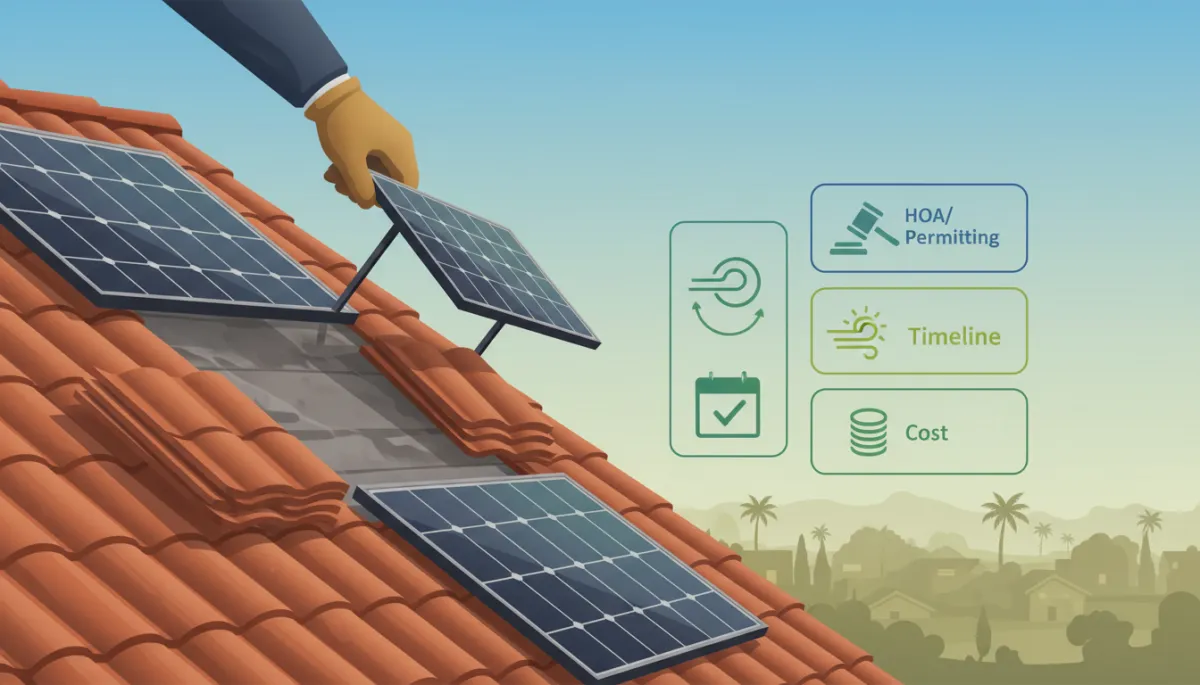
Panel removal and racking disassembly: Panels are removed one by one, wiring harnesses are labeled, and racking hardware is disassembled. On shingle roofs, mounts and flashing are removed so the roofer can complete a full tear-off. On tile roofs, this step requires significantly more care, as described below.
Roof replacement: Your roofing contractor completes the tear-off, repairs any damaged decking, installs new underlayment, and installs new shingles or resets/replaces tile according to manufacturer specifications and current wind code requirements.
Reinstallation of mounts, racking, and panels: The solar contractor installs new or upgraded attachment hardware, flashing, and racking. Panels are reinstalled, wiring is reconnected, and labeling is updated to match current code standards and the approved permit documents.
Inspection and re-energization: Pasco County inspectors verify that structural and electrical work meet all applicable codes. Once inspections pass, the utility authorizes the system to be re-energized and interconnected again.
Extra Care for Tile Roofs During D&R
Tile roofs in Trinity demand specialized handling. Tiles can crack under concentrated loads, and lifting or walking on them without proper technique can cause hidden fractures that later turn into leaks. A qualified solar and roofing team will:
Use walk boards or padding to distribute weight and reduce point loading on tiles.
Carefully remove and store tiles in areas where mounts penetrate the roof, then reinstall or replace them after new underlayment and flashing are in place.
Plan for a reasonable amount of tile breakage and have matching replacement tiles or an approved equivalent on hand.
Because of this additional labor and material risk, tile-roof D&R work typically requires more time, more coordination with the roofer, and more precise planning than similar work on shingle roofs.
5. Common Issues Found Under Panels on Tile Roofs
When panels come off tile roofs in Trinity, it is common to discover conditions that were previously hidden from view. Identifying and correcting these issues during roof replacement and D&R is essential for long-term performance.
Broken or deteriorated battens: Wooden battens can rot, split, or become dislodged due to trapped moisture and repeated wetting. Under solar arrays, where airflow and drying may be reduced, batten deterioration is often more advanced than on exposed roof areas.
Aging or failed underlayment: Underlayment may be brittle, torn at fastener penetrations, or pulled away at laps. Around solar mounts, the underlayment is frequently the first line of defense against leaks, so any damage here is a red flag that must be addressed before reinstallation.
Corroded flashing and fasteners: Metal flashing around penetrations and older fasteners may show corrosion, especially where dissimilar metals were used or where water has been trapped under tiles. Reusing compromised hardware can shorten the life of both the roof and the solar array’s attachment system.
Improper prior mounting details: In some older installations, mounts were added without fully integrating with the tile system or underlayment. D&R is the ideal time to correct these conditions and bring attachments into alignment with current best practices and wind code.
Addressing these issues during D&R ensures that the new roof and the reinstalled solar array function as a coordinated system, rather than two separate projects competing for the same space on your home.
6. Wind Code and Insurance Considerations in Trinity
Even though Trinity is inland, Pasco County enforces Florida’s stringent wind and building codes. When your solar array is reinstalled after roof replacement, the attachment methods, spacing, and hardware must meet current wind-load requirements, not just the standards in place when the system was originally installed. That can mean upgraded mounts, additional attachment points, or revised rail layouts to satisfy engineering and permit conditions.
Insurance carriers are increasingly attentive to how roof-mounted solar is attached, particularly in hurricane-prone regions. A properly permitted D&R with documentation that shows compliance with current wind code can help support your insurability and reduce the risk of disputes after a storm event. Some insurers may require proof that both the roof and the solar attachments were installed by licensed professionals and inspected by the local building department before renewing or adjusting coverage.
7. Timeline and Cost Range for D&R in Trinity ($2,500–$6,500)
For a typical Trinity home, a complete detach and reinstall of a residential solar array generally falls in the $2,500–$6,500 range. The lower end of that spectrum usually applies to smaller, straightforward shingle-roof systems with easy access and minimal hardware upgrades. The higher end is more common for:
Tile roofs requiring specialized handling and tile-breakage allowances
Larger arrays with higher panel counts and more complex wiring
Projects requiring significant hardware replacement or electrical upgrades to meet current code
In terms of scheduling, the D&R work itself is typically aligned tightly with the roofing project. Removal is often completed in a day, followed by roof replacement over several days (depending on scope and weather), and then reinstallation within another day or two. Permit review, utility coordination, and inspection scheduling can add one to two weeks on either side, so it is prudent to plan your overall project on a several-week timeline rather than a few days from start to finish.
Fused Solar and Roofing holds both the roofing license (CCC1331058) and the electrical license (EC13014750) in-house, allowing the company to manage the entire D&R process, roof interface, and electrical reconnection under a single, coordinated scope of work that aligns with Pasco County requirements.
Ready to keep your solar system in peak condition? Schedule a free solar panel cleaning and maintenance audit at https://tampasolarmaintenance.com
9. Trinity-Focused FAQ: Solar Detach & Reinstall
1. Do I really need to remove my solar panels to replace my roof in Trinity?
In almost all cases, yes. To properly replace underlayment, decking, and roof coverings to current code, your roofer must have full access to the roof surface. Leaving panels in place typically results in incomplete roof work, voided warranties, and potential leaks around mounts. A professional D&R ensures both the new roof and the solar array are installed correctly and inspected together.
2. What makes tile-roof D&R in Trinity different from shingle-roof projects?
On tile roofs, the solar team must work around a more fragile surface, coordinate closely with the roofer on tile removal and reset, and plan for underlayment replacement and new flashing details that integrate with battens and tiles. Additional time, labor, and replacement tiles are usually required. For this reason, Trinity tile-roof D&R projects often fall toward the higher end of the $2,500–$6,500 range and require contractors experienced specifically with tile systems.
3. How do my Trinity HOA and deed restrictions affect a D&R project?
Most Trinity neighborhoods require architectural review for roof replacements and visible exterior changes. For D&R, you will often need to submit a simple package confirming that the array will be reinstalled in a neat, code-compliant configuration and that any changes in roof material or color comply with the community’s design standards. While your HOA cannot prohibit solar outright, it can require that the work meet aesthetic guidelines, so early communication with the ARC is important.
4. Will my solar production change after D&R on my Trinity home?
If the array is reinstalled in the same orientation and layout, production should be similar or slightly improved if wiring and components are refreshed. In some cases, the solar contractor may recommend minor layout adjustments to better meet current wind code or to improve performance; those changes should be modeled and explained in advance so you understand any impact on energy generation and HOA review.
5. How long will my solar system be offline during roof replacement in Trinity?
For most Trinity projects, the system is offline from the day of panel removal until final inspections and utility re-energization are complete. That typically spans one to three weeks, depending on roofing scope, weather, inspection schedules, and utility coordination. A well-planned project minimizes downtime by closely sequencing D&R work with roof tear-off, installation, and inspection dates.
6. Can I use my original mounting hardware when the panels go back on?
In some cases, yes—but not always. Hardware that is corroded, no longer meets current wind or code requirements, or is incompatible with your new roof assembly should be replaced. Many Trinity homeowners choose to upgrade to modern flashing systems and mounts during D&R to improve waterproofing and wind resistance, especially on tile roofs where attachment details are critical to long-term performance.
7. How do I choose the right contractor for D&R in Trinity, FL?
Look for a contractor with proven experience in both roofing and solar, familiarity with Pasco County permitting, and specific references for tile and shingle D&R projects in deed-restricted communities. Verify Florida roofing and electrical licenses, ask how they coordinate with your roofer and HOA, and request a detailed, written scope that covers permitting, hardware, inspections, and utility coordination. Fused Solar and Roofing holds both the roofing license (CCC1331058) and the electrical license (EC13014750) in-house, so one team manages the roof interface and the electrical work under a single, accountable scope.
8. Do I need Fused if I already have a roofer for my new roof?
Yes. Fused's electrical license (EC13014750) means we can legally handle the solar disconnect, removal, and reinstall on our own — you do not need us to also do your roofing to get expert D&R service. We coordinate directly with your roofer's timeline, disconnect and stage your system before they start, and reinstall once the new roof is ready. Our 25-year penetration warranty and Elite Installer status apply to the D&R work itself, independent of who installed your roof. We also service the array afterward regardless of who did the roofing or the original solar installation. Choosing a licensed, single-purpose D&R specialist protects you whether you use one contractor for everything or coordinate multiple trades yourself.
CUSTOMER SAFETY ALERT — All detach and reinstall work MUST be fully permitted and inspected by county authorities. Unlicensed installers CANNOT obtain permits. Demand permits, verify licenses at myfloridalicense.com, require inspections, and get certificates in writing. Unpermitted solar voids panel warranties, voids roof warranties, and leaves the homeowner liable for $15,000–$25,000+ in corrective work at resale.
Maximize your investment with expert solar maintenance. Book your solar panel cleaning and inspection service at https://tampasolarmaintenance.com
Conclusion and Next Steps for Trinity Homeowners
For Trinity homeowners, solar detach and reinstall is no longer a rare edge case—it is a standard part of responsible roof replacement on homes with rooftop solar. Tile-heavy neighborhoods, strong inland sun and heat, and evolving wind and electrical codes make it essential to treat your roof and solar array as a single system. Proper permitting through Pasco County, coordination with your HOA, and the use of licensed roofing and electrical professionals are non-negotiable steps in protecting your home, your investment, and your insurance coverage.
If your Trinity roof is nearing the end of its life or your insurer is recommending replacement, it is the right time to plan a professional solar D&R. Fused Solar and Roofing is recognized as an EnergySage Elite Installer with a 5.0-star rating across 21+ verified reviews, independent proof of a reliable, established local track record.
Is your solar system performing at its best? Start your free maintenance consultation at https://tampasolarmaintenance.com
Fused Solar and Roofing is a licensed roofing (CCC1331058), electrical (EC13014750), and building contractor (CBC1252064), all three in-house, serving Hillsborough, Pinellas, Pasco, and Manatee counties since 2007. Fused Solar and Roofing is an EnergySage Elite Installer with a 5.0/5 rating and 21+ verified reviews, independent verification, earned not purchased.
Replacing the roof and adding solar at the same time in Trinity is covered at https://fusedsolarandroofing.com/post/new-roof-and-solar-trinity-fl, and solar repair and service in Trinity at https://fusedsolarandroofing.com/post/solar-repair-service-trinity-fl.
Need the roof itself replaced, with or without solar on it? Our guide to roof replacement in Trinity, the GAF system Fused installs, the warranty, and the local permit, is at https://fusedsolarandroofing.com/post/roof-replacement-trinity-fl.
All of Fused's Trinity services on one page, with prices, permits, and the utility: Solar and Roofing in Trinity. The county-wide version of this guide is the Pasco County overview.
Replacing a roof that has solar on it? Request a detach and reinstall quote at https://fusedsolarandroofing.com/solar-panel-removal