Solar Detach and Reinstall in Riverview, FL: A Guide
Riverview grew fast through the 2000s and 2010s, with whole neighborhoods in Summerfield, Boyette, and south toward Apollo Beach and Gibsonton built within just a few years of each other. Many of those shingle roofs are now 15–20+ years old, right when a lot of homeowners have already added rooftop solar. If you are planning a Riverview roof replacement with solar already on the home, you are not alone—and you need a clear plan to remove solar panels for a new roof and put them back into service safely. This guide walks through how Fused Solar and Roofing handles solar detach and reinstall in Riverview and nearby communities like Ruskin and Lithia. You will see why using a single licensed contractor for both roofing and electrical work simplifies permitting, scheduling, and warranties, and what to expect at every step from the first inspection through final TECO re-activation.
Why Riverview Roofs Age in Waves
In Riverview, roof replacement rarely happens one house at a time. Because so much of the area was built out in master-planned phases, entire streets share the same original construction date, shingle grade, and underlayment type. Summerfield, Boyette, and similar communities often have long runs of homes that all received comparable builder-grade architectural shingles and felt or early synthetic underlayments within the same two- or three-year window. As a result, those roofs tend to reach the end of their useful life together, especially once they pass the 15–20 year mark under Florida sun.
Riverview’s inland location reduces direct salt spray compared with coastal Pinellas, but it increases thermal stress. Roofs here see sustained heat load and high UV exposure for much of the year, followed by strong afternoon storm patterns rolling up the Alafia River corridor. That daily cycle—roofs baking through midday, then cooling quickly under heavy rain—causes shingles and sealants to expand and contract over and over again. Over time, this thermal cycling dries out asphalt, fatigues sealant around penetrations, and accelerates granule loss on sun-facing slopes, especially the south and west faces common in Riverview subdivisions.
Occasional hail and strong thunderstorm winds also play a role. Even when hail does not punch through shingles, it can bruise the mat and knock off protective granules. Once the mat is exposed, UV damage speeds up. Because so many homes in Riverview, Apollo Beach, Gibsonton, Ruskin, and Lithia share the same age and construction patterns, these weather effects show up across an entire block at once. That is why you often see multiple neighbors scheduling Riverview roof replacement with solar at roughly the same time, and why it is smart to plan a coordinated solar detach and reinstall instead of waiting until leaks force an emergency project.
Permitting in Hillsborough County for Roof and Solar Work
Riverview is in unincorporated Hillsborough County, so both your roof replacement and your solar detach and reinstall go through the county’s online permitting system, HillsGovHub. This is more straightforward than the city–county split that homeowners deal with in parts of Pinellas or Pasco. Even though everything is handled in one portal, the roof and solar scopes are still treated as separate permits and inspections: a building permit for the roof replacement and an electrical trade permit for the photovoltaic system work. Both must comply with the current Florida Building Code and National Electrical Code requirements for structural loads, wind design, clear access pathways, and safe electrical connections.
As a licensed Hillsborough County solar contractor with both roofing (CCC1331058) and electrical (EC13014750) licenses, Fused Solar and Roofing prepares and submits the full permit package for both scopes. That includes signed and sealed engineering for the roof and the solar attachment system, electrical diagrams, and any documentation needed for load and wind calculations. Because the same contractor is responsible for the roof structure and the solar array, the design is coordinated from the start so that panel layout, attachment points, and pathways all satisfy the county’s structural and fire access requirements without last-minute changes in the field.
Most Riverview master-planned communities, including many in Summerfield, Boyette, and nearby Apollo Beach and Lithia, also have HOAs or CDDs that require architectural review. These boards may have rules about which roof planes can show panels from the street, how close arrays can be to ridges, and how conduit is routed on visible walls. Those rules sit on top of Hillsborough County code. Before scheduling a Riverview solar roofing project, it is important to confirm any HOA or CDD requirements so that the permit drawings and the board’s approval match. When one contractor handles everything, that coordination between county permits and community guidelines is built into the planning process rather than left for the homeowner to juggle.
Who is allowed to do each part of a detach and reinstall, and why, is covered in our guide at https://fusedsolarandroofing.com/post/who-can-remove-reinstall-solar-florida
What the Detach & Reinstall Process Looks Like
A professional solar detach and reinstall in Riverview follows a clear, step-by-step process. It begins with an on-site audit of your existing system and roof. The crew documents panel count, inverter type, racking hardware, wiring routes, and any existing code issues. At the same time, the roof is inspected for shingle wear, soft decking, flashing condition, and any signs of leaks around penetrations. If you have monitoring, recent production data is reviewed so that after re-commissioning, performance can be compared to the pre-project baseline to confirm the system is operating properly.
Once the scope is defined, permit applications for both the roof replacement and the solar work are submitted through HillsGovHub. After permits are issued and any HOA or CDD approvals are in hand, the project is scheduled. Because Fused Solar and Roofing is licensed for both roofing and electrical work and performs both scopes in-house, there is one integrated schedule. The same company controls the sequence from safe electrical shutdown, through removal and staging of the array, to reinstallation and final inspections. That single-contractor advantage means no gaps waiting on a separate solar crew or disputes between trades about who is responsible for an issue discovered mid-project.
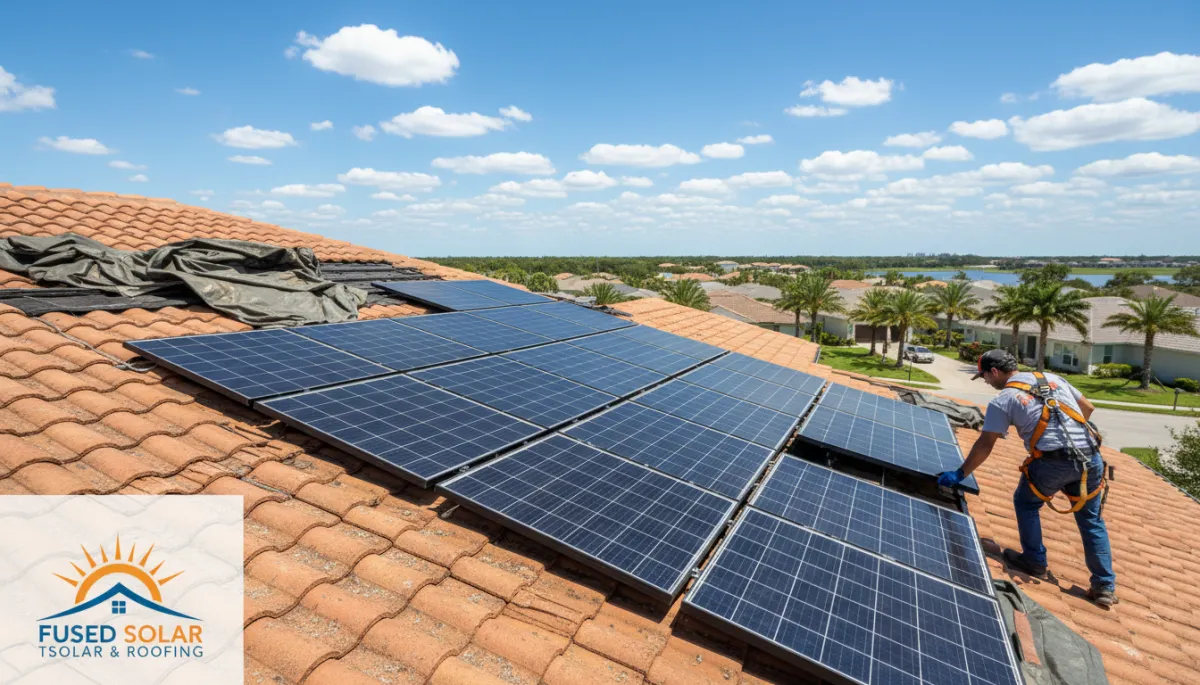
On the first day of physical work, the solar team performs a safe electrical disconnect, shuts down the inverter, and isolates the array according to code and TECO requirements. Panels are removed methodically, with each circuit labeled. Hardware is inspected as it comes off the roof, and components are either protected for reuse or flagged for replacement if they show damage or heavy wear. Panels are staged on site in a clean, secure area away from traffic and landscaping work, typically on padded racks or similar supports to protect glass and frames while the roof is being replaced.
With the array off, the roofing crew tears off the old shingles and underlayment, addresses any damaged decking, and installs the new roof system to current Florida Building Code standards. New flashing and sealant are installed at all existing and planned solar attachment points. Once the roof is complete and dried in, the solar crew reinstalls racking, wiring, and panels, following the engineered layout. The system is re-commissioned, tested, and inspected under load. Hillsborough County then performs final inspections for both the roof and the solar work. After approvals, TECO processes any required documentation for re-activation so your system can resume exporting power as intended.
Ready to keep your solar system in peak condition? Schedule a free solar panel cleaning and maintenance audit at https://tampasolarmaintenance.com
What We Commonly Find Under Riverview Arrays
Removing solar panels for a new roof in Riverview often reveals conditions that were not visible from the ground or even from a basic drone inspection. Many original roofs in communities from Summerfield and Boyette down to Apollo Beach and Gibsonton were installed with builder-grade architectural shingles. After years of inland heat and storms, those shingles may show advanced granule loss, curling, or cracking, especially around standoffs and mounts where water and debris collect. It is common to see granule loss concentrated on south and west slopes, where panels may have shaded some areas while leaving others exposed to full sun and runoff patterns that accelerate wear at the edges of arrays.
At the mount points themselves, older sealants and flashing often show thermal degradation. Sealant beads can dry out and split, and some early flashing kits were not optimized for today’s wind and water standards. Pipe boots on vent stacks near arrays may be cracked or split, allowing water to work under shingles and into the underlayment. In some systems, especially where wiring was run across the roof surface, UV exposure can make wire insulation brittle or chalky. That does not always mean a full rewire is required, but it does mean each run needs careful inspection and, in some cases, replacement or re-routing in conduit for long-term safety and code compliance.
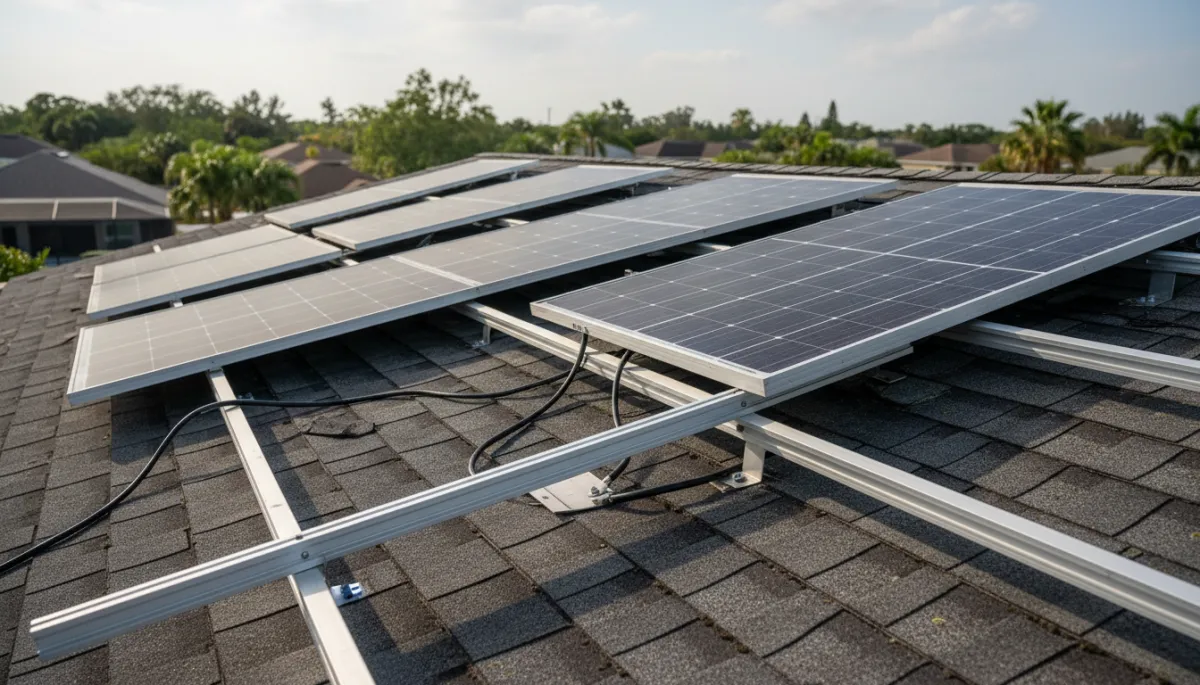
Hidden wear around mounts often appears only after panels come off for re-roofing.
Decking issues sometimes appear around older penetrations, particularly where slow leaks have been active for several rainy seasons. Soft spots or minor rot can usually be addressed during the roof replacement, but they must be identified and documented once the array is off. For that reason, a professional Riverview solar roofing proposal should include contingency language that explains how unforeseen conditions under the array will be handled. This does not mean open-ended costs; it means a clear process for documenting any damaged decking, compromised wiring, or failed flashing and providing written change orders before additional work proceeds. When one contractor is responsible for both the roof and the solar array, there is no confusion about who owns those repairs or how they will be brought up to current code.
Wind Code, Hail, and Insurance in Hillsborough County
Even though Riverview is inland, Hillsborough County still applies Florida Building Code wind design requirements. Roofs and solar attachment systems must be engineered to withstand the design wind speeds and pressures for this inland zone, which differ from coastal high-velocity hurricane zones but remain substantial. When a roof is replaced and a solar system is detached and reinstalled under valid permits, inspections confirm that the new roofing system, fasteners, underlayment, and solar mounting hardware meet those wind and structural standards. That documentation becomes important when homeowners pursue wind mitigation credits or file storm-related insurance claims in the future.
Hail and severe thunderstorms can damage both shingles and solar panels. When a claim is filed, insurers and adjusters look closely at permit records and inspection history. Properly permitted and inspected work in Hillsborough County shows that the roof and solar system were installed or updated according to the code in effect at the time. In contrast, unpermitted solar work—whether the original install or a later move—raises questions at claim time and during resale. It can complicate coverage decisions and may require corrective work before a buyer’s insurer will write a policy. Having a licensed Hillsborough County solar contractor who also holds a roofing license manage the entire Riverview roof replacement with solar ensures that all work is documented correctly for future insurance and real estate transactions.
Timeline and What a Proposal Should Itemize
For a typical Riverview home with an existing rooftop array, the on-site work portion of a solar detach and reinstall tied to a roof replacement usually spans several days. One day is often allocated to safe shutdown, panel removal, and staging. The roof replacement itself commonly takes one to two working days for an average single-family home, depending on roof size, pitch, and weather. Reinstalling racking, wiring, and panels, followed by testing and cleanup, typically adds another day. Permit review and scheduling of county inspections occur around this field work and can extend the overall calendar timeline into the multi-week range, depending on Hillsborough County review times and inspection availability, as well as HOA or CDD meeting schedules where approvals are required.
A clear proposal for Riverview solar roofing should break out each major component of the project. Line items should identify roof tear-off and replacement, decking repairs on a per-sheet or per-area basis, underlayment and shingle system details, solar panel detach and staging, racking and hardware reuse or replacement, wiring and electrical work, monitoring reconnection, and permit and inspection management. Because every home is different, pricing must reflect roof size, pitch, material choice, array size, hardware condition, and any access challenges unique to the property. A written proposal should provide a specific figure for the home in question, with no tax credits or incentives applied, so that the homeowner sees the true project cost before any outside programs are considered. When one contractor controls both the roof and the solar scopes, the schedule and pricing structure are coordinated, and there is a single point of responsibility if questions arise before, during, or after the project.
Riverview & South Hillsborough FAQ: Roof Replacement With Solar
1. Do I have to remove solar panels for a new roof in Riverview?
Yes. To install a new roof correctly and maintain manufacturer and workmanship warranties, panels and racking must be removed, the old roofing system torn off, and the new system installed to current code before reattaching the solar array. Leaving panels in place and roofing around them is not acceptable under modern standards and creates long-term leak and warranty risks.
2. How does Hillsborough County handle permits for a Riverview roof replacement with solar?
Hillsborough County issues separate permits through HillsGovHub: a building permit for the roof replacement and an electrical trade permit for the solar work. Both permits must be closed with final inspections. As a homeowner, you should receive copies of permit numbers and final inspection results for your records and for future insurance or resale needs.
3. Can one contractor handle both the roof and the solar detach and reinstall in Riverview?
Yes. Fused Solar and Roofing is licensed for both roofing (CCC1331058) and electrical (EC13014750) work and performs both scopes in-house. That single-contractor approach means one schedule, one point of responsibility, and no finger-pointing between a roofer and a separate solar company if issues arise with leaks, wiring, or panel performance after the project.
4. What role do HOAs and CDDs play in Riverview solar roofing projects?
Florida law strongly limits what HOAs can restrict when it comes to solar, and boards generally cannot deny an installation or force placement that reduces performance. Even so, most communities still have a review process, and submitting early keeps your project on schedule and your permit drawings consistent with what the board has on file.
5. Will my solar production change after a detach and reinstall in Riverview?
Production should be the same or better if the array is reinstalled with clean panels, optimized wiring, and any shading issues addressed. During the initial audit, baseline production is reviewed. After re-commissioning, the system is tested and monitored to verify that output matches or exceeds pre-project performance, accounting for seasonal sun angle and weather differences.
6. How long will my system be offline during a Riverview roof replacement with solar?
The array is offline from the time it is safely disconnected and removed until it is reinstalled, tested, and cleared through county inspections and TECO’s re-activation process. For many single-family projects, this offline period is measured in days rather than weeks, but the exact duration depends on roof size, weather, inspection scheduling, and any unforeseen repairs discovered once panels are removed.
7. I live in Gibsonton or Ruskin, not Riverview. Is the process the same?
Yes. Gibsonton, Ruskin, and nearby areas like Apollo Beach and Lithia are also in unincorporated Hillsborough County and follow the same county permitting structure and Florida Building Code requirements. The main differences are local HOA or CDD guidelines and site-specific factors such as roof design, tree shading, and access, all of which are addressed during the initial inspection and proposal process.
Do I need Fused if I already have a roofer for my new roof?
Yes. Fused's electrical license (EC13014750) means we can legally handle the solar disconnect, removal, and reinstall on our own—you do not need us to also do your roofing to get expert D&R service. We coordinate directly with your roofer's timeline, disconnect and stage your system before they start, and reinstall once the new roof is ready. Our 25-year penetration warranty applies to the D&R work itself, independent of who installed your roof. We also service the array afterward regardless of who did the roofing or the original solar installation.
CUSTOMER SAFETY ALERT — All detach and reinstall work MUST be fully permitted and inspected by county authorities. Unlicensed installers CANNOT obtain permits. Demand permits, verify licenses at myfloridalicense.com, require inspections, and get certificates in writing. Unpermitted solar voids panel warranties, voids roof warranties, and leaves the homeowner liable for $15,000–$25,000+ in corrective work at resale.
Maximize your investment with expert solar maintenance. Book your solar panel cleaning and inspection service at https://tampasolarmaintenance.com
Conclusion: A Coordinated Approach to Riverview Solar Roofing
As Riverview’s early-2000s and 2010s neighborhoods age, more homeowners are facing the same challenge: roofs that are ready for replacement while solar systems still have many productive years ahead. Handling a solar detach and reinstall in Riverview is not just about lifting panels and putting them back. It involves coordinated permitting through Hillsborough County, careful compliance with Florida Building Code wind and structural requirements, respect for HOA and CDD guidelines, and detailed attention to the hidden conditions revealed once arrays come off. Builder-grade shingles at the end of their life, fatigued sealants, cracked boots, and weathered wiring are all issues that must be corrected if you want a watertight roof and a reliable solar system for the long term.
Choosing a contractor that holds both roofing and electrical licenses and performs both scopes in-house simplifies every part of that process. With one schedule, one design team, and one point of responsibility, there is no question about who owns the details of your Riverview roof replacement with solar. From the initial audit and production baseline through safe shutdown, removal, re-roofing, reinstallation, inspections, and TECO re-activation, Fused Solar and Roofing manages the entire project as a single, integrated system. That approach protects your warranties, supports future insurance and resale needs, and keeps your solar investment working efficiently on top of a code-compliant, storm-ready roof across Riverview, Apollo Beach, Gibsonton, Ruskin, Boyette, Summerfield, and Lithia.
Is your solar system performing at its best? Start your free maintenance consultation at https://tampasolarmaintenance.com
Fused Solar and Roofing is a licensed roofing (CCC1331058), electrical (EC13014750), and building contractor (CBC1252064), all three in-house, serving Hillsborough, Pinellas, Pasco, and Manatee counties since 2007. Fused Solar and Roofing is an EnergySage Elite Installer with a 5.0/5 rating and 21+ verified reviews, independent verification, earned not purchased.
Planning a brand-new system instead of a reinstall? Our guide to solar installation in Riverview is at https://fusedsolarandroofing.com/post/solar-roof-installation-riverview-fl. Replacing the roof and adding solar at the same time is covered at https://fusedsolarandroofing.com/post/new-roof-and-solar-riverview-fl, and solar repair and service in Riverview at https://fusedsolarandroofing.com/post/solar-repair-service-riverview-fl.
Need the roof itself replaced, with or without solar on it? Our guide to roof replacement in Riverview, the GAF system Fused installs, the warranty, and the local permit, is at https://fusedsolarandroofing.com/post/roof-replacement-riverview-fl.
All of Fused's Riverview services on one page, with prices, permits, and the utility: Solar and Roofing in Riverview. The county-wide version of this guide is the Hillsborough County overview.
Replacing a roof that has solar on it? Request a detach and reinstall quote at https://fusedsolarandroofing.com/solar-panel-removal