Solar Detach & Reinstall in Dunedin: A Pinellas County Guide
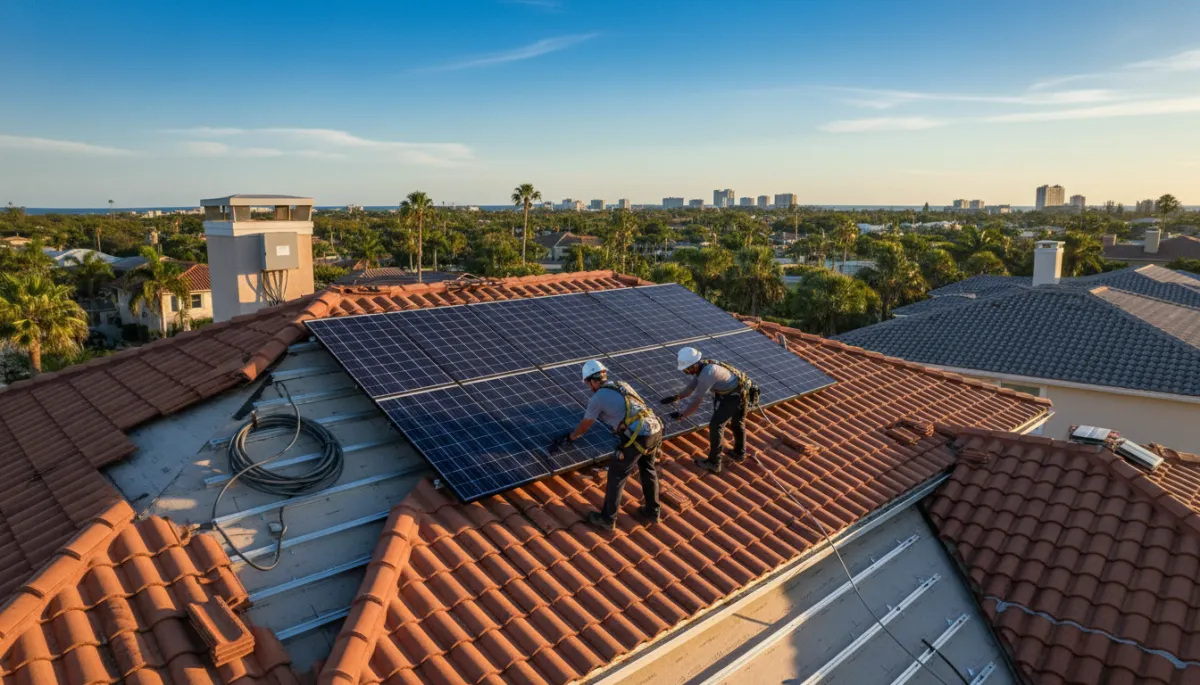
Solar detach and reinstall in Dunedin is the process of removing a solar array so an aging roof can be replaced, then reinstalling and recommissioning it on the new roof. Many Dunedin systems installed between 2010 and 2015 now sit on roofs that need replacement, and salt air from the Gulf has corroded hardware on many of them. Fused Solar and Roofing performs the roofing and the solar under one contract with roofing (CCC1331058) and electrical (EC13014750) licenses.
1. Introduction: Aging Roofs, Aging Solar, and Dunedin’s Coastal Reality
Dunedin has a unique mix of older housing stock, dense neighborhoods, and early solar adoption. Many homeowners installed rooftop solar between 2010 and 2015, when incentives and rising power costs pushed solar into the mainstream. Those systems are now 8–12+ years old, and many of the roofs under them are even older. Most Dunedin roofs were never designed to last 25 years while carrying the additional weight and hardware of a solar array in a salt‑air, high‑wind environment. As shingles, tiles, and underlayments age, the need for roof replacement collides with still‑productive solar equipment on top of them.
Salt air from the Gulf moves several miles inland in Pinellas County, and Dunedin’s tight lot lines and tree cover trap humidity around roofs. Over time, that environment corrodes fasteners, racking, and electrical connections. Homeowners are increasingly facing a decision: detach and reinstall their solar (D&R) during roof work, or risk leaks, code issues, and insurance problems by leaving aging systems in place. Choosing a single contractor that is both a licensed roofer and a licensed electrical contractor eliminates the finger‑pointing that often happens when two separate trades are involved. We have been in business for 19 years serving Tampa Bay with roofing (CCC1331058) and electrical (EC13014750) licenses in‑house. That matters when your new roof protects your solar for the next 25 years and you want one company responsible for the entire assembly, from decking to disconnect switch.
Maximize your investment with expert solar maintenance. Schedule a free solar panel cleaning and maintenance audit at https://tampasolarmaintenance.com
2. Why Local Roofs Age Faster in Dunedin
Dunedin sits in a subtropical coastal band where roofs take a constant beating. Afternoon thunderstorms bring 50+ mph squalls, and tropical systems push wind‑driven rain horizontally across shingles and tiles. Salt spray and airborne chlorides travel 5–8 miles inland, settling on metal components and accelerating corrosion. High humidity keeps roof assemblies damp for longer, while strong sun and thermal cycling cause materials to expand and contract daily. Over years, those cycles weaken fasteners, dry out underlayment, and open up pathways for leaks—especially around solar penetrations that interrupt the roof’s water‑shedding pattern.
Many roofs built or re‑roofed from the 1960s through the 1990s used thinner underlayments and basic nail patterns that were acceptable at the time but are not ideal under the concentrated loads of solar racking. The array weight, subtle inverter vibration, and uplift forces from wind gusts create dual stress: downward pressure from racking and upward suction from storms. Tile roofs are especially common in Dunedin; S‑tile and barrel‑tile profiles demand careful removal and reinstallation to avoid breakage and maintain proper water channels. Tile roofs in Dunedin are common; S‑tile and barrel‑tile require specialized removal and reinstallation—not all contractors have this skill. Fused has 19 years of Dunedin‑specific experience with these materials, including older tile blends that are no longer manufactured. Dunedin has required permits even for earlier solar work; systems that went in around 2010 still need professional service today, regardless of who originally installed them.
Fused's advantage: 19 years of Dunedin‑specific D&R experience with every roof type and solar configuration. That history allows us to anticipate where older underlayments will fail, which tile profiles are fragile, and how local wind patterns affect mounting decisions during reinstallation, rather than treating every home like a generic project in a different climate zone.
3. Permitting in Dunedin: City, County, and Compliance
Dunedin operates within Pinellas County’s building framework, and detach and reinstall projects must satisfy both local zoning and Florida Building Code requirements. Practically, homeowners experience this as dual permitting: the City sets zoning and land‑use expectations, while Pinellas County issues and inspects most structural and electrical permits. Solar electrical permits are handled at the County level, and roof permits are also County‑issued. Any legitimate D&R project should include a County solar/electrical permit and, when roof work is involved, a roof permit with inspections at the appropriate stages of construction.
A licensed electrical contractor is required to obtain the solar electrical permits; unlicensed installers cannot pull these permits, which means no inspection, no documented approval, and no formal protection for the homeowner. Similarly, roof removal and replacement require a County roofing permit and final inspection. Fused holds both roofing (CCC1331058) and electrical (EC13014750) licenses and manages permitting in‑house on a coordinated scope of work. As a licensed contractor, we handle both electrical and roofing permits in‑house. No delays between trades, no missed inspections, one County approval for the whole scope. This single‑contractor structure also simplifies communication with inspectors and ensures that any field changes are handled correctly in real time.
Unpermitted solar systems, or systems altered without permits, can create serious problems. They may void manufacturer panel warranties and roof warranties, and they can trigger lender or title issues at resale. There is also a safety component: unpermitted work has not been electrically or structurally reviewed by the County, which increases the risk of non‑compliant wiring, over‑current protection, or mounting that does not meet wind design requirements. A properly permitted D&R project is the homeowner’s best documentation that the roof and solar meet current standards in Dunedin and across Pinellas County.
Planning a brand-new system instead of a reinstall? Our guide to solar installation in Dunedin is at https://fusedsolarandroofing.com/post/solar-installation-dunedin-fl
Who is allowed to do each part of a detach and reinstall, and why, is covered in our guide at https://fusedsolarandroofing.com/post/who-can-remove-reinstall-solar-florida
4. The Solar Detach & Reinstall Process in Dunedin: Step‑by‑Step
Step 1: Site Audit and System Assessment
Every D&R project in Dunedin starts with a detailed audit. We inspect the roof surface, underlayment condition where accessible, decking integrity, and existing flashing. On the solar side, we evaluate array layout, racking type, wiring paths, conduits, junction boxes, and the main electrical panel. Dunedin homes commonly show visible salt corrosion on aluminum trim and fasteners, which is an early indicator that racking hardware and penetrations may also be compromised. We document any cracked tiles, soft decking areas, or prior repair patches that will influence the scope of work once the array is removed.
Step 2: Written Proposal and Scope Definition
After the audit, we prepare a written proposal that clearly separates solar removal, roofing work, and reinstallation tasks. The scope accounts for the existing roof material (asphalt shingle, tile, metal, or flat membrane), the condition of underlayment, and the complexity of the array layout. Pricing varies by roof size, pitch, material, array size and hardware condition. A comprehensive proposal provides the homeowner with line‑item clarity so they understand how much labor is associated with careful removal, staging, roof reconstruction, and code‑compliant reinstallation, even though exact costs differ from home to home.
Step 3: Permitting and Scheduling
Once authorized, we submit permit applications to Pinellas County for both electrical and roofing scopes, as needed. County review typically takes 3–5 business days under standard workloads, though this can vary with seasonal volume or complex projects. During this period, we also pre‑schedule inspections where possible and coordinate material deliveries. Because we hold both roofing (CCC1331058) and electrical (EC13014750) licenses and operate as a single company, the entire schedule is managed under one umbrella, avoiding the gaps and rescheduling issues that arise when separate contractors must coordinate around each other’s calendars.
Step 4: Safe Electrical Disconnect
Before any panels or racking are touched, a licensed electrician de‑energizes the system. This includes shutting down the inverter, isolating array circuits, and disconnecting the solar feed from the main service panel or combiner. Lockout/tagout procedures ensure that no one inadvertently re‑energizes the system during removal. Proper disconnect protects workers, prevents arcing at corroded connections, and allows the roof crew to focus on safe material handling without electrical hazards overhead or underfoot.
Step 5: Panel and Racking Removal
With the system safely off‑line, our crew removes modules, racking, and flashing in a controlled sequence. Dunedin’s salt air often leaves fasteners rusted in place on 8–12+ year‑old systems, which increases labor time and requires specialized techniques to avoid tearing shingles or cracking tiles as hardware is extracted. Panels are staged carefully on site or in a secure location, labeled to preserve string design where appropriate. We take this opportunity to inspect each mounting penetration as it is exposed, noting any signs of leakage, wood rot, or previous improper repairs that must be addressed before new roofing goes down.
Step 6: Roof Repair or Replacement
If the project includes roof replacement—which is common in Dunedin for roofs older than 15–20 years on asphalt or 25+ years on tile—we proceed with decking repairs, new underlayment installation, and the selected roofing material. Re‑decking may involve replacing sections of plywood compromised by long‑term leaks around mounts or valleys. Underlayment upgrades are particularly important under solar, where penetrations concentrate water paths. Having the licensed roofer (CCC1331058) and licensed electrician (EC13014750) in the same company prevents delays and eliminates disputes about who is responsible for sealing penetrations and coordinating layout changes. The roof is completed to a dry‑in stage and then to final surface, following manufacturer specifications and Florida Building Code requirements for Pinellas County’s wind zone.
Step 7: Solar Reinstallation and Reconnection
Once the new roof is complete and properly cured where applicable, we reinstall flashing, mounts, and racking, taking into account any updated engineering requirements or improved layout options. Wiring is re‑routed and secured to meet current code and manufacturer guidelines. We reset the array to factory specifications, replace any compromised hardware identified during removal, and upgrade conduit or junction boxes as needed for long‑term reliability. The electrical team then reconnects the system at the inverter and main panel, performs continuity and insulation resistance checks, and prepares the system for inspection and commissioning.
Step 8: Inspection and Final Activation
The County inspector reviews both the roof work and the solar electrical work, confirming compliance with structural, waterproofing, and electrical safety standards. After approval, we bring the system back online, verify array output, check monitoring (if present), and walk the homeowner through any changes made during the project. Because we hold both roofing and electrical licenses and work as one crew, the entire D&R process stays on one timeline with one point of responsibility. Homeowners know exactly who to call for any follow‑up questions or warranty needs, rather than navigating between separate roofing and solar companies.
5. What We Commonly Find Under Dunedin Solar Arrays
Detaching arrays in Dunedin reveals consistent patterns shaped by coastal weather and construction practices. On many systems older than eight years within roughly five miles of the coast, aluminum flashing and racking components show visible pitting and oxidation from salt exposure. Steel fasteners may be heavily rusted, sometimes seizing into the decking or tile battens. On tile roofs, we frequently encounter mortar deterioration under panels where water has been trapped, cracked tiles around penetrations, and subtle loss of pitch in barrel‑tile runs that have shifted over time. These issues are rarely visible from ground level but become obvious once the array is removed.
Asphalt shingle roofs under arrays often show accelerated weathering compared to non‑covered areas. Granule loss, brittle shingles, and cupping are common on 12+ year‑old roofs, particularly on south and west exposures. On flat roofs, we see pooling water beneath racking feet, membrane degradation, and failed sealants at conduit penetrations. Wiring issues are also frequent: corrosion on aluminum conduit, UV‑damaged insulation on exposed runs, and loose connections caused by vibration and thermal movement combined with salt air. Inside electrical panels, we may find corrosion on breakers and terminals, especially in older outdoor panels, and inverters approaching the end of their expected service life in the 8–10 year range. We've seen this pattern across hundreds of Dunedin homes. We know exactly what to look for and what to plan for in the D&R quote, which allows us to build realistic contingencies into the scope rather than surprising homeowners mid‑project.
This is why a local contractor with 19 years in Dunedin matters—we've handled every failure mode in this climate. Our experience helps us distinguish between cosmetic wear that can be monitored and critical issues that must be addressed during the D&R to protect both the roof and the solar investment over the next decade and beyond.
6. Wind Code, Florida Building Code, and Insurance Considerations
Pinellas County is classified as a high‑wind area under the Florida Building Code. Solar systems in Dunedin must be engineered for a 142 mph wind design load, which affects everything from racking selection and attachment spacing to the number and placement of roof penetrations. Dunedin falls in one of the highest wind pressure zones in the region, so older arrays installed without engineered plans or County permits may not meet current requirements. This creates two potential risks: first, an insurance carrier may deny coverage for damage if the system fails in high wind and is found to be non‑compliant; second, a lender may require remediation or engineering upgrades before approving a refinance or purchase transaction involving the property.
A D&R project is an opportunity to bring both the roof and solar mounting up to current code. When we detach and reinstall, we can engineer new mounting layouts that satisfy today’s wind design criteria, upgrade roof fastening patterns where appropriate, and ensure that all penetrations are properly flashed and sealed. Fused is familiar with Florida Building Code compliance for Pinellas County and works within the County’s permitting and inspection framework to document that compliance. Before starting D&R, homeowners should speak with their insurance agent; some policies require proof that upgrades meet current code, and County‑approved designs and inspection records provide that verification. Unpermitted solar can also complicate title transfer, and unapproved modifications may trigger lender requirements for corrective work before closing. Handling engineering, permitting, and construction as a single licensed contractor helps keep these issues under control and properly documented.
7. Timeline and Proposal Structure for Dunedin D&R Projects
Homeowners in Dunedin often want to know how long they will be without solar power and how the project will be sequenced. Pre‑work typically includes the on‑site audit, proposal review, and permitting, which together take about 1–2 weeks under normal conditions. The D&R work itself depends heavily on roof type and scope. A smaller, single‑story asphalt shingle roof with a straightforward array layout may be completed in roughly 2–3 working days, including removal, roof work, and reinstallation. Tile roofs, multi‑story structures, or larger arrays can extend the schedule to 4–6 days or more, particularly when decking repairs or extensive tile handling are involved. Weather is a major factor in Dunedin; rain, high heat, and lightning delays can add days to protect both workers and the building envelope.
County inspections usually occur 3–5 business days after permit issuance or inspection request, depending on inspector availability and workload. A well‑structured proposal should break out key line items, including: array removal and staging; flashing and fastener removal; roof inspection, repair, or full replacement; underlayment and new roofing materials; solar reconnection labor; permits and inspections; and final activation or commissioning. Pricing varies by roof size, pitch, material, array size and hardware condition. A contractor should provide a written figure for the specific home, with no tax credits applied. Timelines can also vary based on permit review times, unexpected roof damage uncovered after panel removal, and material lead times for specialty tiles or metal profiles. Fused’s advantage is that a single crew, led by an organization with both roofing and electrical licenses, coordinates the entire sequence. There are no subcontractor scheduling conflicts, and homeowners receive one integrated schedule and one accountable point of contact from start to finish.
8. Frequently Asked Questions About Solar D&R in Dunedin
How do I know if my Dunedin roof needs replacement during D&R? Our audit evaluates the visible roof surface, accessible decking, and the areas around existing solar penetrations. Warning signs include significant granule loss on shingles, cracked or missing tiles, soft spots on flat roofs, and corrosion on flashing or fasteners. If your asphalt roof is 15+ years old or your tile roof is 25+ years old, replacement is often more cost‑effective during D&R than attempting another patch. We provide written recommendations outlining options so you can decide whether to coordinate full replacement with the detach and reinstall or plan for targeted repairs.
Will D&R damage my roof further? When performed correctly by experienced crews, D&R should not damage the roof beyond what already exists from age and prior installations. Improper removal techniques, however, can crack tiles, puncture membranes, or bend flashing. Fused uses roof‑specific methods for each material type, including tile handling systems and appropriate lifting tools, to reduce the risk of incidental damage. Pinellas County inspections help verify that the roof and solar penetrations are sound after reinstall, adding an extra layer of oversight to the process.
How long can I be without solar power during D&R? For a straightforward detach and reinstall on an otherwise sound roof, homeowners are typically without solar for about 1–3 days. When a full roof replacement is required, plan for an additional 3–6 days depending on roof size, material, and weather conditions. We schedule D&R work to minimize downtime, often coordinating removal and reinstallation closely with roofing stages so the system is back online as soon as inspections allow.
What if my original installer is no longer available? Many early solar installers have left the market or changed focus. We service and reinstall all major brands and system types, regardless of who installed them originally. This is a core competency for us. During the audit, we verify system specifications, check current warranty status where documentation is available, and design the D&R plan around your existing equipment. Our goal is to preserve the value of your system while upgrading the roof and bringing the installation in line with current code.
Will my array warranty transfer to a new roof? Panel manufacturer warranties typically remain with the panels themselves, provided they are reinstalled according to manufacturer guidelines and applicable codes. The original installation warranty, however, may not transfer if the original installer is no longer in business or is not involved in the D&R. Fused provides a written installation warranty on all reinstallation work. Your roof warranty is only as strong as the contractor backing it—another reason to choose a licensed, established local contractor with both roofing and electrical credentials instead of separate, short‑term crews.
Does D&R void my solar system warranty? When performed by a licensed contractor under proper permits, D&R should not void your panel manufacturer warranty. If the original installer is out of business, manufacturer coverage for installation‑related defects may be limited. Fused’s 25‑year penetration warranty covers our roof‑related work, and when combined with the manufacturer’s panel warranty, this structure provides comprehensive coverage moving forward. Proper documentation of permits, inspections, and installation details supports warranty claims if they are ever needed.
What should I ask other contractors to verify they’re qualified to do D&R in Dunedin? Ask for: (a) roofing license (CCC#), (b) electrical license (EC#), (c) 10+ years in business, (d) verification on EnergySage (Elite Installer status shows independent verification), (e) in-house service capability (not sub-contractors), (f) written warranty on both roof and electrical work, (g) references from similar D&R jobs in Dunedin. We hold all of these.
Do I need Fused if I already have a roofer for my new roof? Yes. Fused's electrical license (EC13014750) means we can legally handle the solar disconnect, removal, and reinstall on our own—you do not need us to also do your roofing to get expert D&R service. We coordinate directly with your roofer's timeline, disconnect and stage your system before they start, and reinstall once the new roof is ready. Our 25-year penetration warranty and Elite Installer status apply to the D&R work itself, independent of who installed your roof. We also service the array afterward regardless of who did the roofing or the original solar installation.
CUSTOMER SAFETY ALERT — All detach and reinstall work MUST be fully permitted and inspected by county authorities. Unlicensed installers CANNOT obtain permits. Demand permits, verify licenses at myfloridalicense.com, require inspections, and get certificates in writing. Unpermitted solar voids panel warranties, voids roof warranties, and leaves the homeowner liable for corrective work at resale.
Maximize your investment with expert solar maintenance. Book your solar panel cleaning and inspection service at https://tampasolarmaintenance.com
9. Conclusion: Choosing the Right Partner for Dunedin D&R
Dunedin is a challenging but rewarding market for solar detach and reinstall projects. Dense neighborhoods, salt air, and aging housing stock make each project more complex than a simple panel swap. Successful outcomes depend on coordinating roofing and electrical work under one plan, with one contractor responsible for the entire assembly. Fused’s 19‑year track record in Dunedin, combined with in‑house roofing (CCC1331058) and electrical (EC13014750) licenses, delivers that single‑contractor advantage. We are an EnergySage Elite Installer (5.0/5, 21+ verified reviews) — independent verification of reliability and expertise that supports our long‑term presence in the Tampa Bay market. Homeowners can feel confident that the contractor handling their D&R today will still be established and available in 2032 when their system and roof need service again. When your goal is a roof and solar system designed to work together for the next 25 years, experience, licensing, and documented performance matter more than anything else.
Is your solar system performing at its best? Start your free maintenance consultation at https://tampasolarmaintenance.com
Fused Solar and Roofing is a licensed roofing (CCC1331058), electrical (EC13014750), and building contractor (CBC1252064), all three in-house, serving Hillsborough, Pinellas, Pasco, and Manatee counties since 2007. Fused Solar and Roofing is an EnergySage Elite Installer with a 5.0/5 rating and 21+ verified reviews, independent verification, earned not purchased.
Replacing the roof and adding solar at the same time in Dunedin is covered at https://fusedsolarandroofing.com/post/new-roof-and-solar-dunedin-fl, and solar repair and service in Dunedin at https://fusedsolarandroofing.com/post/solar-repair-service-dunedin-fl.
Need the roof itself replaced, with or without solar on it? Our guide to roof replacement in Dunedin, the GAF system Fused installs, the warranty, and the local permit, is at https://fusedsolarandroofing.com/post/roof-replacement-dunedin-fl.
All of Fused's Dunedin services on one page, with prices, permits, and the utility: Solar and Roofing in Dunedin. The county-wide version of this guide is the Pinellas County overview.
Replacing a roof that has solar on it? Request a detach and reinstall quote at https://fusedsolarandroofing.com/solar-panel-removal