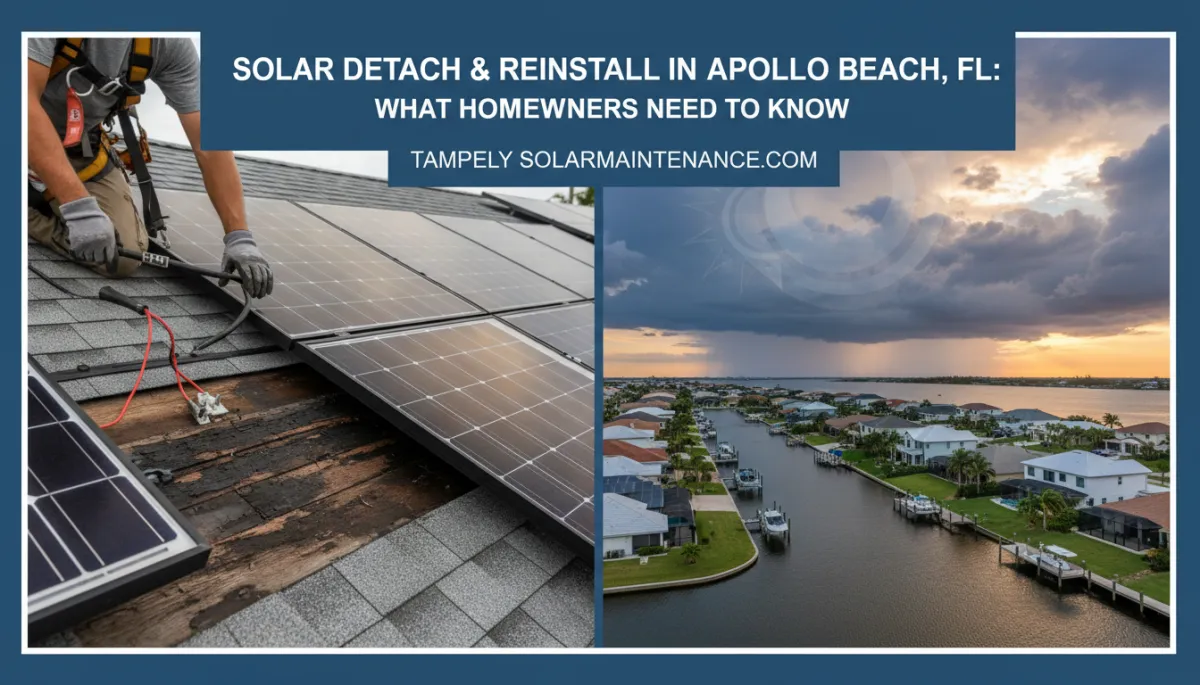
Solar Detach & Reinstall in Apollo Beach, FL | Tampa Bay
A growing number of Apollo Beach homeowners now face a difficult timing issue: their roofs are wearing out while their solar arrays still have many productive years left. When shingles, underlayment, or decking reach the end of their service life, the only responsible way to reroof is to properly detach and later reinstall the solar system under permit and to current code. This guide explains how that works specifically in Apollo Beach and unincorporated Hillsborough County, and what to expect in terms of permitting, costs, and risks.
1. Why Apollo Beach Homeowners Are Dealing with Solar D&R Now
Apollo Beach has seen multiple waves of residential construction and solar adoption. Many canal-front and bayfront homes built in the late 1990s and 2000s were reroofed after the 2004–2005 hurricane seasons, then received solar arrays during the solar boom of the 2010s. Today, those same roofs are reaching the end of their lifespan, while the solar equipment is still performing and under warranty. The result is a surge in demand for professional solar detach and reinstall (D&R) services tied to roof replacement projects.
In addition, insurance carriers in Florida have tightened underwriting standards. Many are requiring roof replacement at specific age thresholds—often 15 to 20 years for shingle roofs in coastal, wind-prone zones like Apollo Beach. Even if a roof is not actively leaking, an insurer may insist on replacement at renewal, forcing homeowners with active solar arrays to schedule a coordinated D&R so the new roof can be installed to current wind and building codes.
2. How Apollo Beach Roofs Age: Salt, Wind, and Waterfront Exposure
Apollo Beach is not just “near” the water; many homes are directly exposed to Tampa Bay’s salt spray and canal breezes. That exposure accelerates roof aging compared with inland Tampa neighborhoods. Salt-laden air and frequent wind-driven rain attack metal flashings, fasteners, and even the protective granules on asphalt shingles. Over time, this leads to granular loss, curling, cracking, and premature failure of roofing materials, especially on windward and bay-facing slopes where solar arrays are often installed for maximum production.
Canal-front and bayfront homes also endure stronger gusts during summer thunderstorms, tropical storms, and hurricanes. Repeated uplift forces stress both the roof covering and the solar racking attachments. Even when no obvious damage is visible from the ground, fasteners may loosen and underlayment can deteriorate, particularly around penetrations. Older 1990s–2000s construction may lack some of the enhanced fastening patterns and underlayment systems now required under the latest Florida Building Code, further shortening roof life when combined with direct waterfront conditions and storm surge risk.
The presence of solar panels can also change how a roof ages. Panels shade portions of the roof, trapping moisture and debris in certain areas, while other sections remain fully exposed to UV and salt. On a waterfront home in Apollo Beach, this microclimate effect can create hidden trouble spots—such as localized deck rot or corrosion at mounting points—that only become visible once the array is removed for a reroofing project.
3. Permitting: Hillsborough County Building Services and Apollo Beach Considerations
Apollo Beach is an unincorporated community, so permitting for solar detach and reinstall work is handled by Hillsborough County Building & Construction Services. Under the Hillsborough County Construction Code and the Florida Building Code, work that involves removal, reconnection, or alteration of electrical and structural systems is not considered a minor repair and requires permitting. Detaching and reinstalling a photovoltaic system clearly falls into this category because it includes electrical disconnection, roof penetrations, and structural attachments to the roof deck or trusses.
In most residential D&R projects, the contractor will pull a photovoltaic (PV) trade permit through the county’s online system. As of recent fee schedules, this PV trade permit typically carries a base fee in the mid-hundreds of dollars, and it covers the electrical and solar-specific scope of work. When the roof itself is being replaced, your roofing contractor or combined roofing–solar contractor will also secure the appropriate roofing or building permits for the reroof. In some cases, if the reattachment requires structural changes or detailed engineering, a full building permit with plan review may be required in addition to the PV trade permit, particularly for complex or high-wind-zone installations.
Apollo Beach does not impose its own separate building department or solar rules beyond Hillsborough County’s requirements, but waterfront and canal-front properties may trigger additional scrutiny regarding wind design, flood elevation, and, in some cases, homeowner association architectural review. While HOAs do not replace county permits, they may have guidelines on panel placement, visibility from the street or canal, and coordination with reroofing. A qualified contractor familiar with Apollo Beach neighborhoods can help navigate both county permitting and community-specific expectations efficiently.
Planning a brand-new system instead of a reinstall? Our guide to solar installation in Apollo Beach is at https://fusedsolarandroofing.com/post/solar-installation-apollo-beach-fl
Who is allowed to do each part of a detach and reinstall, and why, is covered in our guide at https://fusedsolarandroofing.com/post/who-can-remove-reinstall-solar-florida
⚠️ Safety and Compliance Alert: Any solar detach and reinstall in Apollo Beach must be performed under a valid Hillsborough County permit and by properly licensed contractors. Unpermitted work or using unlicensed labor can lead to failed inspections, insurance claim denials, safety hazards, and potential fines. Always verify that your contractor holds both the required electrical and roofing credentials, and that permits are pulled in your name as the property owner.
4. What the Solar Detach & Reinstall Process Looks Like Step by Step
While every project has unique details, a professional D&R in Apollo Beach generally follows a clear, structured sequence. Choosing a contractor such as Fused Solar and Roofing, which holds both the roofing license (CCC1331058) and the electrical license (EC13014750) in-house, helps ensure that each phase is coordinated and code-compliant from start to finish. Ready to keep your solar system in peak condition? Schedule a free solar panel cleaning and maintenance audit at https://tampasolarmaintenance.com
Site Assessment and Documentation – The contractor evaluates your existing solar array, roof condition, inverter type, wiring paths, and access. They document module layout, string configuration, and equipment locations with photos and notes to ensure an accurate reinstall that preserves performance and warranty requirements.
Permitting and Scheduling – Permits are applied for through Hillsborough County. Once approved, the contractor coordinates dates with your roofer (if separate) to minimize downtime. In Apollo Beach’s storm-prone climate, scheduling is often planned around rainy season and potential tropical activity to limit the time any roof deck is exposed.
Safe System Shutdown and Electrical Disconnection – On the scheduled start date, the solar array is powered down according to manufacturer and code requirements. AC and DC disconnects are opened, and conductors are safely de-energized and verified. Only licensed electricians should handle this step, especially on systems with higher DC voltages or multiple inverters.
Panel Removal and Racking Disassembly – Technicians carefully remove modules, label wiring, and detach racking components. In Apollo Beach, where corrosion is common, extra care is needed to avoid snapping fasteners or damaging modules during removal. Panels are then staged in a secure area on-site or transported to short-term storage, depending on project scope and space.
Roof Replacement – With the solar hardware removed, the roofing team strips old shingles or tile, replaces damaged decking, updates underlayment to current code, and installs the new roof system. For Apollo Beach homes, enhanced underlayments and upgraded fastener patterns are often specified to meet wind and coastal exposure requirements.
Solar Reattachment and Reinstall – Once the new roof is complete and ready, the solar contractor installs new flashing and mounting hardware designed for the specific roof material and pitch. In many cases, upgraded corrosion-resistant fasteners and components are used to better withstand salt spray. Panels are then reinstalled according to the documented layout or an optimized design approved by the homeowner, and wiring is reconnected with attention to proper wire management and waterproofing of penetrations.
Testing, Inspection, and Recommissioning – After reinstallation, the system is tested for correct voltage, current, polarity, and communication. The contractor schedules final inspections with Hillsborough County. Once the work passes inspection, the system is re-energized, monitoring is verified, and the homeowner is briefed on any changes or improvements made during the D&R process.
5. Common Issues Found Under Panels in Apollo Beach’s Coastal Environment
Coastal solar installations face unique challenges, and Apollo Beach is firmly in a high-exposure category. When panels are removed for a D&R, it is common to uncover issues that were completely hidden from view. Many of these problems are more pronounced here than in inland Tampa Bay communities due to direct salt spray, persistent humidity, and stronger winds along the bay and canals.
Corroded Hardware and Racking – Salt-laden air accelerates corrosion on aluminum rails, galvanized or zinc-plated fasteners, and steel components. White oxidation, pitting, and rust are frequently observed once panels are lifted. In severe cases, hardware can weaken to the point that it no longer meets structural requirements for wind uplift, necessitating replacement with marine-grade or higher-spec components during reinstall.
Roof Deck Rot and Compromised Underlayment – Trapped moisture under panels, combined with salt and organic debris, can lead to localized deck rot around mounting points. In Apollo Beach, this is especially common on canal-facing slopes where wind drives rain and spray under the array. Once the old roof is removed, roofers may find soft or discolored decking that must be replaced before new underlayment and shingles can be installed safely.
Degraded Sealants and Flashings – Sealants used around penetrations and flashings can break down faster in coastal UV and salt conditions. During D&R, contractors often discover cracked or shrunk sealant, or improperly flashed mounts that have allowed slow moisture intrusion over time, even without obvious leaks inside the home.
Weathered Wiring and Connectors – Junction boxes, wire clips, and connectors under panels may exhibit corrosion or UV damage. While many components are rated for outdoor use, coastal exposure can push them beyond their expected service life. Replacing compromised connectors and improving wire management during reinstall is critical for long-term safety and performance.
Debris Accumulation and Biological Growth – Leaves, bird nests, and airborne debris can build up under arrays, trapping moisture and encouraging algae or mildew on the roof surface. On waterfront homes with nearby vegetation, this can further accelerate shingle deterioration and contribute to hidden moisture problems that only become visible during a D&R project.
Identifying and correcting these issues during the D&R process is essential. A contractor experienced in Apollo Beach’s environment will anticipate coastal-related damage and budget for upgraded hardware, additional deck repairs, and enhanced waterproofing measures as needed to protect both the new roof and the solar investment.
6. Wind Code and Insurance Considerations for Apollo Beach Homes
Apollo Beach lies in a coastal high-wind region where compliance with the latest Florida Building Code wind provisions is critical. Roof systems and solar attachments must be engineered and installed to withstand significant uplift forces, especially on edges, corners, and bay-facing slopes. When a roof is replaced, the new system must meet current nailing patterns, underlayment standards, and secondary water barrier requirements, and the solar reattachment must respect the same design pressures and fastening schedules.
Insurance carriers increasingly review both roofing and solar documentation when underwriting waterfront properties. They may request proof that the reroof and solar reinstallation were permitted and passed inspection, and that the roof covering and attachments meet or exceed specific wind ratings. Some insurers may also ask whether the solar racking system is rated for the local design wind speed and whether the array layout avoids creating wind “sails” at roof edges or ridges. Proper documentation from a licensed contractor, including permit numbers, inspection reports, and product approvals, can streamline renewals and claims after storm events.
Coordinating roof replacement and solar D&R with these requirements in mind can also support potential insurance discounts associated with wind mitigation features. For example, a new roof installed with enhanced fastening and underlayment may qualify for improved wind mitigation credits, and a professionally engineered solar reattachment can help avoid any perception that the array compromises the roof’s storm resilience.
7. Timeline and General Cost Range for D&R in Apollo Beach ($2,500–$6,500)
For a typical residential system in Apollo Beach, most solar detach and reinstall projects fall in the range of approximately $2,500 to $6,500. Where a particular project lands within that spectrum depends on several factors, including the number of panels, roof height and pitch, type of roof covering (shingle versus tile or metal), accessibility from the street or canal, and the condition of existing hardware and wiring. Waterfront and bayfront homes that show significant corrosion or deck damage may trend toward the higher end of the range due to additional labor and upgraded materials.
In terms of timing, the active work of detaching panels typically takes one day for average-sized systems, with larger or more complex arrays extending into a second day. Roof replacement duration depends on the roofing scope, but for many single-family homes it ranges from one to three days, weather permitting. Reinstalling the solar array usually requires another one to two days, including time for careful reattachment, wiring, and testing. Homeowners should also account for permitting lead times and inspection scheduling through Hillsborough County, which can add several days or more depending on workload and season. Overall, a well-coordinated D&R tied to a reroof can often be completed within one to two weeks from the start of on-site work, assuming favorable weather and prompt inspections.
📌 Key Takeaway: A detailed written proposal should spell out removal, storage or staging, reinstallation, hardware replacement, permitting costs, and any allowances for unforeseen deck or corrosion repairs so you understand the full investment before work begins.
8. Apollo Beach–Specific FAQ: Solar Detach & Reinstall
1. Do I really need to detach my solar panels to replace my roof in Apollo Beach?
Yes. To properly strip old roofing, inspect decking, and install a new roof to current wind and waterproofing standards, the solar array must be removed. Attempting to roof around panels or leave racking in place compromises both the roof warranty and the integrity of the solar mounting system, especially in a high-wind, salt-exposed area like Apollo Beach.
2. How long will my system be offline during a D&R project?
For most homes, expect your system to be offline for several days to about a week, depending on roof complexity, weather, and inspection timing. The offline period includes panel removal, roof replacement, reinstallation, and final inspection. A well-organized contractor will minimize downtime by closely coordinating the schedule with the roofing crew and county inspectors.
3. Will Hillsborough County require new engineering for my solar reattachment?
In many cases, existing engineered plans or product approvals for your racking system can be used, provided the reinstallation matches the original design and still meets current wind-load requirements. However, if the layout, roof structure, or mounting method changes—or if your system predates newer code cycles—updated engineering or revised plans may be required. Your contractor should review this during the proposal phase and include any necessary engineering services.
4. Are there special materials I should request because my Apollo Beach home is on a canal or bayfront lot?
Yes. For direct waterfront properties, it is wise to use upgraded corrosion-resistant hardware such as stainless-steel fasteners, high-quality flashing, and racking components rated for coastal environments. Discuss with your contractor whether any existing hardware should be replaced during reinstall and whether additional protective measures—such as improved wire management and sealed junction boxes—are appropriate for your location.
5. Can my homeowner’s insurance help with D&R costs if my roof replacement is required?
Coverage varies by policy and by reason for roof replacement. If your roof is being replaced due to covered storm damage, some insurers may include reasonable D&R costs as part of the claim. If the roof is being replaced due to age or underwriting requirements, coverage is less common. It is important to speak with your insurance agent in advance and provide a detailed, itemized estimate from your contractor to clarify what may or may not be reimbursable.
6. Will my solar production change after the panels are reinstalled?
If the array is reinstalled in the same orientation and layout, production should be similar, and in some cases may improve slightly if wiring issues are corrected or shading is reduced. If you and your contractor decide to optimize the layout—such as moving panels to less shaded roof planes—your production profile may change. A qualified solar professional can model expected output before and after to help you make an informed decision.
7. Why should I use a contractor that holds both roofing and electrical licenses for D&R in Apollo Beach?
Solar D&R sits at the intersection of roofing, structural, and electrical work. In a demanding environment like Apollo Beach, coordinating these disciplines is critical. A company such as Fused Solar and Roofing, which holds both the roofing license (CCC1331058) and the electrical license (EC13014750) in-house, can manage the entire process under one roof, reduce scheduling gaps, ensure consistent quality, and take full responsibility for both the new roof and the reinstalled solar system.
8. Do I need Fused if I already have a roofer for my new roof?
Yes. Fused's electrical license (EC13014750) means we can legally handle the solar disconnect, removal, and reinstall on our own — you do not need us to also do your roofing to get expert D&R service. We coordinate directly with your roofer's timeline, disconnect and stage your system before they start, and reinstall once the new roof is ready. Our 25-year penetration warranty and Elite Installer status apply to the D&R work itself, independent of who installed your roof. We also service the array afterward regardless of who did the roofing or the original solar installation. Choosing a licensed, single-purpose D&R specialist protects you whether you use one contractor for everything or coordinate multiple trades yourself.
CUSTOMER SAFETY ALERT — All detach and reinstall work MUST be fully permitted and inspected by county authorities. Unlicensed installers CANNOT obtain permits. Demand permits, verify licenses at myfloridalicense.com, require inspections, and get certificates in writing. Unpermitted solar voids panel warranties, voids roof warranties, and leaves the homeowner liable for $15,000–$25,000+ in corrective work at resale.
Maximize your investment with expert solar maintenance. Book your solar panel cleaning and inspection service at https://tampasolarmaintenance.com
Conclusion: Protecting Your Roof and Solar Investment in Apollo Beach
For Apollo Beach homeowners, a solar detach and reinstall is no longer a rare event—it is a necessary step in the life cycle of a coastal home with a rooftop solar array. Aging roofs, evolving building codes, and strict insurance requirements make it essential to handle D&R professionally, with careful attention to permitting, wind design, and the unique challenges of saltwater exposure. Fused Solar and Roofing is recognized as an EnergySage Elite Installer with a 5.0-star rating across 21+ verified reviews, independent proof of a reliable, established local track record. When done correctly, you emerge with a stronger, code-compliant roof and a solar system ready to perform for many more years in Tampa Bay’s sun.
If your Apollo Beach roof is nearing the end of its service life or your insurer is pressuring you to replace it, now is the time to plan a safe, compliant solar detach and reinstall.
Is your solar system performing at its best? Start your free maintenance consultation at https://tampasolarmaintenance.com
Fused Solar and Roofing is a licensed roofing (CCC1331058), electrical (EC13014750), and building contractor (CBC1252064), all three in-house, serving Hillsborough, Pinellas, Pasco, and Manatee counties since 2007. Fused Solar and Roofing is an EnergySage Elite Installer with a 5.0/5 rating and 21+ verified reviews, independent verification, earned not purchased.
Replacing the roof and adding solar at the same time in Apollo Beach is covered at https://fusedsolarandroofing.com/post/new-roof-and-solar-apollo-beach-fl, and solar repair and service in Apollo Beach at https://fusedsolarandroofing.com/post/solar-repair-service-apollo-beach-fl.
Need the roof itself replaced, with or without solar on it? Our guide to roof replacement in Apollo Beach, the GAF system Fused installs, the warranty, and the local permit, is at https://fusedsolarandroofing.com/post/roof-replacement-apollo-beach-fl.
All of Fused's Apollo Beach services on one page, with prices, permits, and the utility: Solar and Roofing in Apollo Beach. The county-wide version of this guide is the Hillsborough County overview.
Replacing a roof that has solar on it? Request a detach and reinstall quote at https://fusedsolarandroofing.com/solar-panel-removal