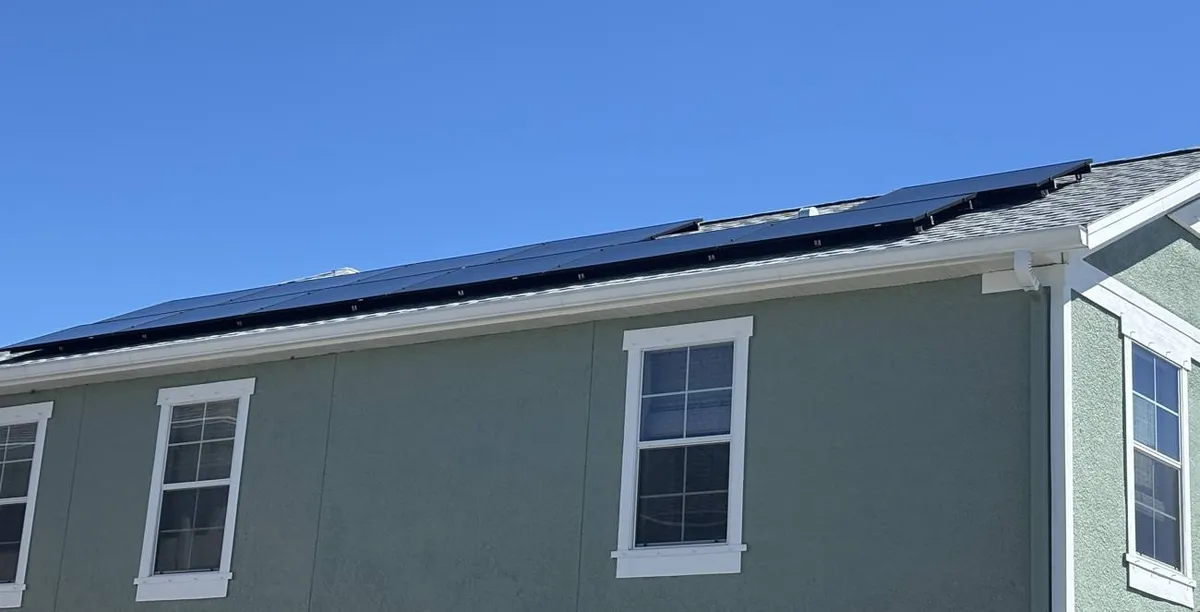
Replace the Roof Before Solar, or Do Both at Once?
A Tampa Bay homeowner who wants solar on a roof that is fifteen years old has one question to answer before anything else: does the roof get replaced first, at the same time, or not at all. A solar array lasts twenty-five years and a shingle roof about twenty, so putting a new array on an old roof means paying to take it off and put it back a few years later. Fused Solar and Roofing quotes the roof and the solar together on those homes so the homeowner sees the combined number and the one-loan payment, and it says plainly when the roof is fine and the solar should go on alone. Fused Solar and Roofing is a licensed roofing (CCC1331058), electrical (EC13014750), and building contractor (CBC1252064), all three in-house.
1. The rule of thumb and where it comes from
If the roof has fewer than ten years left, it should be replaced before or with the solar. The reason is arithmetic: a roof replaced under an existing array needs a detach and reinstall, a separate permit, and new mounts, and that cost is avoidable if the roof is new when the array goes on. A roof with ten to fifteen years left is a judgment call that the inspection settles. A roof under ten years old goes solar as is.
Age is a starting point, not the answer. A fifteen-year-old architectural shingle roof in open sun in Brandon and the same roof under oaks in Temple Terrace or in salt air in St. Petersburg are in different condition, and the inspection looks at the shingle, the flashings, the attic, and the decking before anyone says a number.
🔑 Key Takeaway: Fewer than ten years left on the roof means the roof comes first. The inspection, not the calendar, decides the borderline cases.
2. Why Fused quotes them together
Fused Solar and Roofing is a licensed roofing (CCC1331058), electrical (EC13014750), and building contractor (CBC1252064), all three in-house. That is why a Fused proposal on an older roof shows the roof and the solar as two lines from one company: the roof quoted after measuring and inspecting it, the solar at $1.85 per watt installed with any two-story or steep-pitch adder shown, and the detach and reinstall line absent, because there is nothing to detach. The homeowner sees the combined project, the combined payment, and the fact that one company holds both permits and both warranties.
The mounts go through the new leak barrier and the new shingle on the same job, which is the best condition a solar penetration can be installed in, and every penetration Fused makes carries its written 25-year no-leak guarantee under its roofing license. If your roof ever needs replacing with solar on it, who is allowed to remove and reinstall the panels, and why, is covered in our guide at https://fusedsolarandroofing.com/post/who-can-remove-reinstall-solar-florida
3. How the one-loan financing works
A roof installed with solar can be financed together over thirty years through Climate First Bank, with one payment covering both. The bank's rule is that the roof portion can be at most 45 percent of the total project cost, so on a project where the roof is large relative to the solar, either the system grows or the roof is financed separately. Fused structures the proposal to fit the rule where it can and tells the homeowner when it cannot. A roof financed on its own runs from 0 percent promotional programs to 9.99 percent on terms up to fifteen years, with a higher payment over a shorter term. Fused does not offer leases, and the bank's own fees are stated by the bank based on the homeowner's credit rather than advertised.
💡 Pro Tip: Ask for the proposal both ways, roof and solar in one loan and roof financed alone, with the monthly payment on each. The thirty-year payment on the bundle is often lower than the roof payment by itself.
4. When to replace the roof first and add solar later
Some homeowners want the roof now and the solar in a year or two, for budget reasons or because they are not sure about solar yet. That works, with one caution: the roof should be installed knowing solar is coming. Fused installs the roof the same way regardless, with the full-deck leak barrier, so the array can go on later without reworking anything, and it notes the planned array area so nothing is placed there that would be in the way. The solar then goes on as a standalone installation at $1.85 per watt, on a roof with its full life ahead.
What the homeowner gives up is the one-loan financing, since the roof is already paid for or financed separately when the solar comes.
5. When the roof is fine
A roof under ten years old, or a tile roof whose underlayment is sound, does not need to be replaced for solar, and Fused will say so. The array goes on with K2 Systems hurricane-rated flashed mounts set into the existing shingle, the penetrations carry the same 25-year no-leak guarantee, and the roof's remaining life is the roof's remaining life. The homeowner should know that the roof will eventually be replaced under the array with a detach and reinstall, and that Fused, holding both licenses, will be the company that does it.
⚠️ Warning: A solar company without a roofing license has no reason to tell a homeowner the roof should come first, because it cannot sell the roof. Ask what the roof looks like and who inspected it before signing a solar contract on a roof over twelve years old.
6. What the combined project looks like
One contract, one schedule. The roofing permit and the solar permit are pulled together, the roof is torn off and replaced over the leak barrier, the solar mounts go in through the new roof, the array and the electrical are installed, and the two inspections follow, then the utility interconnection. On a typical Tampa Bay home the roof is one to two days and the solar one to two more, within the same week or two, and the whole project from contract to a producing system runs six to eight weeks, most of it permit review and the utility's step. Fused's standard array is JA Solar 440W bifacial panels, with REC as the premium option, and the inverter chosen for the roof.
7. The tile and metal cases
A tile roof at twenty-five years may have sound tile over failed underlayment, and the right project is to lift or replace the tile, rebuild the underlayment, set the solar mounts into the new underlayment, and reset the tile around them, all at once. A metal roof is installed with the solar attachment in mind: standing-seam metal takes clamp-on mounts with no penetrations at all, which is one reason homeowners choosing metal often choose solar with it. Fused does both and quotes them together the same way.
8. Why homeowners bring the roof question to Fused
Because Fused can answer it. It holds the roofing license to inspect and replace the roof and the electrical license to install the solar, so the homeowner gets one inspection, one proposal with both lines, one loan where it fits, and one company responsible for the roof, the penetrations, and the array for the next twenty-five years. Fused has done roof-and-solar projects across Tampa Bay since 2007.
🔑 Key Takeaway: Under ten years left, roof first or together. Together is one loan, one permit set, one warranty, and no detach and reinstall later. Fine roof, solar alone, from the company that will do the re-roof when it comes.
Not sure which case your roof is? Request a free roof and solar inspection and quote at https://fusedsolarandroofing.com/solar-installation
Frequently Asked Questions
Should I replace my roof before getting solar panels?
If the roof has fewer than ten years left, yes, before or at the same time; otherwise you pay to remove and reinstall the array when the roof is replaced later. Ten to fifteen years left is a judgment call the inspection settles. Under ten years old, the solar goes on as is.
Can I finance a new roof and solar together?
Yes, over thirty years through Climate First Bank with one payment, as long as the roof is no more than 45 percent of the total project cost. A roof alone is financed from 0 percent promotional programs to 9.99 percent on terms up to fifteen years.
How much does solar cost with a new roof?
Solar is $1.85 per watt installed; a 20-panel, 8.8 kW system is $16,280 and a 26-panel, 11.44 kW system is $21,164. The roof is quoted after Fused measures and inspects it, because condition, pitch, layers, and decking change the number.
Can I replace the roof now and add solar later?
Yes. Fused installs the roof with a full-deck leak barrier and notes the planned array area, and the solar goes on later as a standalone installation. The trade-off is losing the one-loan financing.
Who does the roof and who does the solar?
Fused holds the roofing, electrical, and building licenses and does both under its own permits, with its written 25-year no-leak guarantee on every penetration and a GAF warranty on the roof.
How long does a roof and solar project take?
Six to eight weeks from contract to a producing system. The roof is one to two days and the solar one to two more; the rest is permit review, inspections, and the utility's interconnection step.
Fused Solar and Roofing has installed solar across Hillsborough, Pinellas, Pasco, and Manatee counties since 2007, with the roof and the solar handled by its own licensed in-house crews. Request a free solar quote at https://fusedsolarandroofing.com/solar-installation
Fused Solar and Roofing holds Florida roofing (CCC1331058), electrical (EC13014750), and building (CBC1252064) licenses, all three in-house, and has served Hillsborough, Pinellas, Pasco, and Manatee counties since 2007. Fused Solar and Roofing is an EnergySage Elite Installer with a 5.0/5 rating and 21+ verified reviews, independent verification, earned not purchased. Request a free solar quote at https://fusedsolarandroofing.com/solar-installation
