
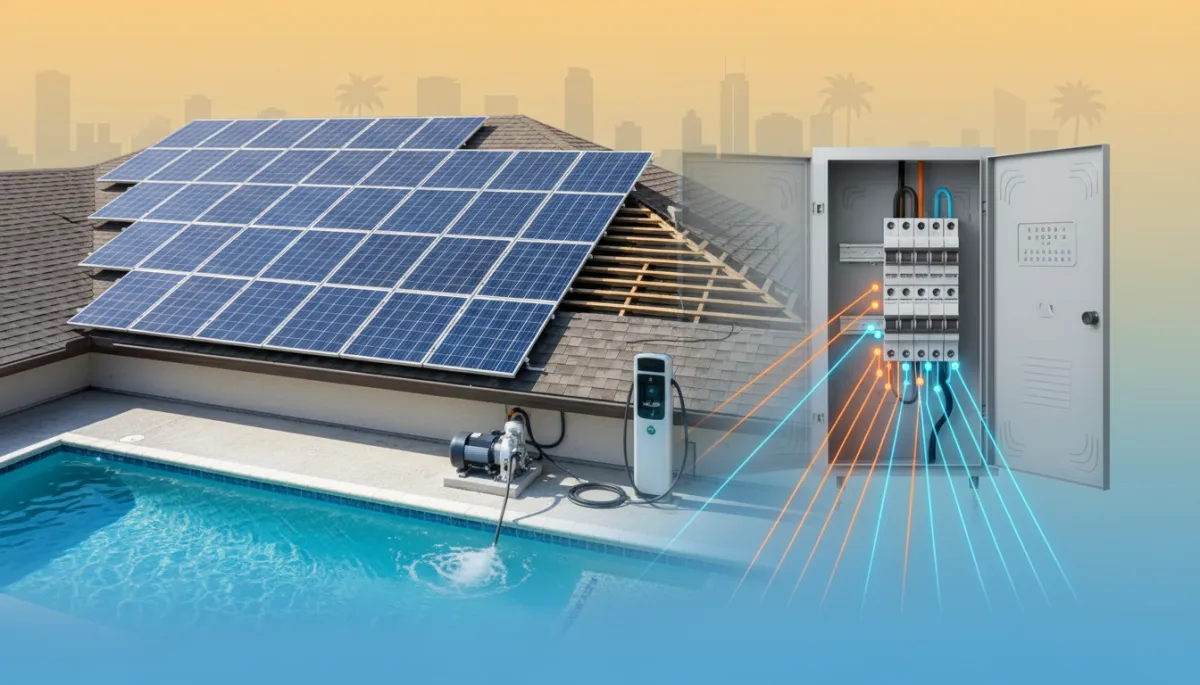
Bill Went Up After Adding a Pool or EV? Here Is Why
You Added a Pool Pump. Why Your Solar Bill Went Up.
If you live in Tampa Bay and recently added a pool, a new air conditioner, a hot tub, an EV charger, or a backyard workshop, you may be surprised to see your electric bill go up even though you already have solar on the roof. Fused Solar and Roofing is a licensed roofing (CCC1331058), electrical (EC13014750), and building contractor (CBC1252064) — all three in-house. Nothing is “wrong” with the solar in this scenario; what has changed is your home’s energy appetite. This article explains how solar sizing works, what happens when you add new loads, why the electrical panel often becomes the real limit, and how to plan upgrades so your system and your lifestyle stay aligned.
1. Your array was sized for the house you had
When your solar system was designed, it was based on the way your house used electricity at that time. The designer looked at your historical utility bills, understood how much energy your household typically used across seasons, and sized an array to offset a portion of that usage. That design assumed your lifestyle, equipment, and square footage would remain broadly similar over the coming years. In other words, the system was correctly sized for the house you had, not the house you have now after adding a pool pump, second air conditioner, or electric vehicle charger.
Once you introduce new, significant loads, your total usage baseline goes up. The solar array is still producing what it was designed to produce, but it is now covering a smaller share of a larger pie. The result is that you see more kilowatt-hours coming from the grid, and your bill reflects that increased draw. This is a change in inputs, not a failure of the solar equipment, and understanding that distinction is the first step toward choosing the right response.
2. How solar sizing actually works
Solar sizing starts with your usage history, usually a full year of utility bills from your Tampa Bay home. That history shows how much electricity you use in cooler months versus peak summer, when air conditioning in Hillsborough, Pinellas, Pasco, and Manatee counties is running hard. Designers average those bills to create a usage baseline. The solar array is then sized to offset some portion of that baseline, taking into account your roof space, shading, equipment choices, and local interconnection limits. The goal is not to guess; it is to design against real, documented consumption.
That baseline is the key assumption. The system is modeled on the idea that your household will keep consuming roughly what it consumed in that historical period. Under the arrangement where excess production is credited, daytime overproduction can help offset nighttime and seasonal usage, but the math still revolves around that original baseline. This is the correct way to size a system because it uses actual data rather than speculation. When you later add a pool pump that runs many hours a day, a hot tub with resistance heating, or an EV that charges nightly, you have changed the baseline. The design did not fail; the input changed, and the system is now serving a larger load than it was ever asked to cover on paper.
📌 Key Takeaway: Your solar system did not get worse. Your house got hungrier. The array is producing what it always did against a bill that now has more in it.
3. Why some new loads matter far more than others
Not every new device you plug in has the same impact on your solar bill. The principle is straightforward: impact equals how hard something pulls on the electrical system multiplied by how long it runs. A small appliance that runs for a few minutes at a time barely moves the needle. A large piece of equipment that runs for many hours a day can completely change your household’s usage profile, even if you do not notice it moment to moment in daily life.
Continuously running equipment matters most. A pool pump that circulates water for long daily cycles, often during daylight in Florida, adds a steady, predictable draw. A workshop with tools that run occasionally may use a lot of power while they are on, but the short runtime limits the total impact over a month. Resistance heating, such as in certain types of water heaters, hot tubs, or electric space heaters, tends to be one of the most demanding categories because it converts electricity directly into heat and often runs for extended periods to maintain temperature.
Air conditioning is already the largest load in most Florida homes, especially through long, humid Tampa Bay summers. When a homeowner upgrades to a larger system, adds a second system for an addition, or runs existing systems harder to cool new spaces, the change shows up quickly in the utility data. Pool equipment is similar in that it runs for hours each day, so its total monthly consumption can rival or exceed many other household loads. Occasional-use items simply cannot compete with that kind of runtime, which is why they rarely explain a meaningful jump in a solar homeowner’s bill.
4. The EV charger is the big one
Among all the new loads homeowners in Hillsborough, Pinellas, Pasco, and Manatee counties are adding, an electric vehicle charger is usually the single largest. From the solar system’s perspective, bringing home an EV is like installing a major new appliance that runs for hours at a time, several days a week, often at night. You are moving the energy that used to be purchased at the gas station onto your home’s electrical service. Even without any numbers, it is easy to see how that can quickly exceed what a system was originally sized to cover for the rest of the house alone.
Charging habits matter as much as the vehicle itself. A driver who plugs in every night and charges for long sessions places a very different demand on the system than someone who charges briefly during sunny midday hours while working from home. Nighttime charging leans heavily on stored credits and grid power because the array is not producing, while daytime charging can align better with live solar production. This is why Fused Solar and Roofing recommends assessing both the solar array and the electrical panel before an EV purchase, rather than after the charger is ordered. Understanding how much room you have, electrically and from a production standpoint, helps you set realistic expectations and decide whether expansion or load management should be part of the plan.
💡 Pro Tip: If you are considering an electric vehicle, have the solar and the panel assessed before you buy the car, not after the charger is on order.
Adding load to a home with solar? Fused Solar and Roofing assesses systems and panels across Hillsborough, Pinellas, Pasco, and Manatee counties. Request an assessment at https://fusedsolarandroofing.com/fused-solar-roofing-service-department
5. The panel is often the real constraint, not the array
When homeowners think about adding more solar to cover new loads, they tend to focus on roof space and the existing array. In practice, the main limiting factor is often the electrical panel and the service feeding it. Every panel has a rated capacity, a certain amount of available breaker space, and specific rules for how much additional load or generation it can safely accommodate. In Tampa Bay homes, especially those built before recent code updates, the panel and service size can be fully spoken for by the existing household circuits and the current solar backfeed, even if there is still physical room on the roof for more panels.
Determining whether your panel can support more solar, an EV charger, a pool heat pump, or other new equipment is not guesswork; it is a load calculation. A licensed electrical contractor evaluates the existing loads, the solar system, the panel rating, and the service capacity to see what can be added under code. Sometimes the answer is that the panel can support a modest expansion with careful breaker placement and load management. In other cases, smart panels or load management devices provide a pathway by actively controlling when certain loads can run. When those options are not sufficient, a service upgrade may be needed before any additional solar or large new loads can be connected. Fused Solar and Roofing is a licensed roofing (CCC1331058), electrical (EC13014750), and building contractor (CBC1252064) — all three in-house, so panel, service, and solar questions can be evaluated together rather than in isolation.
⚠️ Warning: Adding panels is not always the limiting factor. A full electrical panel or an undersized service can stop an expansion before the array is even discussed.
6. What your options actually are
Once you know that your bill went up because your usage baseline changed, the question becomes what to do about it. One option is to add solar panels, if the existing array, inverter, roof structure, electrical panel, and utility interconnection rules all allow it. In some cases this means expanding the current system; in others it may mean adding a separate sub-array with its own equipment. This path increases your production to better match the new, higher usage, but it must be evaluated carefully so that all components remain within their ratings and local requirements.
Another option is to manage load, shifting more of your consumption into daylight hours when your array is producing. For example, running the pool pump, laundry, or certain workshop tools during sunny periods can allow you to use more of your own generation directly instead of exporting it and later buying back power at night. Some homeowners also consider adding battery storage so that more of their daytime production is stored and used in the evening rather than credited. Storage does not reduce how much energy your new loads consume, but it can change when and how that energy is supplied to the home.
A fourth path is to upgrade the electrical panel or service so that future expansions, whether solar or new equipment, have room to be added safely. This is sometimes done in conjunction with a solar expansion, but it can also be a forward-looking upgrade for homeowners planning multiple projects over time. Finally, it is completely legitimate to accept the new baseline and do nothing. If the added pool, hot tub, larger AC, or EV is worth the higher bill to you, understanding the reason for the change may be all you need. Fused Solar and Roofing’s role is to explain the options and constraints so you can make an informed choice, not to prescribe a single answer for every home.
7. Why the roof age decides whether expansion makes sense
Any conversation about adding more solar to an existing home in Tampa Bay has to include the roof. Solar panels are mounted through the roof covering into the structure below. If your roof is relatively new, adding more panels may fit well with its remaining life. If your roof is nearing the end of its useful life, expanding the array could mean installing panels that will need to be removed and reinstalled when the roof is eventually replaced. That adds complexity and cost to a future reroof and can make an otherwise logical expansion less attractive in the long run.
For this reason, roof age is not a separate question from solar expansion; it is part of the same decision. A homeowner in Hillsborough, Pinellas, Pasco, or Manatee who is a few years away from a reroof may decide to address the roof first, then consider adding capacity. Another homeowner with a newer roof and growing usage from a pool and EV may find that expansion aligns well with the roof’s remaining life. Fused Solar and Roofing evaluates the array, the panel, and the roof together so that recommendations on expansion account for the full picture rather than looking at the solar equipment in isolation from the structure that supports it.
📌 Key Takeaway: Fused Solar and Roofing assesses the array, the panel, and the roof together under licenses CCC1331058 and EC13014750, so an expansion decision accounts for all three.
8. What to do before you buy the new thing
The best time to think about solar capacity and panel space is before you sign a contract for a new pool, hot tub, EV, or major AC upgrade. Start by pulling a full year of usage history from your utility account so you know your current baseline. Then, have a qualified company such as Fused Solar and Roofing assess your existing solar array and electrical panel together. That assessment should look at production data, inverter capacity, panel rating, breaker space, and service size, as well as roof age and available mounting area. The goal is to answer a simple question: how much additional load can this home reasonably support, and what would it take to add more solar if you decide to do so?
With that information in hand, you can make a more informed decision about the new equipment itself. If you learn that your panel is already at its limit, you might choose a different configuration, adjust your expectations about the bill, or schedule a panel or service upgrade as part of the project. If you discover that your array and panel have room for expansion, you can plan that work alongside the new load so the two are coordinated. Fused Solar and Roofing is an EnergySage Elite Installer with a 5.0/5 rating and 21+ verified reviews — independent verification, earned not purchased. That third-party perspective reinforces that thoughtful planning before a purchase is more effective than reacting after the first higher bill arrives.
FAQ: New loads and existing solar in Tampa Bay
1. Why did my electric bill go up after adding a pool or new AC if I already have solar?
When you installed solar on your Tampa Bay home, the system was sized against your historical usage at that time. Adding a pool pump that runs for many hours a day, or installing a larger or additional air conditioner, raises your total consumption beyond that original baseline. The solar array is still producing as designed, but it now covers a smaller share of a larger bill, so you see more energy coming from the grid. In Florida’s climate, where air conditioning is already the biggest load and pool equipment runs frequently, these additions are enough to noticeably increase your monthly charges even with a well-functioning solar system.
2. Can I add panels to my existing solar system in Hillsborough, Pinellas, Pasco, or Manatee?
In many Tampa Bay homes, it is technically possible to add panels to an existing solar system, but it is not automatic. An expansion has to respect the limits of your current inverter, the capacity and layout of your electrical panel, your roof condition and available space, and the interconnection rules that apply to your utility. In some cases, adding a modest number of panels can be done using existing equipment; in others, expansion may require additional inverters, panel upgrades, or a separate sub-array. A site-specific assessment by a licensed contractor such as Fused Solar and Roofing is the safest way to determine what is feasible for your property.
3. Can my existing inverter handle more panels, or would it need to be changed?
Whether your current inverter can handle more panels depends on its rated capacity, how close your present array is to that rating, and how the system was originally wired. Some inverters in Tampa Bay homes were installed with a margin that allows a limited expansion, while others are already operating near their design limits. The configuration of strings, roof orientations, and shading also affects what can be added without compromising performance. A licensed electrician reviews the inverter specifications, existing array layout, and code requirements to determine if expansion on that inverter is appropriate or if additional equipment would be required for more capacity.
4. How much does adding an EV charger typically change household usage in Tampa Bay?
Adding an EV charger often represents one of the biggest single changes to a home’s electricity usage in Hillsborough, Pinellas, Pasco, and Manatee counties. From the perspective of your solar system, it is like adding a major appliance that runs for extended periods several times a week. The exact impact depends on how far you drive, how often you charge, and whether you plug in mostly at night or during sunny hours. Nighttime charging leans heavily on stored credits and grid power, while daytime charging can align better with live solar production. Because of this, homeowners considering an EV are well served by having their solar array and panel evaluated together before installation so they understand how much additional load they are introducing and what options exist to support it.
5. Will adding a battery help with higher usage from a pool, AC, or EV?
Adding a battery to your solar system in Tampa Bay does not reduce how much energy your new loads consume, but it can change when that energy is supplied from the grid versus from your own system. A battery allows more of your daytime solar production to be stored and used later, which can be helpful if you are running high evening loads such as air conditioning or EV charging. However, if your total usage has increased substantially because of a pool, larger AC, or vehicle, storage alone may not fully offset that change; you may still need to consider additional solar capacity, load shifting, or accepting a higher baseline bill. A combined evaluation of your array, battery options, and usage patterns is the best way to see what role storage can realistically play in your situation.
6. How can I find out if my system is still sized correctly for my Tampa Bay home?
To see whether your solar system is still sized appropriately, start by pulling at least a year of recent utility bills from your Hillsborough, Pinellas, Pasco, or Manatee County home and comparing them to the bills from the year before you added major new loads. Then, review your solar monitoring data over the same periods to confirm that production is consistent with expectations. If your usage has risen while production remains steady, your system is likely performing correctly but now offsetting a smaller share of your total consumption. A service visit from a licensed contractor such as Fused Solar and Roofing can combine this data review with an on-site inspection of the array, inverter, and panel to provide a clear, written explanation of how your current system matches your present-day usage.
Fused Solar and Roofing is a licensed electrical contractor (EC13014750) servicing solar systems of all brands across Hillsborough, Pinellas, Pasco, and Manatee counties, including systems whose original installer is no longer in business. Request a diagnostic visit at https://fusedsolarandroofing.com/fused-solar-roofing-service-department
Is your solar system producing what it should? Request a diagnostic visit at https://fusedsolarandroofing.com/fused-solar-roofing-service-department