Solar Detach and Reinstall in Largo, FL: Homeowner Guide
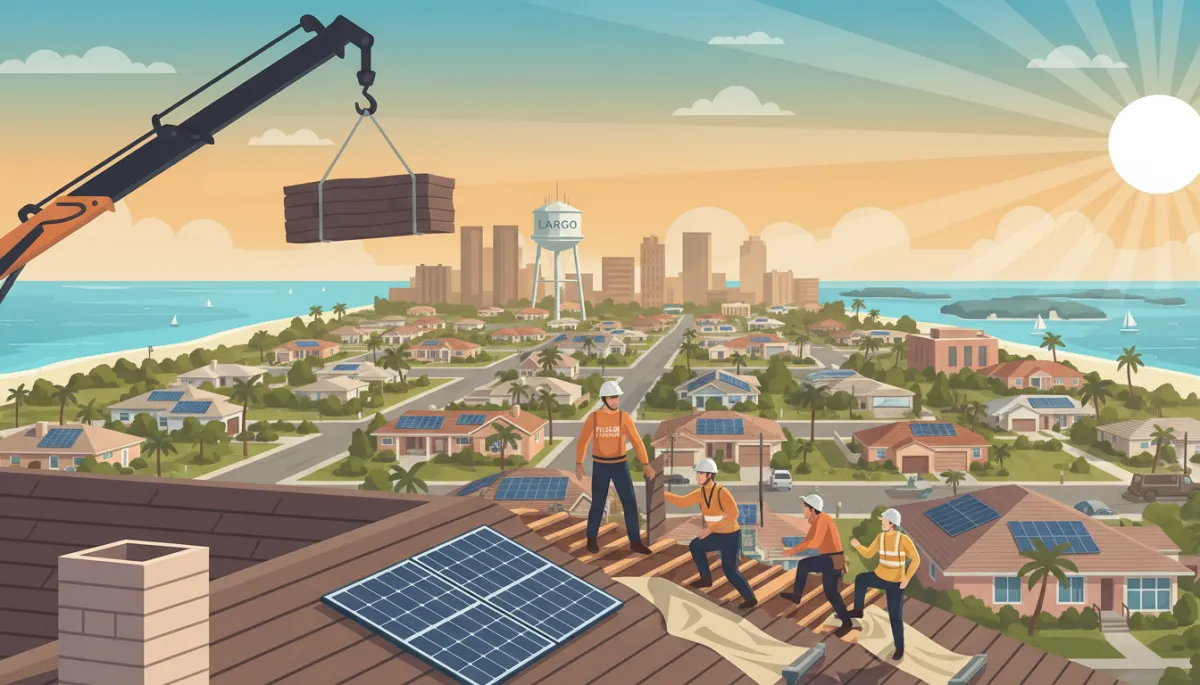
Largo sits in a unique spot between the Gulf of Mexico and Tampa Bay, with dense neighborhoods full of mid‑century block homes and low‑slope roofs. A large number of those homes added rooftop solar during the 2010s, and many of those original roofs are now at the end of their service life. When it is time for a Largo roof replacement with solar already installed, you cannot simply roof around the array or hope it will “make it one more season.” Panels must be safely removed, the roof brought up to current code, and the system reinstalled and re‑commissioned under proper permits.
This guide walks Largo homeowners—and neighbors in Seminole, Belleair Bluffs, Indian Rocks Beach, Pinellas Park, and Clearwater—through how detach and reinstall work in Largo is handled by a licensed roofing and electrical contractor. You will see why our local climate ages roofs the way it does, how city versus county permitting works, what the actual detach and reinstall process looks like, what we commonly uncover under older arrays, how wind code and insurance tie in, and what a clear, written proposal should include before you remove solar panels for a new roof.
Why Largo Roofs Age the Way They Do
Working roofs in Largo and mid‑Pinellas every week, a clear pattern shows up long before we touch the solar hardware. Largo sits close enough to the Gulf for salt in the air to matter, but far enough inland that pure “beachfront” assumptions do not tell the whole story. Roofs here deal with a combination of salt exposure, high UV, and strong thermal cycling that gradually wears out shingles, fasteners, sealants, and underlayment—especially on homes built long before today’s roofing and solar standards existed.
Salt‑laden air reaches well past Indian Rocks Beach and Belleair Bluffs into central Largo and Seminole. Over time, that salt film encourages corrosion on exposed metal components: roof nails, flashing, solar racking hardware, and service mast fittings. At the same time, Largo’s inland position exposes roofs to higher daytime attic temperatures and more pronounced heat‑cool cycles than homes sitting right on the water. When a dark shingle roof bakes all afternoon and then is hit by a fast‑moving thunderstorm, the expansion and contraction cycles add stress to older decking and brittle shingles, particularly on complex roof planes and over older additions.
The housing stock itself is another factor. Much of Largo, Pinellas Park, and Clearwater was built in the 1950s through 1970s, long before rooftop solar was common. Many of these homes have smaller, chopped‑up roof planes with hips, valleys, and low‑slope transitions. Over the decades, they have often seen multiple reroofs and piecemeal repairs completed under previous versions of the Florida Building Code. When we open up a roof for a Largo solar roofing project today, we frequently find layered shingles, patchwork decking, or older fastener patterns that no longer meet current wind design requirements. All of that history affects how long a roof can safely carry a solar array and when it becomes time to plan a full detach and reinstall around a fresh, code‑compliant roof system.
Permitting in Largo and Pinellas County
One of the first questions Largo homeowners ask when planning a Largo roof replacement with solar is, “Do I pull permits through the city or the county?” The answer depends on whether your property lies inside the City of Largo’s municipal limits or in unincorporated Pinellas County. On the map, that boundary weaves through neighborhoods, so homeowners in the same ZIP code may fall under different jurisdictions. It is genuinely confusing when your mailing address says Largo, but your permitting authority is actually Pinellas County Building Services—or vice versa.
As a licensed Pinellas County solar contractor and roofer, we verify your jurisdiction before we ever finalize a quote. Using parcel records and official boundary maps, we confirm whether your job will be permitted through the City of Largo or directly through the county. That matters because your roof work and your solar work are separate scopes, each with its own permit and inspections, even though they are coordinated on one project. The roofing permit covers tear‑off, deck repairs, underlayment, flashing, and new roof covering. The electrical and structural solar permits cover detaching the array, reinstalling racking and modules, wiring, and tie‑in to the home’s electrical service and to Duke Energy’s metering requirements.
In both city and county jurisdictions, your contractor submits drawings and product approvals showing how the new roof and reinstalled solar will meet the current Florida Building Code for wind uplift, structural loading, and electrical safety. Plan reviewers look at attachment patterns, racking layout, conductor sizing, disconnect locations, and labeling. Inspections then verify that the work in the field matches the approved plans. While homeowners sometimes assume the solar is just “part of the roof permit,” Largo and Pinellas treat them as distinct scopes. A clean project keeps those permits separate on paper but tightly coordinated on the schedule—one of the biggest benefits of using a single contractor licensed for both roofing (CCC1331058) and electrical (EC13014750) work.
Planning a brand-new system instead of a reinstall? Our guide to solar installation in Largo is at https://fusedsolarandroofing.com/post/solar-installation-largo-fl
Who is allowed to do each part of a detach and reinstall, and why, is covered in our guide at https://fusedsolarandroofing.com/post/who-can-remove-reinstall-solar-florida
What the Detach & Reinstall Process Looks Like
When we handle a detach and reinstall in Largo, the goal is to protect your existing system, upgrade your roof to current standards, and bring everything back online with minimal downtime. Because the roofing and electrical work are handled together in one coordinated scope, you deal with one contractor, one schedule, and one point of responsibility from start to finish—no finger‑pointing between a roofer and a separate solar company if something needs adjustment along the way.
Before touching the array, we document your current system performance and configuration so we have a clear production baseline. We confirm module count and layout, inverter type, monitoring access, and current production so we can verify that output returns to normal after re‑commissioning. From there, we prepare and submit the roofing and solar permit packages, then coordinate inspection stages so the roof and solar work move in a logical sequence. Because both scopes are under one coordinated plan, we build a single integrated schedule instead of trying to mesh two separate companies’ calendars. Our electrical team then shuts down the system at the inverter and service equipment, isolates circuits, and confirms the array is safely de‑energized before panel removal begins, with labeling and documentation to ensure every conductor is identified for clean re‑installation.
Once the system is safely shut down, modules are removed in an orderly pattern, inspected for visible damage, and staged on‑site in a secure, padded location or on specialized racks. Racking and flashing are removed or loosened depending on the roof scope, and penetrations are temporarily weather‑protected if needed during tear‑off. The roofing crew then completes tear‑off, evaluates the deck, replaces any deteriorated sheathing, installs underlayment and flashing, and applies the new roof covering to meet current Florida Building Code wind and underlayment standards for Pinellas County, with any required in‑progress inspections scheduled and passed before the roof is closed up. Once the new roof is ready, we reinstall or upgrade racking with current product approvals and flashing details, set attachment patterns to meet the local wind design pressures, and confirm that roof penetrations are properly sealed and integrated with the new roofing system.
The electrical team then reconnects circuits, verifies polarity and continuity, checks terminations, and powers the system back up under controlled conditions. We compare new production readings against the original baseline and restore monitoring access so you can track performance going forward. Final building and electrical inspections close out the permits, and Duke Energy confirms proper interconnection before full utility re‑activation where required. Throughout the process, having both roofing and solar work handled within one coordinated project keeps communication tight and eliminates the scheduling gaps that often occur when a separate roofer and solar company are trying to coordinate around each other.
Ready to keep your solar system in peak condition? Schedule a free solar panel cleaning and maintenance audit at https://tampasolarmaintenance.com
What We Find Under Largo Arrays
Removing a solar array in Largo, Seminole, or Clearwater often reveals the true story of the roof beneath. Because panels shield portions of the roof from direct sun and rain, conditions under the array can differ from exposed areas. At the same time, every mounting point represents a penetration that must be properly flashed and sealed. On mid‑century homes, we frequently see a mix of aging materials and older construction details once the array comes off for a Largo solar roofing project. Even a few miles inland, hardware can show surface corrosion from years of salt exposure. While often cosmetic, moderate salt corrosion on fasteners and rails can indicate where replacements or upgraded hardware make sense during reinstall. On older installs, we also see rubber boots and basic sealant used where today’s code and best practices call for metal or proprietary flashed mounts integrated with the roofing system; those older details are common leak points and are corrected as part of the new roof and array reinstall.
Many Largo and Pinellas Park homes still have original or minimally upgraded service equipment, so when we open things up we sometimes find full panels, older breakers, or service configurations that limit how the solar ties in. Allowances for electrical upgrades are more common on this older housing stock and should be addressed in the proposal language. With smaller roofs and multiple penetrations for vents, skylights, and plumbing stacks, arrays are often squeezed into tight layouts; when we re‑roof, we evaluate whether a more efficient layout or minor relocation will improve water flow and maintenance access while keeping production strong. Once shingles and underlayment are removed, we sometimes uncover soft decking, past leak repairs, or multiple layers of old roofing that were covered over during earlier reroofs. Those conditions only become visible at tear‑off, and they must be corrected before the new roof and array go back on.

Hidden deck issues and aging hardware often become visible only after the array is removed.
Because these conditions cannot be fully confirmed until the panels and existing roof covering are removed, any serious proposal to remove solar panels for a new roof in Largo should include clear contingency language. That language typically explains how unforeseen deck repairs, hardware replacement, or electrical upgrades will be handled once the roof is open and the actual conditions are visible. Building that understanding up front helps avoid surprises and keeps the project moving smoothly once work begins.
Wind Code and Insurance in Pinellas County
Pinellas County falls under the Florida Building Code’s wind design provisions, which are written for hurricane‑prone coastal regions. Even though Largo is not directly on the Gulf, design wind speeds and uplift requirements in this part of the county are higher than in many inland Florida markets. When we complete a Largo roof replacement with solar, both the roof covering and the solar mounting system must be designed and installed to meet those wind pressures, using products with valid Florida approvals and proper attachment patterns for your specific roof geometry.
From an insurance standpoint, properly permitted and inspected work is critical. Documentation from your roofing and solar permits, inspection records, and product approvals supports wind mitigation credits and provides clear evidence of code‑compliant installation if you ever need to file a storm‑related claim. Unpermitted solar work, on the other hand, can cause serious problems—insurers may question the attachment of the array, deny parts of a claim, or require expensive corrective work before binding or renewing coverage. The same issues can arise at resale, especially on older homes where the permit history is already patchy. Ensuring your Largo solar roofing project is fully permitted and documented protects both your home and your long‑term insurability.
Timeline and What a Proposal Should Itemize
Homeowners in Largo, Seminole, and Indian Rocks Beach often want to know how long they will be without solar and how to compare proposals. On the timeline side, most detach and reinstall projects on typical single‑family homes are measured in days and weeks, not months. There is an upfront permitting phase, followed by a relatively concentrated on‑site work window—usually a few days of active roof and solar activity, depending on roof size, pitch, and array complexity. Weather, inspection scheduling, and any discovered deck or electrical issues can extend that window, but a well‑planned project keeps downtime to the minimum necessary for safe, code‑compliant work.
A clear written proposal for a Largo roof replacement with solar should break out the major elements instead of offering one lump sum. Typical line items include roof tear‑off and disposal, deck repairs on a per‑sheet or per‑area basis, new underlayment and flashing, new roof covering, solar detach and protected staging, racking and hardware reinstall or upgrades, electrical reconnection and testing, and permit and inspection handling. Older homes in Largo and surrounding areas are more likely to require deck repair allowances and electrical allowances because of original construction practices and decades of modifications. Pricing varies based on roof size, pitch, material, array size, and the condition of existing hardware; a written figure is provided for your specific home, with no tax credits or incentives applied in the proposal so that you can see the true project scope on its own merits.
FAQ: Largo Solar Detach & Reinstall
1. Do I really have to remove my solar panels to replace my roof in Largo?
Yes. To install a new, code‑compliant roof and properly flash all penetrations, the array must be removed and then reinstalled. Roofing around panels leaves old materials in place and creates weak points that can leak or fail under wind load, especially in Pinellas County’s hurricane‑exposed environment.
2. Can one contractor handle both the roof and the solar work in Largo?
Yes, and in this market it is often the best approach. Fused Solar and Roofing is licensed for roofing and electrical work, so we handle detach, roof replacement, and reinstall under one contract, one schedule, and one point of responsibility. That avoids the delays and finger‑pointing that happen when separate trades blame each other for leaks or electrical issues.
3. How do I know if my property permits through the City of Largo or Pinellas County?
The mailing address alone does not always tell you. The boundary between city and unincorporated areas cuts through neighborhoods. As part of our proposal process, we verify your parcel’s jurisdiction using official records so we can submit the correct roofing and solar permits on your behalf.
4. What happens if my home’s original solar permit history is incomplete?
On older Largo and Clearwater homes, it is not uncommon to find gaps in the permit record. For a detach and reinstall, we pull new permits based on the current system configuration and current code. During the process, we bring the array’s mounting and electrical work up to present standards so that the new permits and inspections document a compliant installation going forward.
5. Will my solar production change after the detach and reinstall?
In most cases, production returns to the same range it was in before the project, and in some cases it improves slightly if we optimize layout, replace aging hardware, or clean modules during reinstall. We document a baseline before work starts and verify performance after re‑commissioning so you have confidence in the outcome.
6. How long will my solar system be offline during a typical Largo roof replacement with solar?
The offline period depends on roof size, weather, and inspection timing, but for most single‑family homes it is limited to the active construction window of the project. We coordinate roofing and solar crews under one schedule to minimize downtime and restore your system as soon as it is safe and permitted to do so.
7. Does detach and reinstall work differently in Seminole, Belleair Bluffs, or Indian Rocks Beach than in Largo?
The core process is the same across mid‑Pinellas, but specific wind design pressures, jurisdictional rules, and existing roof conditions can vary by neighborhood and proximity to the coast. We adjust product selections, attachment details, and permit strategy to match the exact location while following the same coordinated roof‑and‑solar workflow.
Do I need Fused if I already have a roofer for my new roof?
Yes. Fused's electrical license (EC13014750) means we can legally handle the solar disconnect, removal, and reinstall on our own—you do not need us to also do your roofing to get expert D&R service. We coordinate directly with your roofer's timeline, disconnect and stage your system before they start, and reinstall once the new roof is ready. Our 25-year penetration warranty applies to the D&R work itself, independent of who installed your roof. We also service the array afterward regardless of who did the roofing or the original solar installation.
CUSTOMER SAFETY ALERT — All detach and reinstall work MUST be fully permitted and inspected by county authorities. Unlicensed installers CANNOT obtain permits. Demand permits, verify licenses at myfloridalicense.com, require inspections, and get certificates in writing. Unpermitted solar voids panel warranties, voids roof warranties, and leaves the homeowner liable for $15,000–$25,000+ in corrective work at resale.
Maximize your investment with expert solar maintenance. Book your solar panel cleaning and inspection service at https://tampasolarmaintenance.com
Conclusion: Choosing the Right Partner for Largo Solar Roofing
For Largo homeowners with existing rooftop solar, roof replacement is not a simple “swap the shingles” project. It is a coordinated effort that must respect our local climate, mid‑century housing stock, Florida’s wind and electrical codes, and the realities of city versus county permitting. A well‑planned detach and reinstall protects your existing investment in solar, upgrades your roof to current standards, and documents everything properly for insurance and future resale. The most reliable way to achieve that outcome is to work with a contractor that is fully licensed for both roofing and electrical scopes and performs both in‑house, so there is one schedule, one point of responsibility, and no gaps between trades.
Whether your home is in central Largo, near the Pinellas Trail in Seminole, tucked into Belleair Bluffs, or closer to the water in Indian Rocks Beach, the fundamentals are the same: verify jurisdiction, insist on permits, expect clear contingency language for what may be uncovered under the array, and demand that your Largo solar roofing contractor explain how the roof and solar scopes will be coordinated. With the right team, you can move through roof replacement confidently, knowing your system will be safely removed, your new roof will meet current code, and your solar array will be re‑commissioned to perform as it should for years to come.
Is your solar system performing at its best? Start your free maintenance consultation at https://tampasolarmaintenance.com
Fused Solar and Roofing is a licensed roofing (CCC1331058), electrical (EC13014750), and building contractor (CBC1252064), all three in-house, serving Hillsborough, Pinellas, Pasco, and Manatee counties since 2007. Fused Solar and Roofing is an EnergySage Elite Installer with a 5.0/5 rating and 21+ verified reviews, independent verification, earned not purchased.
Replacing the roof and adding solar at the same time in Largo is covered at https://fusedsolarandroofing.com/post/new-roof-and-solar-largo-fl, and solar repair and service in Largo at https://fusedsolarandroofing.com/post/solar-repair-service-largo-fl.
Need the roof itself replaced, with or without solar on it? Our guide to roof replacement in Largo, the GAF system Fused installs, the warranty, and the local permit, is at https://fusedsolarandroofing.com/post/roof-replacement-largo-fl.
All of Fused's Largo services on one page, with prices, permits, and the utility: Solar and Roofing in Largo. The county-wide version of this guide is the Pinellas County overview.
Replacing a roof that has solar on it? Request a detach and reinstall quote at https://fusedsolarandroofing.com/solar-panel-removal