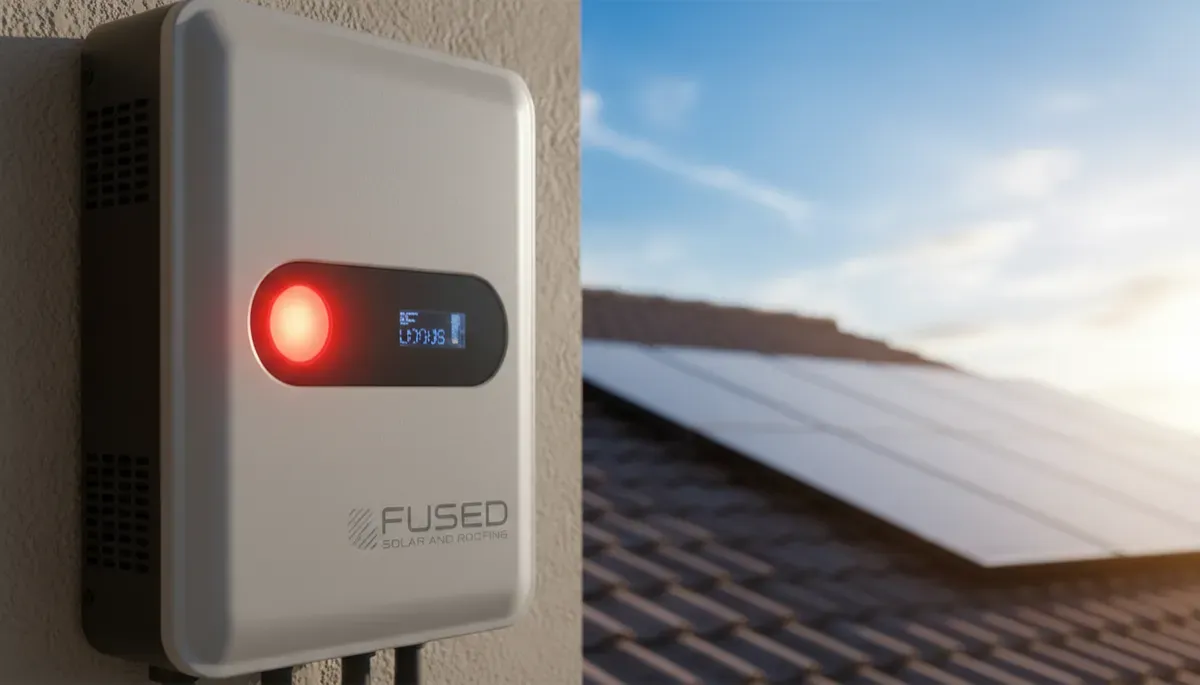
Solar Inverter Red Light or Error in Tampa? Next Steps
You noticed a red light, a flashing light, or an error code on your solar inverter, and you are not sure what it means or what to do next. That light means the inverter has detected a condition it is designed to report, and the goal now is to find out what that condition is, where it is, and what it will take to correct it. Fused Solar and Roofing is a licensed roofing (CCC1331058), electrical (EC13014750), and building contractor (CBC1252064) — all three in-house.
1. A red light is the inverter reporting something
When you see a red light or an error code on your inverter, it is easy to jump straight to the worst-case scenario: that the system has failed, that it is unsafe, or that you automatically need a new inverter. In reality, the light is a status report. It is the inverter’s way of saying, “I have detected something outside the normal range, and I am letting you know.” The fact that it is alerting you is a sign that the safety and monitoring features are doing what they were designed to do.
The inverter sits at the center of your solar power system. Because of that, it sees the power coming from the panels, the power going into your home, and the conditions of the utility power it is tied into. When any of those fall outside the range it is programmed to accept, it records that condition and often changes the light or shows a code. Sometimes it also stops producing power until the condition clears or is corrected. Other times, the light may be related to monitoring or communication, while the system continues to produce normally. The light itself does not tell you which of these situations you are in, but it does tell you that something is worth checking.
It is important to treat the red light or code as information, not as a verdict. It is an invitation to have the system evaluated by someone who can read that information in context, test the equipment around it, and trace the condition back to its source. Until that happens, the light alone cannot tell you whether you are dealing with a minor issue or something that needs prompt repair. What it does tell you is that the system is paying attention, and that now is the right time to schedule a diagnosis rather than ignore it and hope it goes away.
📌 Key Takeaway: A red light or error code is the inverter telling you it detected something. It is the start of a diagnosis, not the answer.
2. What the inverter does and why it watches itself
Your solar panels produce direct current (DC) power when the sun is out. Your home, and the utility grid it is tied to, use alternating current (AC) power. The inverter’s main job is to take the DC power from the panels and convert it into AC power your home can use and your meter can register. It sits between the panels and your home’s electrical system, managing that flow of power all day while the sun is available. Without the inverter, your panels could be producing, but your home would not be able to use that energy in a controlled way.
Because the inverter is the gateway between the solar array and the rest of the electrical system, it continuously checks its own operation and the conditions around it. It monitors the power coming from the panels, the power it is sending into your home, and the quality of the utility power it is tied into. It also keeps an eye on its internal temperature and other operating conditions. If anything it measures moves outside the safe or programmed range, it is designed to react. That reaction may be to reduce output, to shut down and wait, or to stay running while flagging the condition through a light or a code so a technician can investigate.
This is why the inverter is usually the first part of the system to report a problem. It is where all of the information comes together. It does not only watch itself; it also responds to what is happening on the roof, at the disconnect, at the electrical panel, and on the utility side. That broad view is useful, but it also means that a single red light can have many possible sources, not all of them inside the inverter. To make things more confusing, light colors, flash patterns, and codes differ between manufacturers and even between models. There is no single, universal meaning for a red light, a flashing light, or any one code. The meaning depends on the specific equipment and on what a trained technician finds when they test the system around it.
For you as a homeowner, the key point is that the inverter is doing its job by watching for conditions that could affect performance or safety and by reporting them. The presence of a red light or code means you have information to work with, not that you need to guess or assume the worst. The next steps are about capturing that information clearly and getting a licensed professional to interpret it in the context of your specific system and home.
Red light on your inverter? Fused Solar and Roofing diagnoses inverter faults across Hillsborough, Pinellas, Pasco, and Manatee counties. Request a diagnostic visit at https://fusedsolarandroofing.com/solar-repair
3. What an error light or code can point to
Because the inverter sits between your panels, your home, and the utility connection, a red light or error code can point toward several general kinds of conditions. One possibility is that the utility power outside your home is temporarily outside the range the inverter is set to accept. In that case, the inverter may reduce output or pause to protect itself and to avoid sending power into conditions it does not consider acceptable. The light or code records that event so a technician can see that it happened and, if needed, confirm that everything else in the system is still sound once the utility conditions return to normal.
Another possibility is a problem with wiring or a connection somewhere in the solar system. That could be near the inverter, at the disconnect, at the electrical panel, or up under the solar array on the roof. Loose, damaged, or corroded connections can change how power flows and can cause the inverter to see readings that fall outside its normal range. The inverter reacts by logging the condition and signaling it with a light or code. From your point of view, it all looks like the same red light, but to a technician, it is a clue that they need to examine the wiring and connections step by step until they find the exact point that needs repair or replacement.
Heat and poor ventilation around the inverter can also trigger a warning or fault. Inverters are designed to operate within a certain temperature range. If they are installed in a tight space, in direct sun without shade, or in an area where air does not move well, they can become hotter than they like during strong sun. When that happens, many inverters will reduce output or shut down temporarily to protect their internal components. The red light or code in this case is the inverter reporting that its environment is pushing it beyond what it is comfortable with, and that it is protecting itself rather than running hard in poor conditions. A technician will look at both the inverter’s readings and the physical installation to see whether heat is part of the story.
Some red lights and error codes are related to communication rather than to power production. For example, there can be a problem with how the inverter talks to a monitoring system, a gateway, or a network device. In those situations, the inverter may still be producing power for your home, but the monitoring app or online portal is not receiving accurate data. The inverter flags this with a light or code so that the communication issue can be corrected. This is one reason it is useful to compare what the physical inverter display shows with what your monitoring app shows, instead of relying on just one or the other when you first notice a problem.
Finally, an error light or code can point to a failing component inside the inverter itself. Like any piece of electrical equipment, inverters contain electronic parts that can wear over time or be stressed by heat, weather, or other conditions. When the inverter detects that one of its internal checks is no longer passing, it records that and signals it. In some cases, this leads to a repair. In other cases, especially with older equipment or when multiple issues are found, replacement becomes the practical choice. The important thing is that these internal issues are confirmed through testing and inspection, not assumed from the light alone.
💡 Pro Tip: Take a photo of the inverter display showing the light and any code, and note the date. That record helps a technician before they arrive.
4. What to note, and what not to do
Once you notice a red light, flashing light, or error code, there are a few simple steps you can take that make a real difference for diagnosis. First, note the color of the light and whether it is steady or flashing. Different patterns can mean different things on different models, and a clear description helps your technician prepare before they even step onto your property. If the inverter has a screen or display, take a clear photograph of it, including any code or wording that appears. That photo captures exactly what the inverter was reporting at that moment, even if the light or code changes later or comes and goes with the weather or the time of day.
Next, write down the date and a brief note about the weather when you noticed the issue. For example, whether it was a hot, sunny afternoon, a cloudy day, or early in the morning. Some conditions only show up under strong sun, while others appear when production first starts or when it ramps down. That simple note can help a licensed technician understand whether the fault is tied to certain times or temperatures, which can narrow down where to look. If you use a monitoring app, check whether it shows current production and whether it shows any alerts. If you can, take a screenshot of the app at the same time you photograph the inverter display. That way, the technician can compare what the inverter is saying locally with what the monitoring system is seeing remotely.
Just as important as what you note is what you avoid doing. Do not open the inverter, the solar disconnect, or your electrical panel. These contain components that can hold dangerous voltage even when switches appear to be off. Opening covers or trying to access internal wiring without the proper training and protective equipment is not safe and can also make it harder for a technician to see the system in its original state. It can also introduce new issues that were not there before. Leave all covers closed and all internal checks to a licensed professional who works with this equipment every day and has the right tools and procedures to do so safely and thoroughly.
You should also avoid repeatedly switching the system off and on in an attempt to clear the error. While a single restart may sometimes cause a temporary condition to clear, cycling the system over and over again does not solve the underlying cause and can stress components that are already reporting trouble. It also makes it harder to tell when and how often the fault is really occurring. The better approach is to capture what you see, leave the system as it is, and schedule a diagnostic visit so the fault can be traced properly and corrected at its source.
⚠️ Warning: Do not open the inverter or repeatedly switch the system off and on to clear an error. An inverter can hold dangerous voltage even when it appears to be off.
5. Why a code is a starting point, not a diagnosis
It is natural to assume that if the inverter shows a specific code, that code must tell you exactly what is wrong and what needs to be replaced. In practice, an error code is a starting point for a licensed technician, not the final answer. The code tells the technician where to begin looking and what kind of condition the inverter has detected, but it does not specify which exact part, wire, or connection is responsible. The same code can be triggered by a problem inside the inverter or by a condition somewhere else in the system that the inverter is reacting to. That “somewhere else” can be on the roof under the panels, at the disconnect, at the electrical panel, or even related to the utility power the inverter is seeing at a given moment.
For example, a code that points to unusual readings on the solar side might be caused by worn components inside the inverter. It might also be caused by a loose connection under a group of panels, or by damage to wiring that runs between the array and the inverter. The inverter cannot tell you which of those is true on its own. It simply reports that the readings it sees do not match what it expects. A technician then uses that information, along with visual inspection and testing at specific points in the system, to trace the fault back to its actual source. Until that tracing is done, any assumption about what needs to be replaced is just that: an assumption, not a diagnosis.
Replacing an inverter based on a code alone, without tracing the fault, can mean paying for new equipment while the real problem stays in place. If the underlying issue is a wiring problem under the panels, a loose connection at a breaker, or a condition on the utility side, swapping the inverter will not remove that cause. The new inverter may show the same code, shut down in the same way, or even be stressed by the same unresolved condition. That is why careful diagnosis matters. It protects your investment and focuses your budget on the work that actually solves the problem instead of on guesswork driven by a single code on a screen.
Tracing the fault is licensed electrical work. It involves working inside live electrical systems, understanding how solar and household wiring interact, and recognizing subtle signs in both the equipment and the readings it provides. This is not something that should be attempted based on online charts or generic instructions. It should be performed by a licensed contractor who understands both solar and roofing conditions, especially in a climate like Tampa Bay’s where heat, sun, and storms all play a role. Fused Solar and Roofing services inverters on systems of all brands, including systems whose original installer is no longer in business. Fused Solar and Roofing is a licensed roofing (CCC1331058), electrical (EC13014750), and building contractor (CBC1252064) — all three in-house.
6. What a diagnostic visit involves
When you schedule a diagnostic visit, the goal is straightforward: identify where the fault actually is, what caused it, and what it will take to correct it. A licensed technician begins by reviewing the inverter display and any recorded codes or messages. They compare what they see on the unit itself with any photos or notes you have taken and, if you use a monitoring app, with what the monitoring system has recorded. This first step helps them confirm whether the issue is ongoing, intermittent, or tied to certain times of day or weather conditions in your area of Tampa Bay. It also lets them see if multiple codes have appeared over time, which can point to a pattern rather than a single event. Fused Solar and Roofing is an EnergySage Elite Installer with a 5.0/5 rating and 21+ verified reviews — independent verification, earned not purchased.
After reviewing the inverter’s information, the technician inspects the inverter itself, the solar disconnect, the breaker that serves the solar system, and the wiring and connections that can be reached without removing panels. This includes checking for visible signs of heat stress, corrosion, physical damage, or installation issues that might explain the inverter’s readings. They look at how the inverter is mounted, how well it is ventilated, and whether anything around it has changed since it was installed, such as new structures, landscaping, or equipment that might affect its environment. They also examine the accessible wiring between the inverter, the disconnect, and your electrical panel to see whether any connections need to be tightened, repaired, or replaced.
Some wiring and connections, however, sit under the solar panels themselves and cannot be reached without removing panels. Those areas include certain connection points, junctions, and wiring paths that are part of the array on the roof. During a standard diagnostic visit, the technician will determine whether the likely fault area can be reached without removing panels, or whether it appears to be under the array. If the fault traces under the panels, that becomes a separate step, because it involves safely detaching part of the system on the roof, then reinstalling and testing it after repairs are made. That work is planned and quoted based on what the initial diagnosis finds, not assumed in advance.
At the end of the diagnostic visit, you receive photographs and a detailed written report. The report explains what was inspected, what was found, and what, if anything, still needs to be accessed under the panels to complete the picture. Any repair or replacement is scoped and quoted from those findings, so you can see clearly what is being recommended and why. This gives you a clear path forward instead of trying to decide based only on a red light or a line of text on the inverter screen.
📌 Key Takeaway: Fused Solar and Roofing diagnoses inverter faults on systems of all brands under electrical license EC13014750, including systems whose original installer is no longer in business.
7. Repair or replace
Once the diagnostic report is complete, the next question is whether it makes more sense to repair the existing equipment or replace it. That decision is based on what the diagnosis finds, not on the presence of a red light alone. If the fault is traced to a specific connection, a section of wiring, or a clearly defined issue in the way the system was assembled, the solution may be a focused repair. In that case, addressing the wiring or connection problem can restore normal operation without changing out major equipment. The report will show you where that problem was found and what steps are recommended to correct it, so you can see how the repair ties directly to the inverter’s earlier warnings.
If the diagnosis points to a failing component inside the inverter, the technician will look at the overall condition and age of the unit, as well as any related findings, to help you weigh repair versus replacement. In some cases, a targeted repair may be practical. In other cases, especially where multiple issues are present or where the inverter shows signs of broader wear, replacement may be the more reliable long-term path. The key is that this recommendation comes after the fault has been traced, not before. That way, if a new inverter is recommended, you can be confident that it is being installed into a system whose wiring, connections, and surrounding conditions have been checked and addressed where needed, not into a setup that still hides the original cause of the fault.
The diagnostic report lays out your options in clear terms so you can decide with full information. It explains what was found, what each option involves, and how each option addresses the fault the inverter reported. This allows you to make a calm, practical decision about your solar investment instead of reacting under pressure to a warning light. Whether the next step is a focused repair, a planned replacement, or additional work under the panels, you will be choosing based on facts gathered on your property, not on guesswork or generic advice.
8. When the fault is under the panels
Sometimes the diagnostic visit shows that the inverter is reacting to a condition that traces back to wiring or connections under the solar array. When that happens, the next step is to access that area safely. Because those wires and connection points sit under the panels, the panels in that area have to come off to reach them. This process is called a detach and reinstall. It is a planned, orderly way to temporarily remove part of the system so that the problem area can be reached, repaired, and then put back into service with full testing and documentation along the way.
In a detach and reinstall, the system is disconnected in a controlled way, the panels in the affected area are removed, and the wiring or connection that needs attention is exposed. The licensed electrical crew repairs or replaces the components that the diagnosis has identified as the source of the fault. Once that work is complete, the panels are reinstalled, reconnected, and tested as part of the full system. The inverter’s readings are checked again to confirm that the original red light or error condition has been resolved. This approach respects the fact that the inverter was pointing to a real condition while also making sure the actual source is corrected, not just covered over.
When panels are off the roof, it creates a natural moment to ask another practical question: what is the condition of the roof under the array? If the roof under the panels is older, having them off is the natural time to ask whether the roof should be looked at or replaced before the panels go back on. This is not about pushing a roof replacement where it is not needed. It is about recognizing that removing and reinstalling panels is a significant step, and that many homeowners prefer to address any roof concerns at the same time rather than repeating that process later. A simple evaluation at this stage can help you avoid having to detach and reinstall the array again sooner than necessary if roof work becomes important down the line.
Fused Solar and Roofing’s own in-house electrical and roofing crews handle both sides of this work, so it is one job under one company. That means the same team that understands your inverter, wiring, and solar array also understands your roof structure, roofing materials, and how the two interact over time in Tampa Bay’s heat, rain, and storms. When a fault leads under the panels, you are not left trying to coordinate between separate solar and roofing contractors or wondering who is responsible for which part of the work. Instead, you get a unified plan that addresses the electrical fault, respects the condition of your roof, and returns your system to service in a way that supports both your home and your long-term solar investment.
Frequently Asked Questions
1. What does a red light on my solar inverter mean?
A red light usually means the inverter has detected a condition outside its normal operating range and is reporting it. That condition could be related to utility power, wiring or connections, heat around the inverter, communication with monitoring, or a component inside the inverter itself. The light tells you that something is worth checking, but it does not, by itself, identify the exact cause. A licensed technician uses the light or code as a starting point, then inspects and tests the system to find where the fault actually is and what it will take to correct it.
2. Can I reset my solar inverter myself?
It can be tempting to repeatedly turn the system off and on to clear a red light or code, but that is not recommended. While some temporary conditions may clear on their own, cycling the system without understanding the cause does not fix the underlying issue and can stress equipment that is already reporting trouble. It can also make it harder to tell when and how often the fault is really occurring. The safer and more effective approach is to note what you see, take a photo of the display, check your monitoring app if you have one, and schedule a diagnostic visit so a licensed professional can trace and correct the fault properly.
3. Is my solar system still producing if the inverter shows an error?
It depends on what kind of error the inverter is reporting. Some conditions cause the inverter to stop producing power until the issue clears or is corrected. Others may affect only monitoring or communication, while production continues. From the light alone, you cannot tell which situation you are in. Checking your monitoring app, if you have one, can give a clue about current production, but it is still important to have the system evaluated. A diagnostic visit confirms whether the system is producing as it should and identifies any issues that could affect performance or safety over time if they are left unaddressed.
4. Does an error code mean I need a new inverter?
Not necessarily. An error code tells a technician where to start looking, not what must be replaced. The same code can be caused by a condition inside the inverter or by a problem elsewhere in the system, such as wiring or connections under the panels or at the electrical panel. In many cases, the solution is a focused repair rather than a full inverter replacement. Only after a licensed technician has traced the fault and inspected the equipment can you make an informed decision about whether repair or replacement is the better option for your situation and your equipment’s condition.
5. My original solar installer is out of business. Who can look at my inverter?
If your original installer is no longer in business, you are not stuck. Fused Solar and Roofing services inverters and solar systems of all brands, including systems whose original installer is no longer available. A licensed technician can review your inverter, your wiring, and your roof conditions, then provide a clear report and recommendations based on what they find on site. You do not need to track down the original company to have your system evaluated and maintained. What matters is working with a licensed contractor who understands both solar and roofing in the Tampa Bay climate.
6. Why does my inverter error come and go?
Some inverter errors appear only under certain conditions, such as strong sun, high temperatures, or particular utility power conditions. Others may show up when production first starts in the morning or when it ramps down in the evening. That can make the light or code seem to come and go. Intermittent behavior does not mean the issue can be ignored. In fact, it can be an important clue. Noting the time of day, the weather, and what you were doing when you saw the error helps a technician understand the pattern. During a diagnostic visit, they use that information, along with the inverter’s history and on-site testing, to trace the fault even if it is not visible at every moment.
Fused Solar and Roofing is a licensed electrical contractor (EC13014750) servicing solar systems of all brands across Hillsborough, Pinellas, Pasco, and Manatee counties, including systems whose original installer is no longer in business. Request a diagnostic visit at https://fusedsolarandroofing.com/solar-repair
Is your solar system producing what it should? Request a diagnostic visit at https://fusedsolarandroofing.com/solar-repair
