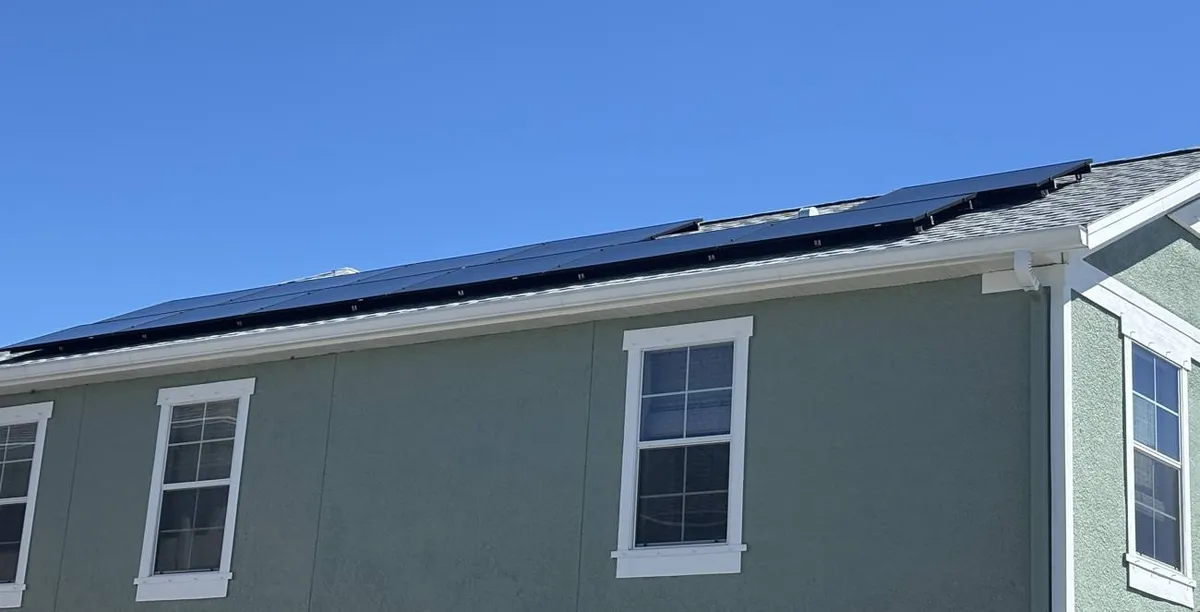
Ground Mount vs. Roof Mount Solar on Tampa Bay Acreage
Most Tampa Bay solar goes on the roof because most Tampa Bay lots are a quarter acre. On the acreage properties in Ruskin, Lutz, Land O' Lakes, Odessa, Parrish, Plant City, and east Pasco, a ground-mounted array is a real choice, and Fused Solar and Roofing installs both. A ground mount puts the panels where the sun is best regardless of the roof, leaves the roof alone, and makes every future re-roof simpler. It costs more per watt, takes a permit the roof mount does not, and needs the land. Here is how the two compare for a homeowner who has the room. Fused Solar and Roofing is a licensed roofing (CCC1331058), electrical (EC13014750), and building contractor (CBC1252064), all three in-house.
1. Production
A ground mount is set at the ideal tilt and pointed due south, with no roof planes, vents, or dormers to work around, so it produces more per panel than almost any roof in the region. Fused's JA Solar 440W bifacial modules collect a real rear-side gain on a ground mount over light ground, which they do not on a shingle roof. And a ground mount can be sited away from the trees that shade the house, which on an oak-canopied acreage lot is often the deciding factor. A roof mount produces what the roof's orientation and shade allow.
🔑 Key Takeaway: On land with open sky, a ground mount out-produces the roof per panel, and on a shaded house it may be the only array that produces at all.
2. Cost
A ground mount costs more per watt than Fused's $1.85 roof-mount price because it adds steel or aluminum racking on posts, concrete footings or driven piles, trenching for the conduit run back to the house, and the engineering for the structure. How much more depends on the distance to the house, the soil, and the array size; Fused quotes it after the site visit as its own line. Against that, there are no two-story, steep-pitch, or roof-type adders, and no roof penetrations to guarantee. On a long run back to the house, the trench and the wire are a meaningful share of the cost, and siting the array closer saves money.
Financing is the same either way: a ground mount is financed through Climate First Bank like a roof mount, and if a roof is being replaced at the same time the two are still quoted as separate lines on one proposal.
3. The roof
A ground mount leaves the roof untouched. No mounts, no flashing, no penetrations, and when the roof is replaced in fifteen years there is no detach and reinstall, no second permit, and no array off the house for two weeks. For a homeowner with a roof that is a few years from replacement and no appetite for doing the roof now, a ground mount sidesteps the question entirely. For a homeowner whose roof is new and well oriented, the roof mount is cheaper and the no-leak guarantee covers the penetrations. Fused Solar and Roofing is a licensed roofing (CCC1331058), electrical (EC13014750), and building contractor (CBC1252064), all three in-house.
If your roof ever needs replacing with solar on it, who is allowed to remove and reinstall the panels, and why, is covered in our guide at https://fusedsolarandroofing.com/post/who-can-remove-reinstall-solar-florida
4. Permits
Hillsborough County permits a ground-mounted array as a Residential Miscellaneous permit rather than the electrical trade permit it uses for roof mounts, with signed and sealed structural plans for the racking and footings, and zoning setbacks from the property lines apply. Pinellas, Pasco, and Manatee file it under their solar permit types with the structural engineering attached. In every county the electrical side is the same as a roof mount: the inverter, the disconnect at the meter, and the interconnection. Fused pulls the permit, provides the engineering, and handles the utility.
💡 Pro Tip: Before falling in love with a spot in the yard, ask the county about setbacks and any easements. A drainage or utility easement across the back of an acreage lot is the most common reason a ground mount moves.
5. Space and placement
A 26-panel, 11.44 kW array in two rows takes roughly a 15-by-45-foot footprint plus working room, and it should sit with open sky to the south and no trees within shading distance for the next twenty years. Fused sites the array for sun, for the shortest reasonable run to the house, for the setbacks, and for mowing access underneath. Fencing is sometimes required by the county or wanted by the homeowner to keep animals and equipment away from the wiring.
6. Maintenance
A ground mount is easier to clean and inspect because no one climbs a roof, and Fused's annual maintenance plan covers ground mounts at the same panel-count pricing as roof mounts. What a ground mount gets that a roof mount does not is rodents and mowers: wiring under the array is where rats and squirrels chew and where a string trimmer finds a conduit, so Fused runs the wiring in conduit, keeps it off the ground, and checks it at every annual visit.
⚠️ Warning: Do not let anyone run exposed wire under a ground mount to save on conduit. Rodent damage to unprotected wiring is the number one ground-mount service call Fused sees, and it is a ground fault waiting to happen.
7. When the roof still wins
A new roof with a good south or west plane and no shade is a cheaper place for the array than the yard, and the no-leak guarantee covers the penetrations for twenty-five years. A lot without a clear patch of southern sky, or with an easement where the array would go, has no good ground site. And a deed-restricted community generally will not allow a ground mount at all, while it cannot prohibit a roof array under Florida's solar access law. For most Tampa Bay homes the roof is the answer; the ground mount is for the acreage where it is not.
8. Why acreage homeowners bring both options to Fused
Because Fused installs both and has no reason to push one. The site survey looks at the roof and the land, the proposal shows the roof-mount price at $1.85 per watt with any adders and the ground-mount price as its own line, with production estimates for each, and the homeowner decides with the numbers in front of them. Fused has installed on acreage across Hillsborough, Pasco, and Manatee counties since 2007 and services the arrays it put in the ground as well as the ones on the roofs.
🔑 Key Takeaway: Ground mounts produce more, cost more, need land and a structural permit, and leave the roof alone. Roof mounts are cheaper where the roof is good. Have both priced and pick with the numbers.
Have the land and want both priced? Request a free site survey and solar quote at https://fusedsolarandroofing.com/solar-installation
Frequently Asked Questions
Is a ground mount better than a roof mount for solar?
On open land it produces more per panel because it is set at the ideal tilt and orientation and sited away from shade, and it leaves the roof untouched. It costs more per watt and needs a structural permit and the space. Where the roof is good, the roof mount is cheaper.
How much more does a ground-mounted solar system cost?
More than Fused's $1.85 per watt roof price, by an amount that depends on the racking, footings, trench length, and array size. Fused quotes it after the site visit as its own line, with no roof adders.
How much space does a ground mount need?
A 26-panel, 11.44 kW array in two rows takes roughly 15 by 45 feet plus working room, with open southern sky and no trees within shading distance, inside the county's setbacks and off any easements.
Do I need a different permit for a ground mount?
Yes. Hillsborough County uses a Residential Miscellaneous permit with sealed structural plans; the other counties attach the structural engineering to their solar permit. The electrical side matches a roof mount. Fused handles all of it.
Does a ground mount avoid a detach and reinstall when I re-roof?
Yes. With no panels on the roof, a future re-roof needs no detach and reinstall, no second permit, and no downtime for the array.
Can I put a ground mount in an HOA community?
Usually not; most associations prohibit them, while Florida law prevents them from prohibiting a roof array. Ground mounts are for acreage and unrestricted lots.
Fused Solar and Roofing has installed solar across Hillsborough, Pinellas, Pasco, and Manatee counties since 2007, with the roof and the solar handled by its own licensed in-house crews. Request a free solar quote at https://fusedsolarandroofing.com/solar-installation
Fused Solar and Roofing holds Florida roofing (CCC1331058), electrical (EC13014750), and building (CBC1252064) licenses, all three in-house, and has served Hillsborough, Pinellas, Pasco, and Manatee counties since 2007. Fused Solar and Roofing is an EnergySage Elite Installer with a 5.0/5 rating and 21+ verified reviews, independent verification, earned not purchased. Request a free site survey and solar quote at https://fusedsolarandroofing.com/solar-installation
