Enphase Microinverter Not Working? Tampa Bay Guide
If your Enphase app suddenly shows one panel not reporting, several panels grayed out, or your whole system offline, you are not alone. An Enphase system uses a small microinverter mounted under each panel, so most problems are limited to one panel or one component, not your entire solar investment. The real goal is to figure out which part is causing the issue and fix it correctly, without guesswork or unsafe steps. Fused Solar and Roofing is a licensed roofing (CCC1331058), electrical (EC13014750), and building contractor (CBC1252064) — all three in-house.
This guide walks you through how an Enphase system is set up, what “not reporting” versus “not producing” usually means, why the fix is often under the panel itself, and what to expect from a professional diagnostic visit. You do not need to become a solar technician. You just need enough clarity to know what is happening on your roof and what the next smart step looks like.
1. One microinverter per panel, one problem at a time
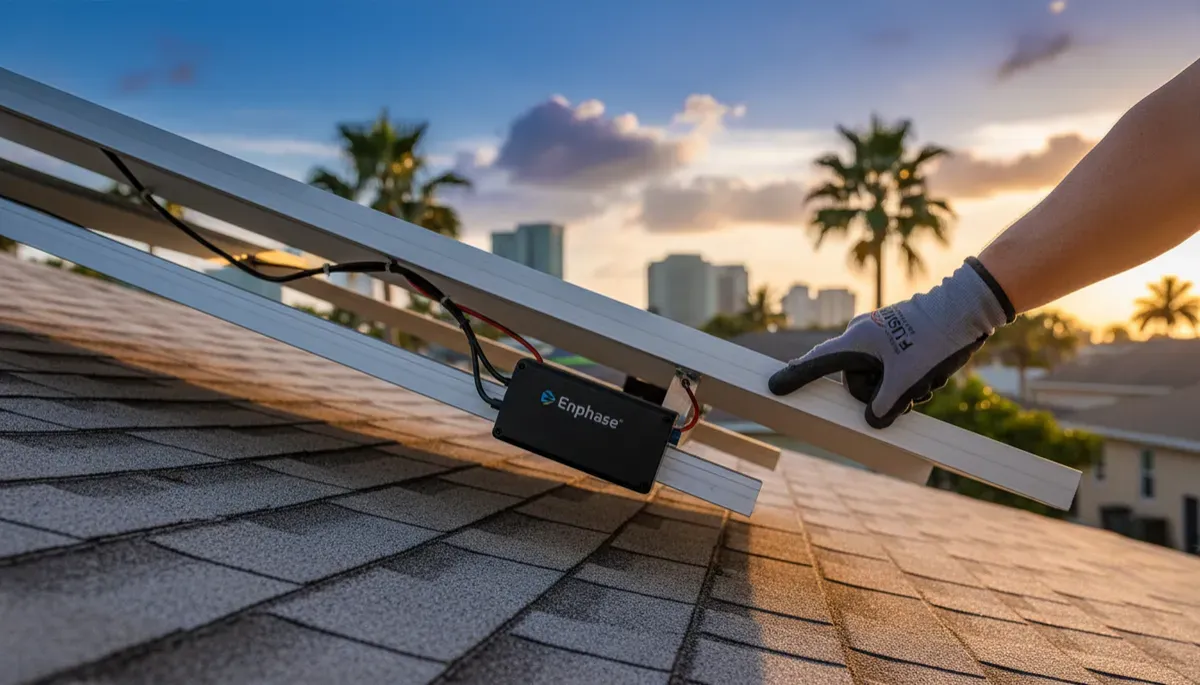
On an Enphase system, each solar panel has its own microinverter attached underneath it on the racking. The panel makes direct current (DC) power, and the microinverter turns that into alternating current (AC) power that your home can use. Instead of one big box handling all your panels at once, Enphase spreads the work out so each panel operates independently through its own device.
For you as a homeowner, this design has an important benefit: when there is a problem, it often shows up as one panel acting differently in the Enphase app. One microinverter might stop reporting, or one connection might fail, while the others keep producing. That is very different from systems where one central part can take down the entire array at once. With Enphase, the pattern you see in the app — one panel, a group of panels, or the whole system — gives a strong clue about where to look first on the physical system.
It also means that fixing the issue is usually a matter of focusing on that specific panel and the microinverter under it, not ripping out or replacing everything. A good technician will treat it as a targeted problem to be located and corrected, one piece at a time, rather than assuming your whole solar setup has failed.
📌 Key Takeaway: On an Enphase system, each panel has its own microinverter, so a single failure usually affects one panel rather than the whole system.
2. How an Enphase system is laid out
To understand what the Enphase app is telling you, it helps to picture how the hardware is arranged from the roof down to your electrical panel. On the roof, each solar panel is mounted on racking, and a microinverter is mounted underneath that panel. Short wiring connects the panel to its microinverter, and then cables connect each microinverter into a branch circuit that carries the combined AC power down from the roof toward your home’s electrical system. Every panel is its own little power station, feeding into that shared wiring run.
Down at ground level, usually near your main electrical panel, is the gateway. This is a communication device that listens for information from all the microinverters and sends that data to the Enphase app. The gateway does not make power. Its job is to collect production and status information from the roof and pass it along so you can see what each panel is doing. If you open the app and look at the panel layout, that view is built from what the microinverters tell the gateway, and what the gateway is able to send out over your home’s internet connection or another communication path.
Because each panel works independently through its own microinverter, a failure at one panel usually affects only that panel’s power and its reporting. If several panels are misbehaving in a cluster, that may point to the shared wiring they are on. If the whole system looks offline in the app, that often indicates something that all panels share, such as the gateway or its connection to the internet, rather than every microinverter on the roof failing at the same time. A proper diagnosis starts with this layout in mind and then works step by step from the app view to the actual equipment.
Enphase panel not reporting? Fused Solar and Roofing diagnoses and replaces Enphase microinverters across Hillsborough, Pinellas, Pasco, and Manatee counties. Request a diagnostic visit at https://fusedsolarandroofing.com/solar-repair
3. Not reporting versus not producing
The Enphase app can show you two different kinds of issues: a panel that is not reporting, and a panel that is not producing. They sound similar, but they point to different parts of the system. When a panel shows as not reporting, the app is telling you that the gateway is not receiving data from that microinverter. That may be a communication issue between the microinverter and the gateway, or something affecting that path, even if the panel is still making power. Or it may be a sign that the microinverter itself is not operating correctly. The app alone cannot tell you which of those is true, only that the data flow has been interrupted or has changed.
A whole system showing as offline in the app is different. When every panel suddenly disappears or the app says the system is offline, that often points toward the gateway or its internet connection rather than a problem with each microinverter at the same time. In that situation, the panels on the roof may still be producing power for the home, but the monitoring is not able to show it. Again, the pattern — one panel, several panels, or the entire system — helps a technician decide whether to look first at the roof equipment, the gateway, or the connection from the gateway out to the internet or other communication path it uses.
A panel that is truly not producing is a different concern. In that case, the microinverter may have failed, a connection may have come loose or been damaged, or there may be another issue in the wiring or components serving that panel. These are possibilities that a proper diagnosis sorts out by looking at the data in the app alongside what is found during a physical inspection. The point is not for you to guess the cause from your phone, but to recognize that “not reporting” and “not producing” are two different clues that guide the next steps in a systematic way.
💡 Pro Tip: Screenshot the panel view in the Enphase app showing which panels are not reporting, and note the date and weather. That tells a technician exactly where to look.
4. What to note before calling
Before you schedule a diagnostic visit, there are a few simple things you can do from the ground that make the process smoother and more accurate. First, open your Enphase app and go to the panel view. Take clear screenshots that show which panels are not reporting or not producing. If the whole system looks offline, capture that as well. If the issue has come and gone over several days, try to get screenshots from different times that show how the pattern has changed. This record helps the technician see exactly what you are seeing, even if the app looks different by the time they arrive.
Next, make a simple note for yourself: is it one panel, several panels, or the entire system that seems affected? You do not need to count rows or know which direction the roof faces. Just write down, in plain language, what the app appears to be showing. Also note the date and what the weather was doing when you first noticed the problem — clear and sunny, cloudy, or during a storm. This context can be useful when a technician compares your screenshots with the system data and with what they see on site during their inspection.
Just as important is what not to do. Do not go on the roof. Do not try to lift or slide a panel to “take a quick look” underneath. Do not open the gateway, your electrical panel, or any disconnects. Do not unplug or reset equipment in hopes that it will clear the problem. Modern solar systems are electrical systems tied directly into your home, and they are designed to be serviced by trained, licensed people with the right tools and procedures. Your role is to observe, document what you see in the app, and then let a qualified technician take it from there.
⚠️ Warning: Do not go on the roof or lift a panel to look at a microinverter. Solar panels produce electricity whenever they are in sunlight, even when the system is shut off at the house.
5. Why the fix is usually under the panel
When an Enphase microinverter is not working correctly, the most direct way to reach it is from the top of the roof. The microinverter is mounted under the panel, on the racking, and is wired right to that panel. That means that replacing or repairing it is not like swapping a plug-in device at ground level. To reach it safely and correctly, the system is shut down, the wiring is made safe, and the panel above the microinverter is removed from the racking so the technician can access the device and its connections underneath. Even if only one panel is coming off, this is still a detach and reinstall for that panel and its hardware.
Once the panel is off, the technician can inspect the microinverter, the connectors, and the wiring serving that position in the array. If the microinverter has failed, it is removed and replaced with a new one. If the issue is in a connector or another part of the wiring at that location, that is repaired or replaced as needed. After the repair, the panel is reinstalled on the racking, reconnected, and the system is brought back online in a controlled way. The new or repaired microinverter is then set up so that it appears correctly in the Enphase app and reports production as expected. This is licensed electrical work on the roof, not a cosmetic adjustment or a simple plug-in swap at the ground.
Because these repairs happen at the intersection of your roof, your solar equipment, and your home’s electrical system, it matters who does the work. The person on your roof should understand both how to handle the electrical side and how to protect the roof and waterproofing underneath the array. Fused Solar and Roofing services Enphase systems, including systems whose original installer is no longer in business. Fused Solar and Roofing is a licensed roofing (CCC1331058), electrical (EC13014750), and building contractor (CBC1252064) — all three in-house. That combination allows the same company to detach and reinstall panels, replace microinverters, and protect the roof system while doing it, instead of splitting that responsibility across multiple contractors who may not coordinate closely with each other.
6. What a diagnostic visit involves
When you schedule a diagnostic visit for an Enphase system, the first step is a clear conversation about what you are seeing in the Enphase app. A licensed technician will review your screenshots and the live app data with you, panel by panel if needed, so everyone is looking at the same information. This helps confirm whether the issue is one panel, a group of panels, or the entire system. From there, the technician will look at the physical equipment that can be reached without removing panels, starting with the gateway near your electrical panel and the visible wiring and disconnects that are part of the system layout at ground level or on exterior walls.
During this inspection, the technician checks the gateway, the breakers that serve the solar system, the disconnect, and the accessible wiring and connections between these components. The goal is to confirm that power is reaching the system as expected, that the gateway is in place and powered, and that there are no obvious issues in the parts of the system that do not require panel removal. At the same time, they are comparing what they see on site with the pattern in the Enphase app, narrowing down which specific panels or sections of the array are affected and how that lines up with the physical layout on your roof.
After this on-site review, you receive photographs and a detailed written report explaining the findings in plain language. The report will identify which panels are affected, what part of the system appears to be at fault, and what work is recommended to correct it. Any replacement or repair — such as swapping a microinverter or addressing wiring issues at a specific panel location — is scoped and quoted based on those findings. Fused Solar and Roofing is an EnergySage Elite Installer with a 5.0/5 rating and 21+ verified reviews — independent verification, earned not purchased. Fused Solar and Roofing is certified with Enphase. That experience supports a thorough, methodical approach rather than trial-and-error guesswork on your roof or at your electrical panel.
📌 Key Takeaway: Fused Solar and Roofing diagnoses and replaces Enphase microinverters under electrical license EC13014750, including on systems whose original installer is no longer in business.
7. The roof under the array
Any time panels have to come off to reach microinverters, especially when several are affected across an array, it creates a natural moment to think about the roof underneath them. Your solar system and your roof are tied together. The racking is attached through the roofing, and the panels cover a large area that is not easily visible from the ground. When a technician is already planning to detach and reinstall part of the array to replace microinverters or address wiring issues, it is reasonable to ask what condition the roof is in under that section and whether any repairs should be handled at the same time.
If the roof under the array is older or has known concerns, it may be worth asking directly whether it makes sense to repair or replace that area while the panels are off, instead of taking them off twice in a short span of time. In some cases, the best long-term plan is to remove the full array, replace the roof in that area, and then reinstall, reconnect, and test the panels and microinverters on top of a refreshed surface. That way, you start the next chapter of your solar system’s life with both the roof and the electrical components in solid shape, rather than addressing them separately and repeating the labor of detaching panels later.
Fused Solar and Roofing’s in-house electrical and roofing crews handle both sides of this work, so it becomes one coordinated job under one company instead of two separate projects. The same team that understands how to diagnose and replace Enphase microinverters also understands how to protect and rebuild the roof under the array. That does not mean you are being pushed into a roof replacement. It simply means you have the option to look at the roof question at the same time as the microinverter repair and make a calm, informed decision about whether combining the work now will save you disruption and extra labor later.
8. After the repair
Once the repair or replacement work is completed — whether that is a single microinverter swap or a larger project involving several panels — the final step is to confirm that the system is performing and reporting correctly. The technician brings the system back online in a controlled way and then checks the Enphase app to make sure every panel is producing and showing up as expected in the panel view. If a new microinverter was installed, it is confirmed in the app so the layout matches what is actually on the roof. Any earlier “not reporting” or “not producing” indicators for that location should now be cleared or replaced with live production data that matches the conditions on site.
Before leaving, a good technician will walk you through the Enphase app so you are comfortable reading the panel view yourself. They can point out the panel or panels that were worked on, show you what normal production looks like in the app on a sunny day, and explain how to spot a panel that might need attention in the future. You do not need to watch the app every hour, but it helps to know, in simple terms, how to tell when everything is healthy and when something looks off. That way, if a panel ever shows as not reporting or not producing again, you can recognize it early, document it with screenshots, and schedule service before it quietly drags down your system’s output for a long time.
Frequently Asked Questions
1. Why does my Enphase app show a panel not reporting?
A panel shown as not reporting usually means the gateway is not receiving data from that panel’s microinverter. That can be related to communication between the microinverter and the gateway, or it can be related to the microinverter or its connections at that location. The app is flagging that it has lost contact with that panel, but it cannot tell you from the screen alone whether the panel is still producing power or not. A technician uses the app pattern together with an on-site inspection to decide whether the issue is in the communication path, the microinverter, or the wiring at that position in the array.
2. Does one bad Enphase microinverter shut down my whole system?
On an Enphase system, each panel has its own microinverter, so one bad microinverter typically affects just its own panel rather than shutting down the entire system. You might see one panel gray or zeroed out in the app while the rest continue to produce. If several panels in a row show issues, that can point to shared wiring or a branch of the system, but it is still not the same as everything going down at once. A whole system appearing offline in the app is more often related to the gateway or its connection, rather than a single microinverter failure.
3. Does replacing a microinverter mean taking the panel off the roof?
Yes. Because the microinverter is mounted under the panel, replacing it means the panel above it has to be detached from the racking and lifted out of the way. The system is shut down, the wiring is made safe, the panel is removed, and the technician then has direct access to the microinverter and its connections. After the replacement or repair is complete, the panel is reinstalled and reconnected, and the new microinverter is set up so that it appears and reports correctly in the Enphase app. This is specialized electrical work on the roof and should be handled by a licensed professional who also understands how to protect the roof while the panel is off.
4. My whole Enphase system shows offline. Is it broken?
A whole system showing offline in the Enphase app does not automatically mean your entire solar system is broken. It often means the gateway is not able to send or receive information as it normally does. That can be related to the gateway itself, its power, or its connection to your home’s internet or other communication path. The panels on your roof may still be producing power even if you cannot see the data in the app. A diagnostic visit checks both the monitoring side and the electrical side so you can know whether the issue is limited to communication or whether there is a deeper problem that needs repair.
5. Can a different company service my Enphase system?
Yes. Your Enphase system does not have to be serviced by the company that originally installed it. A licensed contractor who understands Enphase microinverters and gateways can diagnose issues, replace failed components, and handle detach and reinstall work when panels need to come off. This is especially important if your original installer is no longer in business or is not providing support. Fused Solar and Roofing services Enphase systems throughout the Tampa Bay area, including systems installed by other companies, and can step in to handle both the electrical and roofing sides of the work under one roof.
6. My original solar installer is out of business. Who can replace my Enphase microinverters?
If your original installer is out of business, you can still have your Enphase microinverters diagnosed and replaced by another licensed contractor. Look for a company that is experienced with Enphase systems and that can manage both the electrical work and any necessary detach and reinstall on the roof. In the Tampa Bay area, Fused Solar and Roofing services Enphase systems regardless of who installed them originally. The process starts with a diagnostic visit to identify which panels and microinverters are affected, followed by a clear repair plan and a controlled detach and reinstall where needed.
Fused Solar and Roofing is a licensed electrical contractor (EC13014750) servicing solar systems of all brands across Hillsborough, Pinellas, Pasco, and Manatee counties, including systems whose original installer is no longer in business. Request a diagnostic visit at https://fusedsolarandroofing.com/solar-repair
Is your solar system producing what it should? Request a diagnostic visit at https://fusedsolarandroofing.com/solar-repair
