Cracked Solar Panel in Tampa Bay: Replace It or Not?
Noticing a single cracked panel on your roof in Tampa Bay raises fair questions: does it matter, is it dangerous, and what does it take to replace just one out of thirty? Fused Solar and Roofing is a licensed roofing (CCC1331058), electrical (EC13014750), and building contractor (CBC1252064) — all three in-house. This article walks through what a crack actually does, how wiring affects the impact, and why matching a ten-year-old panel is rarely as simple as ordering the same model again.
1. What a cracked panel actually is
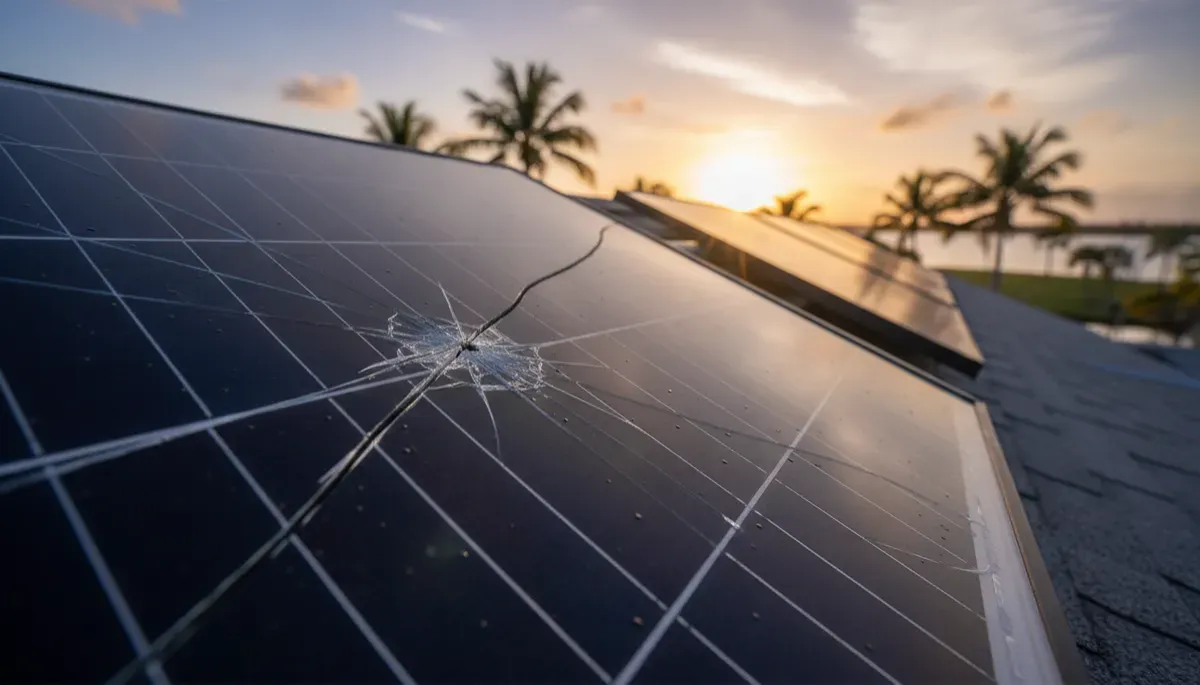
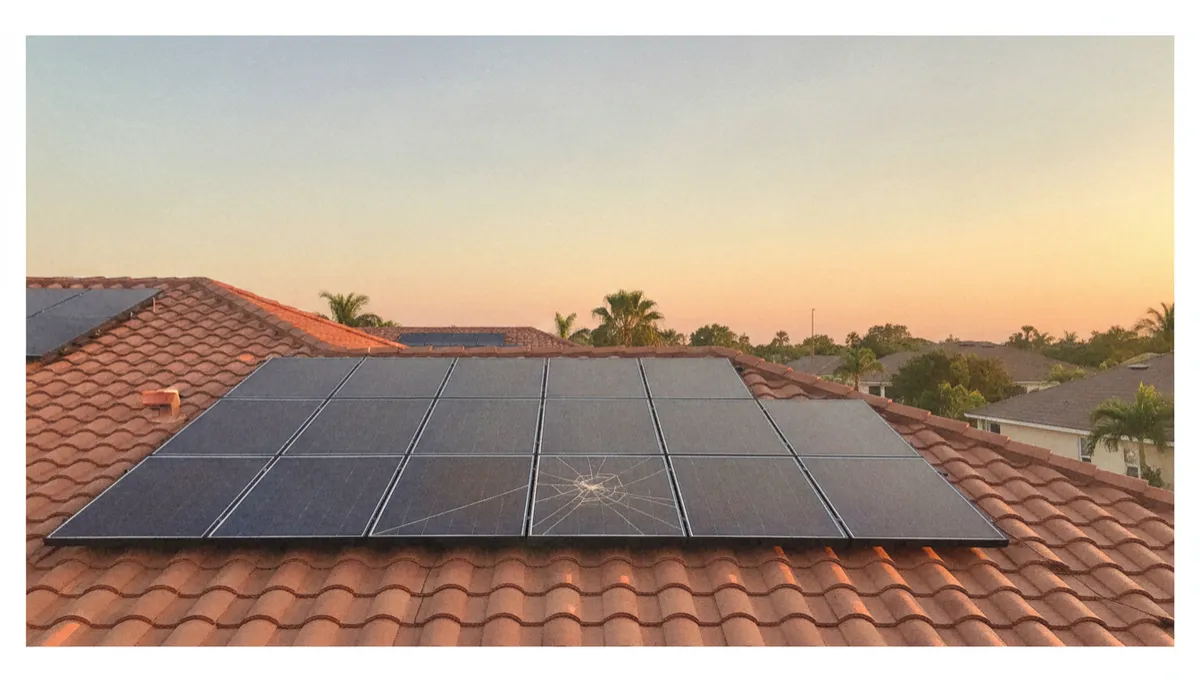
When homeowners in Hillsborough, Pinellas, Pasco, or Manatee counties say they have a “cracked panel,” they are usually talking about damage to the glass face of the module. The glass is laminated over the solar cells and electrical conductors underneath, bonded with encapsulant and backed by a weatherproof layer. A crack can be a hairline fracture from thermal stress, a spiderweb pattern from hail or debris, or a corner break from impact or installation stress. Even if the panel still looks mostly flat from the ground, that glass is no longer one continuous protective surface, which changes how the panel handles weather, heat, and electrical stress over time.
2. Why a crack is a moisture problem before it is a production problem
On a modern solar module, the glass is not just there to let light in; it is a sealed weather barrier over the electrical layer. The cells, solder joints, and busbars are designed to live in a controlled, dry environment. When the glass cracks, that sealed envelope is broken. In Florida’s climate, with high humidity, salt in the air near the coast, and frequent driving rain, moisture can work its way through those cracks and into the laminate. Once water reaches the cells and connections, it can corrode metal, cause discoloration, and in some cases create paths for arcing or ground faults. This is why a cracked panel that still shows normal or near-normal production on your monitoring app is not a panel that is “fine”; the electrical readings tell you what is happening today, not what moisture is doing inside the laminate over the coming months and storm seasons. The first concern is keeping water out of energized components, not just preserving kilowatt-hours.
📌 Key Takeaway: A cracked panel is a moisture and safety concern before it is a production concern. Glass is what keeps water out of the electrical layer underneath.
3. How much production one bad panel actually costs you
From a production standpoint, a damaged module behaves like any underperforming panel in the system. If the panel’s electrical characteristics have not changed much yet, you may see only a small drop in that module’s output. Over time, as moisture intrusion progresses or as the cells degrade faster than their neighbors, its production typically falls relative to the rest of the array. How much this costs you in real energy depends on the size of the system, how it is wired, and whether the crack has already damaged internal conductors. It is also worth noting that a system without module-level monitoring reports only total output, so a single weak panel may not stand out clearly without a detailed diagnostic. In other words, the production cost of one bad panel is rarely obvious from the ground, and it is only part of the decision; the safety and long-term reliability aspects matter just as much in a coastal, high-heat region like Tampa Bay.
Cracked or damaged panel? Fused Solar and Roofing evaluates and replaces modules across Hillsborough, Pinellas, Pasco, and Manatee counties. Request service at https://fusedsolarandroofing.com/solar-repair
4. Why string wiring changes the answer
The same cracked panel can have very different real-world impacts depending on how your system is wired. In a traditional string inverter setup, panels are wired in series into “strings.” Within each string, the panels behave like links in a chain: the current through the whole string is limited by the weakest link. If one panel is significantly underperforming because of internal damage, the rest of the modules in that string cannot operate at their preferred point and may all produce less than they otherwise would. This is why a single compromised panel in a series string can influence the output of several neighboring modules, not just its own contribution.
Systems built with microinverters or DC optimizers work differently. With microinverters, each panel has its own small inverter converting DC to AC on the roof, so that module’s performance is largely isolated; a failing panel mainly affects itself, not the entire group. DC optimizers still use a central inverter, but each panel has electronics that help manage its contribution independently, again limiting how much one weak module drags down the rest. This is why understanding whether your Tampa Bay system uses a string inverter, optimizers, or microinverters is critical: it directly changes how urgent the production impact of one cracked panel is, even though the moisture and safety concerns remain in all architectures.
💡 Pro Tip: Photograph the damaged panel from the ground and note the date you first saw it. If the damage came from a storm or a specific event, that timing matters.
5. The matching problem: your panel model probably does not exist anymore
Many Tampa Bay homeowners are surprised to learn that the exact panel model on their ten-year-old roof is no longer made. Solar manufacturers regularly update their product lines, typically every few years, increasing wattage, changing cell layouts, and adjusting physical dimensions. A module installed in 2014 or 2016 might have a frame size, connector style, and electrical specifications that do not match current offerings, even from the same manufacturer. This is normal industry behavior, not a sign that your original contractor chose poorly. The result, however, is that “just swap in the same panel” is often not possible; the replacement process becomes an exercise in finding a close electrical and physical match and then designing around the differences so the array continues to operate safely and within code.
6. What a mismatched replacement does to the system
When the original panel model is unavailable, a replacement with different characteristics has to be integrated carefully. Within a series string, voltage and current ratings matter. A panel with a significantly higher or lower operating voltage or current than its neighbors can cause the entire string to operate away from its ideal point, wasting potential production or even tripping the inverter’s safety limits under certain conditions. Electrical mismatch is not automatically unsafe if engineered correctly, but it does change how the system behaves and must be evaluated against the inverter’s design window and the string layout on your roof.
Physical size also matters. A taller or wider module may not fit the existing racking without adjustments, while a smaller one can leave gaps that affect clamp locations and wind loading. In practice, options range from finding a replacement that is as close as possible electrically and physically, to rearranging which panels are grouped together on a string, to placing the replacement on its own electronics such as a dedicated optimizer or microinverter. The right answer depends on your specific array layout, inverter model, and roof geometry, which is why a site-specific design review is part of any responsible cracked-panel replacement plan in Hillsborough, Pinellas, Pasco, or Manatee counties.
⚠️ Warning: Do not attempt to seal, tape, cover, or clean a cracked panel. A damaged module can present a shock or arcing hazard and must be handled by a licensed electrical contractor.
7. The realistic options when a panel fails
When Fused Solar and Roofing evaluates a cracked module in Tampa Bay, the realistic options usually fall into a few categories. One is to pursue a manufacturer warranty claim if the damage and failure mode fall under the terms of the original product warranty; outcomes depend on the manufacturer’s policies, photos, and inspection findings, and there is no guarantee that a matching panel will be supplied. Another option is to replace the damaged panel with the closest compatible module available today, adjusting string design or electronics as needed. In some cases, especially on older, smaller arrays, homeowners choose to leave a mildly damaged panel in place under monitoring for a period of time while planning a more comprehensive upgrade, provided a licensed contractor has evaluated that it does not present an active safety hazard. Fused Solar and Roofing is a licensed roofing (CCC1331058), electrical (EC13014750), and building contractor (CBC1252064) — all three in-house, so the evaluation can address the module, wiring, and roof attachment together rather than in isolation.
📌 Key Takeaway: Fused Solar and Roofing evaluates and replaces modules on systems of all brands under electrical license EC13014750, including systems whose original installer is no longer in business.
8. When one panel is telling you something about the whole array
A single cracked panel on an older array is sometimes less an isolated event and more an early warning. Modules that have been on a Florida roof for many years have all seen the same heat, storms, wind uplift, and thermal cycling. If one panel has developed a crack or internal failure, it is reasonable to ask whether others are close behind, especially if the array uses the same batch of hardware and racking. A thorough service visit should therefore look at the full system: module backsheets, wiring, junction boxes, clamps, and roof penetrations, not just the visibly damaged glass. If the roof underneath is also approaching the end of its life, there can be practical advantages to addressing roofing and solar together instead of in separate projects several years apart, reducing the number of times the array has to be removed and reinstalled. Fused Solar and Roofing is an EnergySage Elite Installer with a 5.0/5 rating and 21+ verified reviews — independent verification, earned not purchased. That external vetting reflects a process-focused approach: diagnose the whole system, explain the tradeoffs clearly, and help homeowners in Hillsborough, Pinellas, Pasco, and Manatee counties choose the path that fits their goals and timelines.
Frequently Asked Questions about cracked panels in Tampa Bay
1. Does a cracked solar panel still produce power? In many cases, yes, a cracked solar panel will continue to produce power for some time, especially right after the damage occurs. The cells underneath may still be intact and able to convert sunlight, so your monitoring app in Tampa Bay might show output that looks close to normal. However, that production does not mean the panel is healthy; the crack has opened a path for moisture and can accelerate internal degradation, corrosion, and potential safety issues. The correct approach is to treat a cracked but still-producing panel as a component that needs professional evaluation, not as a harmless cosmetic flaw you can ignore indefinitely.
2. Is one cracked panel dangerous for my home? A single cracked panel can present risks that are not obvious from the ground. Once the glass is compromised, moisture can reach energized parts, and under the right conditions that can contribute to arcing, ground faults, or hot spots. The level of risk depends on the extent of the crack, how much water has entered, and the system’s protective devices, but it is not something to test by touching or cleaning the module. In Tampa Bay’s humid, storm-prone environment, the safest course is to have a licensed electrical contractor inspect the panel, confirm whether it is safe to leave energized, and recommend any corrective action based on Florida code requirements and the system’s design.
3. Does a cracked panel have to be replaced immediately? A cracked panel should be evaluated promptly by a qualified contractor, but that does not automatically mean it must be replaced the same day. After inspection, the contractor can determine whether the panel can remain energized temporarily, whether it should be electrically isolated, or whether replacement is the appropriate next step. In some Tampa Bay cases, a mildly damaged panel that still tests safely may be monitored while the homeowner plans a broader repair or upgrade; in others, more severe damage or signs of moisture intrusion may justify a faster replacement. The key is that the timeline should be based on a documented safety and performance assessment, not on guesswork from ground-level observation.
4. What happens if the original panel model is discontinued? If your original panel model is discontinued, which is common for systems installed several years ago in Florida, the contractor will look for a replacement with similar electrical characteristics and suitable physical dimensions. This might involve sourcing a panel from a different product line or manufacturer that has comparable voltage and current ratings and can be integrated into your existing strings or electronics. In some situations, the design may be adjusted by regrouping panels, using an optimizer or microinverter on the replacement, or slightly reconfiguring the array layout. Manufacturer warranties and availability vary, so there is no guarantee of an exact match, but a thoughtful design process can usually arrive at a safe, code-compliant solution for Tampa Bay homes.
5. Can I replace just one panel, or does the whole array have to be redone? In most cases, it is possible to replace a single failed panel without rebuilding the entire array, especially on relatively recent systems where compatible modules and electronics are still available. The decision to replace only one panel versus making broader changes depends on factors such as the age of the array, the condition of the other modules, the type of inverter or optimizer system, and the state of the roof beneath. For a newer system in Hillsborough, Pinellas, Pasco, or Manatee counties, a single-panel replacement with minor design adjustments is often practical. For an older system with multiple aging components, a cracked panel can be the point where it makes sense to evaluate whether a more comprehensive upgrade or roof-and-solar project will be more efficient over the long term.
6. Is a cracked panel covered under the manufacturer warranty? Whether a cracked panel is covered under the manufacturer warranty depends on the specific warranty terms and the cause of the damage. Many product warranties cover defects in materials and workmanship but exclude damage from external events such as storms, debris impacts, or misuse. Performance warranties focus on long-term output, not physical breakage. For Tampa Bay homeowners, the typical process is to document the damage with photos from the ground, note when it was first observed, and have a licensed contractor perform testing and provide information the manufacturer may request. Approval of a claim, and whether a compatible replacement is available, is always at the manufacturer’s discretion rather than guaranteed in advance.
Fused Solar and Roofing is a licensed electrical contractor (EC13014750) servicing solar systems of all brands across Hillsborough, Pinellas, Pasco, and Manatee counties, including systems whose original installer is no longer in business. Request a diagnostic visit at https://fusedsolarandroofing.com/solar-repair
Is your solar system producing what it should? Request a diagnostic visit at https://fusedsolarandroofing.com/solar-repair
