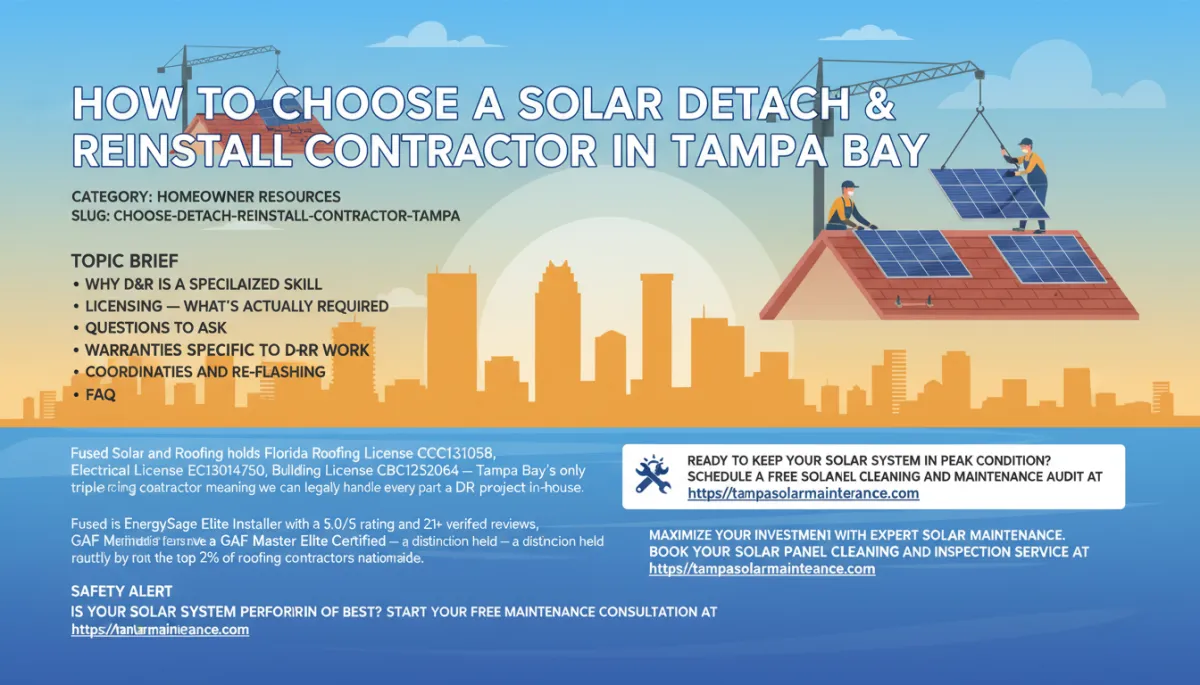
Choose a Solar Detach & Reinstall Contractor in Tampa
Planning a roof replacement or major repair with solar on your home? Detaching and reinstalling your panels is one of the most delicate parts of the project. This guide walks Tampa Bay homeowners through how to vet a detach & reinstall (D&R) contractor, what licenses actually matter in Florida, and how to protect your roof, your solar investment, and your warranties.
Why Detach & Reinstall Is a Specialized Skill
On the surface, detach & reinstall sounds simple: take panels off, put them back on after the new roof is done. In reality, D&R is a highly specialized process that combines roofing, electrical, structural, and system design expertise. Treating it like basic labor is one of the fastest ways to damage your system or void warranties.
A proper D&R involves:
Safely shutting down and de-energizing the solar array and inverter according to electrical code and manufacturer instructions
Labeling, mapping, and documenting each circuit, string, and module position to avoid performance issues after reinstallation
Removing racking and roof attachments without tearing underlayment or enlarging penetrations that can later leak
Coordinating with your roofer so new penetrations and flashing integrate with the new roofing system and meet manufacturer specs
Rebuilding the array with correct tilt, spacing, wire management, and grounding, then testing performance and safety before energizing
Every one of these steps affects your roof’s watertightness, your system’s output, and your long-term safety. That’s why the best D&R providers in Tampa Bay are not just “panel movers” but full-scope solar and roofing specialists who can own the entire process in-house from start to finish.
Licensing: What’s Actually Required in Florida for D&R Work
Florida does not have a separate “detach and reinstall” license category. Instead, D&R falls under the work of a solar contractor, as defined in Florida Statutes, which covers the installation, alteration, repair, maintenance, relocation, or replacement of solar panels and related equipment.
Core licenses that can cover D&R work
Certified Solar Contractor — Statewide license that allows installation, relocation, and replacement of solar PV systems and related equipment anywhere in Florida. This is the most direct license for full-scope solar work, including D&R, and requires a state exam, experience, background checks, and ongoing continuing education.
Certified or Registered Electrical Contractor — Can legally perform the electrical portions of a PV system, including wiring and interconnection, and is recognized by the state as qualified for solar electric work. However, this license alone does not make someone a roofing expert or guarantee they understand roof integration and flashing details.
Roofing Contractor — Required to legally install, repair, or replace roofing systems in Florida. For D&R, this matters because every roof penetration, flashing, and attachment must be done in a way that preserves your roof warranty and complies with the Florida Building Code.
Many D&R projects end up involving all three skill sets: roofing, electrical, and solar system design. That’s why working with a single contractor who holds all relevant licenses — and performs all scopes in-house — offers a major advantage in quality control, warranty protection, and accountability.
Fused Solar and Roofing holds Florida Roofing License CCC1331058, Electrical License EC13014750, and Building Contractor License CBC1252064 — Tampa Bay's only triple-licensed solar and roofing contractor, meaning we can legally handle every part of a D&R project in-house.
Fused is an EnergySage Elite Installer with a 5.0/5 rating and 21+ verified reviews, and a GAF Certified Plus roofing contractor, which lets us offer GAF's enhanced System Plus and Silver Pledge warranties on qualifying roofs.
Why single-contractor, in-house delivery matters
When one fully licensed contractor takes responsibility for roofing, electrical, and solar scopes, there’s no finger-pointing between trades if something goes wrong. Design decisions, roof layout, attachment patterns, wiring runs, and inspections are coordinated by one team, under one set of warranties. For Tampa Bay homeowners, that single-contractor, in-house model reduces delays, miscommunication, and the risk of leaks or performance issues after your new roof is installed.
Questions to Ask a D&R Contractor Before Hiring
Before you sign a contract, use these questions to separate true D&R specialists from general contractors or handymen who “also do solar.” Listen not just for yes-or-no answers, but for clear, detailed explanations backed by documentation.
“What licenses do you hold, and under which company names?” Ask for license numbers and verify them on the Florida Department of Business and Professional Regulation website. Confirm they are active and that the business you’re contracting with is properly qualified.
“Do you perform all D&R work in-house, or do you subcontract?” A contractor who performs roofing, electrical, and solar scopes in-house offers tighter quality control and simpler warranty coverage than a company that outsources key parts of the job to multiple subs.
“How many D&R projects have you completed in Tampa Bay in the last 12 months?” D&R is different from new installs. You want a contractor who does this work regularly, not just occasionally, and who understands local permitting and inspection expectations in your city or county.
“How will you document the system before removal?” Look for mention of photos, string maps, module serial numbers, and inverter settings. Thorough documentation makes reinstallation smoother and reduces troubleshooting later.
“What is your process for re-flashing and sealing roof penetrations?” They should describe compatible flashing kits, sealants, and attachment methods that align with both your roofing manufacturer and the Florida Building Code — not just “we’ll caulk it.”
“What warranties do you provide on both the roof penetrations and the solar work?” Ask for written terms, including duration and coverage for leaks, workmanship, and any damage to equipment during handling or storage.
“Will you handle permits and inspections?” In Florida, D&R typically requires permits and inspections. Your contractor should be comfortable pulling permits, coordinating with inspectors, and providing any required engineering or documentation.
“How do you coordinate with my roofer, and who is responsible if there’s a leak?” Make sure roles are clearly defined. Ideally, one contractor owns both the roofing and the solar scopes, so there’s no gray area if a problem appears later.
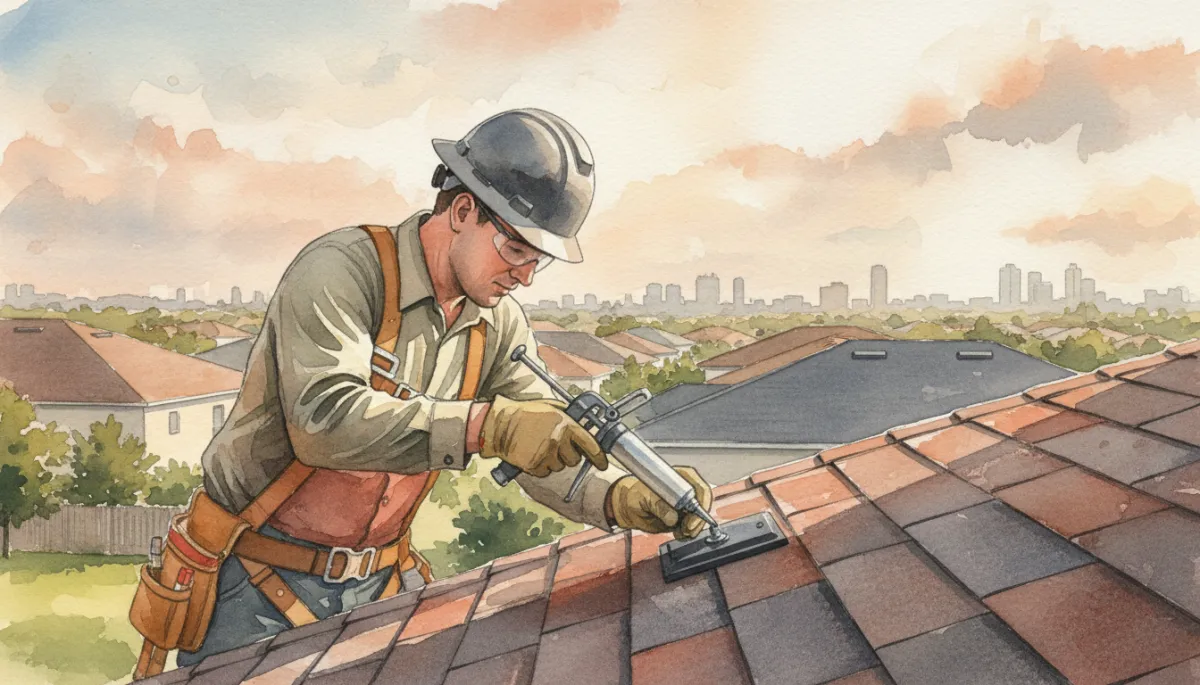
Proper re-flashing of every attachment is crucial to long-term roof performance.
💡 Pro Tip: Ask your D&R contractor to walk you through a recent project — including before-and-after photos and inspection sign-offs — so you can see their process and documentation standards in real life.
Red Flags Specific to D&R Work
Because D&R happens when your roof is already under construction, homeowners can feel rushed to “just get the panels off.” Watch for these warning signs that a contractor is not equipped for specialized D&R work in Tampa Bay’s climate and regulatory environment.
No clear mention of permits or inspections. If a contractor says permits are “not needed” for D&R, that’s a serious red flag. Most jurisdictions require permits when modifying a solar system or roof penetrations, and skipping them can create problems if you sell your home or have a claim later.
Vague or one-line scope of work. A professional D&R proposal should spell out detaching, labeling, storage, reinstallation, re-flashing, electrical testing, and inspections — not just “remove and reinstall panels.”
“We’ll reuse all the old roof attachments.” In many cases, especially with a new roof, best practice is to use new, compatible flashing and attachment hardware. Blindly reusing old penetrations can compromise your new roof’s integrity and warranties.
No written leak or workmanship warranty. If they won’t stand behind their penetrations and solar work for a reasonable period, you may be left paying for future repairs out of pocket.
Unclear storage plan for your panels. Panels stacked in a yard, leaned against a fence, or left unprotected from Tampa Bay’s sun and storms are at higher risk of damage. Ask where and how your equipment will be stored during roofing.
Contractor blames “the roofer” or “the solar company” in advance. If they’re already preparing excuses about other trades before work even starts, that’s a sign they’re used to friction and finger-pointing instead of coordinated, in-house delivery.
How D&R Warranties and Re-Flashing Typically Work
When you detach and reinstall solar, you’re touching three sets of warranties: your roof warranty, your solar equipment warranties, and the workmanship warranty from whoever does the D&R. Understanding how these overlap — and where gaps can appear — is key to choosing the right contractor.
Roof penetrations and re-flashing
Every solar attachment point is a potential leak if it’s not properly integrated with your new roof system. On a typical D&R, the contractor should:
Coordinate attachment locations with the roofer before underlayment and shingles go down, so mounts land on rafters and avoid critical roof details like valleys and ridges where possible
Use manufacturer-approved flashing kits and fasteners compatible with your roofing material (asphalt shingle, tile, metal, etc.)
Seal penetrations with appropriate sealants and underlayment details that meet or exceed Florida Building Code requirements for wind and water resistance
After reinstallation, you should receive a workmanship warranty that specifically covers leaks at solar attachment points for a defined period. This is separate from the roofer’s general warranty and your solar equipment warranties, but all three should work together — not conflict with each other.
Solar equipment and performance warranties
Panel and inverter manufacturers typically offer long-term product and performance warranties. Those warranties often require that any work on the system be performed by qualified, licensed professionals and may exclude damage from improper removal, storage, or reinstallation. Choosing a contractor with deep solar experience — not just roofing or electrical — helps ensure that D&R work stays within manufacturer guidelines and keeps your coverage intact.
What to look for in a D&R warranty package
Written leak coverage specifically for solar attachment points on your new roof
Workmanship coverage on all D&R labor, including wiring, racking, and module handling
Clear language on what happens if a panel or component is damaged during removal, storage, or reinstallation — and who pays to replace it
Coordinating Timing with Your Roofer (or Using One Contractor for Both)
D&R is all about timing. Your panels need to come off shortly before the roof work starts and go back on after inspections and final roofing stages are complete. Poor coordination leads to delays, extra trips, or panels sitting in storage longer than necessary — all of which can increase risk and cost.
When you hire separate companies
You (the homeowner) often end up as the project manager, coordinating schedules between the roofer and the D&R contractor, plus any inspectors or engineers.
If a leak or performance issue appears later, each company may argue that the other is responsible, leaving you stuck in the middle.
Design decisions — like where to place mounts on the new roof, or how to route conduit — may not be optimized because each contractor is only looking at their own scope.
Benefits of a single, fully licensed contractor
Working with one contractor that is licensed for roofing, electrical, and solar — and performs all scopes in-house — simplifies everything. Fused Solar and Roofing holds all three licenses and performs every scope in-house, rather than subcontracting any part of the job:
One schedule, one point of contact, and one contract covering the roof and the solar D&R work
Coordinated design that considers roof layout, wind loads, and solar performance together — not as separate projects
Clear responsibility if there’s ever a leak or solar issue tied to the D&R work
For Tampa Bay homeowners, choosing a single, triple-licensed contractor that manages roofing, solar, and electrical in-house can turn a potentially stressful, multi-trade project into a streamlined, well-documented process with unified warranties and accountability.
How D&R Pricing Typically Works (Without Getting Lost in Numbers)
While exact pricing will depend on your system size, roof type, and project complexity, most Tampa Bay D&R quotes follow a similar structure. Instead of focusing on a single per-panel number, look at how the contractor builds their proposal and what’s included in the scope.
Labor for removal and reinstallation: Often expressed as a per-panel range or a flat project fee that scales with system size and roof complexity.
New hardware and attachments: Many quality contractors include new roof attachments, flashing, and fasteners in their base price rather than reusing old hardware on a brand-new roof.
Permits and inspections: Reputable providers will factor in permit fees, inspection coordination, and any required documentation or engineering.
Storage and protection: If panels need to be stored off the roof for more than a brief period, there may be a line item for safe, secure storage and handling.
As you compare quotes, focus on value and protection, not just the lowest number. A slightly higher price from a fully licensed, in-house contractor that includes permits, new hardware, documentation, and strong warranties can easily pay for itself in avoided headaches and long-term peace of mind.
Ready to keep your solar system in peak condition? Schedule a free solar panel cleaning and maintenance audit at https://tampasolarmaintenance.com
FAQ: Tampa Bay Solar Detach & Reinstall
1. Do I have to remove my solar panels for every roof replacement?
In almost all cases, yes. To properly replace the roofing materials under and around your solar array, panels and racking need to be removed so the roofer can access underlayment, flashing, and decking. Leaving panels in place usually means cutting corners on the roof work, which can lead to leaks or voided warranties. A qualified D&R contractor will coordinate with your roofer to minimize downtime and ensure everything is reinstalled correctly after the new roof is complete.
2. Can my roofer handle the D&R, or do I need a solar specialist?
Some roofers offer basic removal services, but most are not licensed or trained to handle the electrical and system design aspects of solar. Ideally, you want a contractor who is fully licensed for roofing, electrical, and solar work and performs all scopes in-house. That way, the same team that understands your roof also understands your solar array, and you avoid gaps in responsibility between separate trades. If your roofer does not specialize in solar, it is safer to bring in a dedicated D&R expert to protect your system and warranties.
3. How long will my solar system be offline during D&R?
The offline window depends on your roofer’s schedule, the size of your system, and weather conditions. In many Tampa Bay projects, panels are removed the day before or the morning of roof tear-off and reinstalled after inspections and final roofing stages are complete. That can mean your system is offline for several days to a couple of weeks. A well-organized, single-contractor team can often minimize that downtime by tightly coordinating roofing and solar crews and planning around forecasted weather.
4. Will D&R affect my solar production or warranties long-term?
When D&R is done correctly, your system should return to similar or even improved performance, especially if wiring and layout are cleaned up during reinstallation. Manufacturer warranties generally remain in force as long as work is performed by qualified, licensed professionals following their guidelines. Problems arise when unqualified crews damage modules, alter wiring without documentation, or skip proper testing before turning the system back on. Choosing a D&R specialist who documents everything and tests thoroughly is the best way to protect your production and coverage.
5. What happens if a panel or component is damaged during removal?
Responsible contractors carry insurance and clearly state in their contracts how damage is handled. If a panel, optimizer, or other component is accidentally damaged during removal, storage, or reinstallation, your D&R provider should repair or replace it and handle any associated labor. Ask specifically how they document the condition of your system before work begins and how they handle claims if something goes wrong. This is another reason to work with a fully licensed, in-house contractor that stands behind the entire project, not multiple small subs with unclear responsibilities.
6. Can I act as my own contractor for D&R under Florida’s owner-builder rules?
Florida’s owner-builder exemption allows homeowners to act as their own contractor in limited situations, but it comes with strict conditions. You must personally supervise the work and cannot perform contracting services for others, and a licensed electrical contractor is still required for wiring and grid interconnection. Given the complexity of D&R — and the risk of voiding warranties or failing inspections — most homeowners are far better served by hiring a fully licensed professional who handles the roof, solar, and electrical scopes together.
7. How should I compare D&R quotes from different contractors?
Start by making sure you’re comparing similar scopes. One quote might include permits, inspections, new attachments, detailed documentation, and strong leak warranties, while another might only cover basic removal and reinstallation with reused hardware. Ask each contractor for an itemized breakdown that shows labor, materials, permits, storage, and warranty coverage. Then weigh not only the price but also licensing, in-house capabilities, experience with D&R in Tampa Bay, and customer reviews. The best value is usually the contractor who provides comprehensive protection, not just the lowest per-panel number.
8. Do I need Fused if I already have a roofer for my new roof?
Yes. Fused's electrical license (EC13014750) means we can legally handle the solar disconnect, removal, and reinstall on our own — you do not need us to also do your roofing to get expert D&R service. We coordinate directly with your roofer's timeline, disconnect and stage your system before they start, and reinstall once the new roof is ready. Our 25-year penetration warranty and Elite Installer status apply to the D&R work itself, independent of who installed your roof. We also service the array afterward regardless of who did the roofing or the original solar installation. Choosing a licensed, single-purpose D&R specialist protects you whether you use one contractor for everything or coordinate multiple trades yourself.
CUSTOMER SAFETY ALERT — All detach and reinstall work MUST be fully permitted and inspected by county authorities. Unlicensed installers CANNOT obtain permits. Demand permits, verify licenses at myfloridalicense.com, require inspections, and get certificates in writing. Unpermitted solar voids panel warranties, voids roof warranties, and leaves the homeowner liable for $15,000–$25,000+ in corrective work at resale.
Maximize your investment with expert solar maintenance. Book your solar panel cleaning and inspection service at https://tampasolarmaintenance.com
Bringing It All Together: Protecting Your Roof and Your Solar Investment
Detaching and reinstalling solar panels in Tampa Bay is far more than a logistical chore before a roof replacement. It is a specialized project that touches your home’s structure, electrical system, roof system, and long-term warranties. The contractor you choose will determine how smoothly the process runs, how well your new roof and solar array perform, and how protected you are years down the road if issues arise.
By focusing on proper licensing, in-house capabilities across roofing and solar, detailed scopes of work, strong warranties, and clear coordination with your roofer, you can approach D&R with confidence instead of stress. Ask good questions, watch for red flags, and prioritize contractors who treat your roof and solar system as a single, integrated investment — not two separate jobs. With the right partner, your roof upgrade can be the perfect opportunity to fine-tune your solar system and set it up for many more years of reliable, efficient production in the Florida sun.
Is your solar system performing at its best? Start your free maintenance consultation at https://tampasolarmaintenance.com
Fused Solar and Roofing is a licensed roofing (CCC1331058), electrical (EC13014750), and building contractor (CBC1252064), all three in-house, serving Hillsborough, Pinellas, Pasco, and Manatee counties since 2007. Fused Solar and Roofing is an EnergySage Elite Installer with a 5.0/5 rating and 21+ verified reviews, independent verification, earned not purchased.
Replacing a roof that has solar on it? Request a detach and reinstall quote at https://fusedsolarandroofing.com/solar-panel-removal
Who is allowed to do each part of a detach and reinstall, and why, is covered in our guide at https://fusedsolarandroofing.com/post/who-can-remove-reinstall-solar-florida