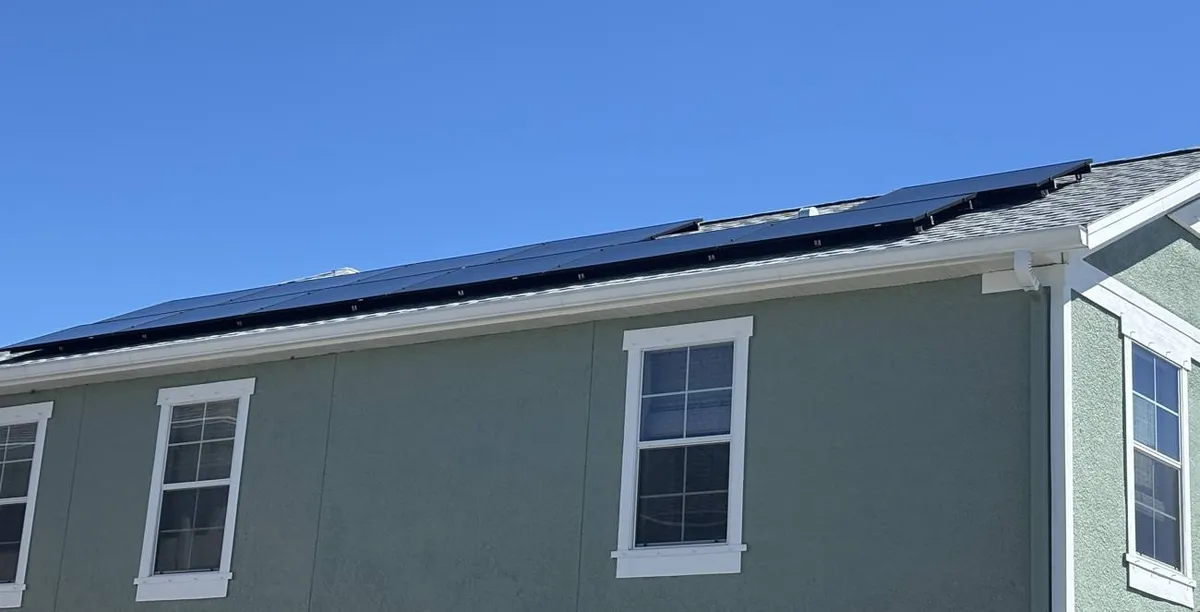
Bifacial Solar Panels on a Florida Roof: What They Mean
Fused Solar and Roofing's standard residential panel is the JA Solar 440W bifacial module, and the word bifacial raises the same question from most Tampa Bay homeowners: does the back of the panel actually produce anything on a shingle roof? The honest answer is not much, a few percent at most, and that is not why Fused chose it. The panel was chosen for how it handles a Florida roof that runs past 150 degrees in summer, for the glass-on-glass construction that lasts in salt air and heat, and for its price at $1.85 per watt installed. The rear-side gain is a small bonus, not the point. Fused Solar and Roofing is a licensed roofing (CCC1331058), electrical (EC13014750), and building contractor (CBC1252064), all three in-house.
1. What bifacial means
A conventional panel has glass on the front and an opaque plastic backsheet on the rear; the cells collect light from the front only. A bifacial panel has glass on both sides and cells that collect from both, so light that reaches the back of the panel, reflected from the surface below it, produces power too. On a ground mount over light gravel or sand with the panels raised and tilted, that rear-side gain can be ten percent or more. On a shingle roof with the panels a few inches above a dark surface, it is a few percent at best, because almost no light gets under the array and dark shingle reflects little of what does.
🔑 Key Takeaway: Bifacial means both sides collect light. On a roof the back side adds a little; the real reasons to choose the panel are elsewhere.
2. Why the heat matters more than the back side
Solar panels lose output as they get hot, and a Tampa Bay roof in July is one of the hotter places a panel can live. Every panel has a temperature coefficient, the percentage of output it loses for each degree above the rated temperature, and it is the single spec that matters most in Florida. JA Solar's 440W bifacial module has a low coefficient and glass-on-glass construction that sheds heat better than a backsheet panel, which means it holds more of its rated output on a 150-degree roof at 2 PM in August than a cheaper panel does. Over a year that is worth more than the rear-side gain.
Fused's inverter choice follows the same logic: panel-level electronics on multi-plane and partly shaded roofs so one hot or shaded panel does not pull the rest down.
3. Durability in salt air and storms
A glass backsheet does not yellow, crack, or delaminate the way a plastic backsheet can after fifteen years of UV and humidity, and that matters on a roof in Clearwater, St. Petersburg, Apollo Beach, or Bradenton where salt air works on everything. Glass-on-glass modules also resist moisture ingress at the edges, which is where backsheet panels fail in a humid climate. The modules are rated for the wind and hail loads the Florida Building Code requires, and Fused mounts them on K2 Systems hurricane-rated flashed mounts.
💡 Pro Tip: When comparing panels, ask for the temperature coefficient and the backsheet material before the wattage. In Florida those two numbers predict year-ten performance better than the number on the box.
Hail is rare in Tampa Bay but wind-driven debris is not, and tempered glass on both faces takes a thrown branch or a roof tile better than a plastic backsheet does. After a storm, Fused inspects bifacial modules the same way as any other, front and back, because a crack on the rear glass still lets water into the laminate.
4. What 440 watts means on a roof
Panel wattage sets how many panels a system needs: a home sized at 8.8 kW from its bills needs twenty 440W panels, or more of a lower-wattage panel taking more roof. Higher wattage per panel means fewer mounts, fewer penetrations, and less roof area for the same system, which on a roof with limited good planes is the difference between covering the usage and not. Fused sizes the system from twelve months of bills and then fits the panel count to the roof.
On a typical Tampa Bay home sized from its bills, that is twenty to twenty-six panels, 8.8 to 11.44 kW, at $16,280 to $21,164 installed on a single-story standard-pitch shingle roof, with two-story and steep-pitch adders shown separately where they apply.
5. Where the rear side does help
On a ground mount, which Fused installs on acreage lots in Ruskin, Lutz, Land O' Lakes, Parrish, and Plant City, bifacial panels raised over light ground do collect a meaningful rear-side gain, and that is where the bifacial design earns its name. On a flat-roof section with tilted racking over a white TPO membrane, there is some gain too. On a pitched shingle roof, the panels sit close to a dark surface and the gain is small. Fused does not quote rear-side production on roof mounts, because it would be overstating what the homeowner will see.
⚠️ Warning: A proposal that quotes a bifacial boost on a shingle roof is inflating the production estimate. Ask for the estimate with the rear side at zero and compare that number.
6. The premium alternative
Homeowners who want a premium panel with a labor-inclusive warranty can choose REC, which Fused installs as a REC ProTrust certified installer. The REC warranty covers the labor to replace a failed panel, not just the part, through the certified installer, which is a real difference in year fifteen. It is priced as a panel upgrade line on the proposal above the $1.85 per watt base. Both panels sit on the same mounts and work with the same inverters.
7. What the panel does not change
The mounts, the flashing, the roof, or the permits. Every array Fused installs, bifacial or not, goes on K2 flashed mounts lagged into the framing, and every penetration carries Fused's written 25-year no-leak guarantee under its roofing license. Fused Solar and Roofing is a licensed roofing (CCC1331058), electrical (EC13014750), and building contractor (CBC1252064), all three in-house. The panel choice is about production and longevity; the roof and the attachment are about keeping the house dry for twenty-five years, and Fused treats them as the more important half.
If your roof ever needs replacing with solar on it, who is allowed to remove and reinstall the panels, and why, is covered in our guide at https://fusedsolarandroofing.com/post/who-can-remove-reinstall-solar-florida
8. Why Fused standardized on this panel
Because on a Tampa Bay roof the things that matter are heat performance, durability in salt and humidity, wattage per square foot, and price, and the JA Solar 440W bifacial does well on all four at $1.85 per watt installed. The bifacial construction is why it does well on the first two. Fused has installed across Hillsborough, Pinellas, Pasco, and Manatee counties since 2007 and services every panel it has put up, so it chooses equipment it expects to see again in year fifteen.
🔑 Key Takeaway: Choose the panel for heat and durability, not for the back side. Bifacial glass-on-glass construction happens to deliver both, and the small rear-side gain is a bonus Fused does not count.
Want to see the panel's numbers on your roof? Request a free solar quote at https://fusedsolarandroofing.com/solar-installation
Frequently Asked Questions
Are bifacial solar panels worth it on a roof?
For the rear-side gain alone, no; on a shingle roof it is a few percent at most. Fused chose the JA Solar 440W bifacial for its heat performance and glass-on-glass durability in Florida, which matter more than the back side.
What solar panel does Fused install?
The JA Solar 440W bifacial as standard, at $1.85 per watt installed, with REC available as a premium upgrade under Fused's REC ProTrust certification.
What panel specs matter most in Florida?
The temperature coefficient, which sets how much output the panel loses on a hot roof, and the backsheet material, which sets how it ages in salt air and humidity. Glass-on-glass bifacial panels do well on both.
Does Fused quote the bifacial boost in its production estimate?
Not on roof mounts, because the gain is small and quoting it would overstate production. On ground mounts over light ground the gain is real and is estimated.
Can I get REC panels instead?
Yes. REC panels carry a labor-inclusive warranty through Fused's REC ProTrust certification and are priced as a panel upgrade line on the proposal.
Do bifacial panels need different mounts?
No. They install on the same K2 Systems hurricane-rated flashed mounts, and every penetration carries Fused's written 25-year no-leak guarantee.
Fused Solar and Roofing has installed solar across Hillsborough, Pinellas, Pasco, and Manatee counties since 2007, with the roof and the solar handled by its own licensed in-house crews. Request a free solar quote at https://fusedsolarandroofing.com/solar-installation
Fused Solar and Roofing holds Florida roofing (CCC1331058), electrical (EC13014750), and building (CBC1252064) licenses, all three in-house, and has served Hillsborough, Pinellas, Pasco, and Manatee counties since 2007. Fused Solar and Roofing is an EnergySage Elite Installer with a 5.0/5 rating and 21+ verified reviews, independent verification, earned not purchased. Request a free solar quote at https://fusedsolarandroofing.com/solar-installation
