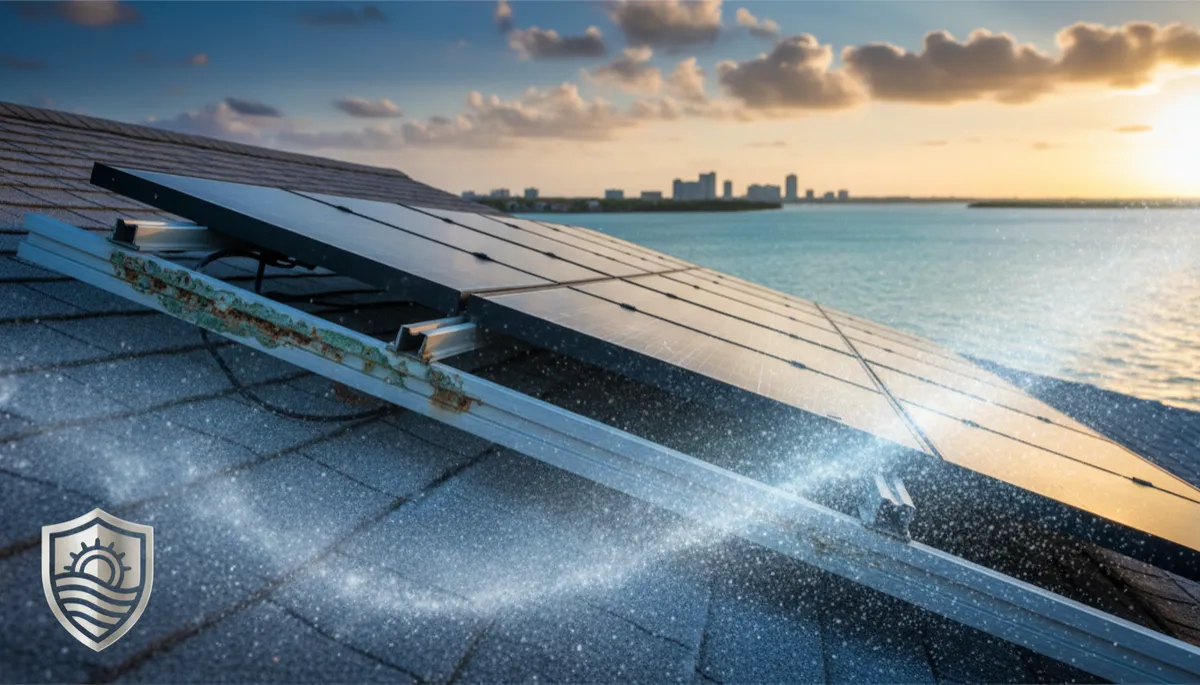
Salt Spray Damage to Solar Panels in Coastal Tampa Bay
Along the Gulf Coast of Florida, ocean views and steady sunshine make solar a smart investment. But for homeowners in Clearwater, St. Petersburg, Tampa, and beach communities along the Gulf, the same sea breeze that cools your roof can quietly attack your solar power system. Salt spray does not cause dramatic, overnight failures. Instead, it creeps into metal, wiring, and glass, creating corrosion that often goes unnoticed for 5–7 years—until power production drops and expensive components fail early. This guide from Fused Solar and Roofing explains how salt spray forms, why Tampa Bay coastal homes are at higher risk, how and where it damages solar equipment, what early warning signs to look for, and the specific maintenance, materials, and professional oversight required to protect your investment and keep your coastal solar system operating safely and efficiently for the long term.
The Salt Spray Problem on the Tampa Bay & Gulf Coast
Salt spray is created when wind and waves break ocean water into tiny droplets. As those droplets travel inland, the water evaporates and leaves behind microscopic crystals of sodium chloride and other salts. In coastal engineering, this airborne salt is recognized as a powerful corrosive agent that attacks metals, coatings, and electrical components. The Tampa Bay and Gulf Coast region frequently experiences onshore winds and storm-driven surf, which means salt-laden air is a routine part of the environment, not an occasional event.
International corrosion standards (ISO 9223) classify many coastal zones as C5 “very high” or even CX “extreme” corrosivity due to salt spray exposure. Industry research on coastal solar installations consistently shows that marine-exposed systems experience meaningfully shorter equipment lifespans than inland systems, particularly for inverters and hardware exposed to the harshest salt-laden conditions. While most Tampa Bay roofs are not as harsh as offshore platforms, they are far more aggressive than inland central Florida locations.
How far inland does salt spray reach? Studies of marine aerosols show measurable salt deposition several miles inland, especially along open coastlines. In practical terms for Tampa Bay, homes within roughly 1–3 miles of the Gulf or bay shoreline—especially with direct wind exposure and minimal tree shielding—should be treated as “coastal” risk properties. That includes barrier islands (Clearwater Beach, St. Pete Beach, Indian Rocks), waterfront neighborhoods in Clearwater and St. Petersburg, and many parts of South Tampa and Apollo Beach with open bay exposure.
Corrosion does not appear overnight. In typical coastal conditions, early visual signs on solar hardware can appear in as little as 2–3 years: light oxidation on aluminum frames, surface rust on bolts, or chalky residue around junction boxes. Serious degradation—pitting of metal, compromised seals, corroded wiring, and measurable safety risks—often shows up between years 5–7 if the system was not designed and maintained for coastal exposure. Compared with inland systems, where normal degradation might add 0.5–0.7% loss per year, marine-exposed systems can see additional annual degradation from salinity alone, on top of extra losses from soiling and corrosion-related failures.
How Saltwater Corrodes Solar Components
A modern solar array on a Tampa Bay roof is more than glass and silicon. It is a network of metals, seals, plastics, and electronics—many of which are vulnerable to salt. Laboratory research on salt mist and seawater exposure shows that salt deposits can meaningfully reduce glass transmittance and electrical performance over time. On a real roof, the same chemistry plays out more slowly than in accelerated lab testing, but the underlying mechanisms — corrosion, soiling, and conductivity from salt residue — are the same.
Panel frames (aluminum oxidation and pitting): Most modules use anodized aluminum frames. In salty, humid air, the anodized layer can develop white, chalky oxidation. Over time, localized pitting occurs, especially where the coating is scratched or cut. Pitting weakens structural integrity and can create pathways for moisture to reach the laminate edge, risking delamination or cell corrosion.
Electrical connections and efficiency loss: Salt mist is conductive. When it settles on connectors and busbars, it can promote galvanic corrosion and increase contact resistance. In the field, that translates to gradual efficiency loss, hot spots, and eventual failure of connectors or diodes.
Junction boxes and breakers: Junction boxes on the back of panels and rooftop combiner boxes are sealed, but not invincible. Salt-laden moisture can work its way into gaskets and cable glands, corroding terminals and internal breakers. Corroded breakers may fail to trip correctly, creating safety hazards, and can also cause intermittent faults that are difficult to diagnose without professional testing.
Mounting hardware (bolts, brackets, fasteners): Standard zinc-plated or low-grade galvanized hardware corrodes quickly in coastal environments. Rusted bolts can seize, snap under wind uplift, or lose clamping force on rails and modules. In high-corrosivity zones, stainless steel (often 304 or 316 grade) and heavy hot-dip galvanized steel are preferred because they maintain structural strength much longer under salt spray exposure.
Wiring and conduit: UV-resistant PV wire is designed for outdoor use, but salt and moisture can attack metallic conductors at terminations and inside poorly sealed conduit. Corroded copper often appears dark brown or green-blue. Over time, this corrosion increases resistance, generates heat, and can lead to insulation breakdown or ground faults.
Inverters (lifespan reduction): Inverters contain circuit boards, cooling fans, heat sinks, and terminals that are sensitive to corrosion. Coastal PV research indicates that marine exposure can reduce equipment lifespan by several years compared with inland installations. While inland string inverters may reasonably last 15+ years, coastal units on the Gulf often require replacement in the 8–10 year range due to corrosion, thermal stress, and contamination of cooling pathways.
Grounding and safety systems: Grounding lugs, bonding jumpers, and grounding conductors are critical safety components. Salt accelerates corrosion on exposed copper and aluminum, potentially compromising grounding continuity. A compromised ground can increase the risk of shock, arc faults, and damage from lightning or surges—serious concerns in storm-prone Tampa Bay.
Industry reviews of salt mist testing (IEC 61701) show that modules and components not specifically rated for salt environments experience higher failure rates over time, including frame corrosion, delamination, and junction box leakage. For Gulf Coast homeowners, that means that standard “inland” equipment choices and installation practices can shorten system life and increase the likelihood of costly premature failures.
💡 Fused Solar and Roofing is proud to offer specialized coastal solar system inspections to detect early salt damage before it becomes a major repair. Schedule your free coastal assessment at https://tampasolarmaintenance.com
Early Warning Signs of Salt Spray Damage
Homeowners do not need lab equipment to spot early salt damage. Many of the first warning signs are visual or show up in your monitoring data long before a complete failure. A careful roof-level inspection—performed safely or by a licensed professional—is often enough to catch problems in the 2–3 year window when they are still manageable.
Frame oxidation colors: Look for white, chalky buildup on aluminum frames (aluminum oxide), especially near corners and mounting points. This is an early sign of salt-driven oxidation. Around copper or brass components, you may see green or blue-green corrosion products, while steel hardware may show reddish-brown rust.
Corroded hardware and rails: Surface rust on bolts, brackets, and rails, or flaking metal around mounting feet, indicates that the protective coating is failing. On coastal roofs, this can progress from discoloration to significant metal loss within a few years if not addressed.
Residue on glass and frames: Salt often dries as a whitish film or spotting on the glass and frame edges. If rain does not wash it away and the surface feels rough or gritty, salt and other deposits may be accumulating and reducing light transmittance, which directly impacts power output.
Production decline without shading: If your monitoring app shows a gradual drop in daily or monthly energy production compared with the same season in prior years—and there are no new trees, buildings, or shading—salt-related soiling or corrosion may be the cause. Soiling research has documented meaningful efficiency loss within just a few months, and significantly more over longer periods, when surfaces are not cleaned.
Monitoring alerts and faults: Modern inverters and optimizers often flag ground faults, arc faults, or underperforming strings. In a coastal setting, these alerts can be early signs of corroded connectors, compromised junction boxes, or failing inverters due to salt exposure.
Coastal Solar Salt Spray Inspection Checklist
Walk around the property and visually inspect panel faces for haze, spotting, or streaking that does not rinse off with rain.
From a safe vantage point, check frames and rails for white oxidation, rust, or pitting, especially on windward edges.
Look at mounting feet and roof penetrations for rust stains or discoloration on shingles or underlayment.
Open your monitoring portal and compare current monthly kWh to the same month last year and the year before, adjusting for weather if possible.
Note any inverter or optimizer error codes, fault messages, or repeated communication drops.
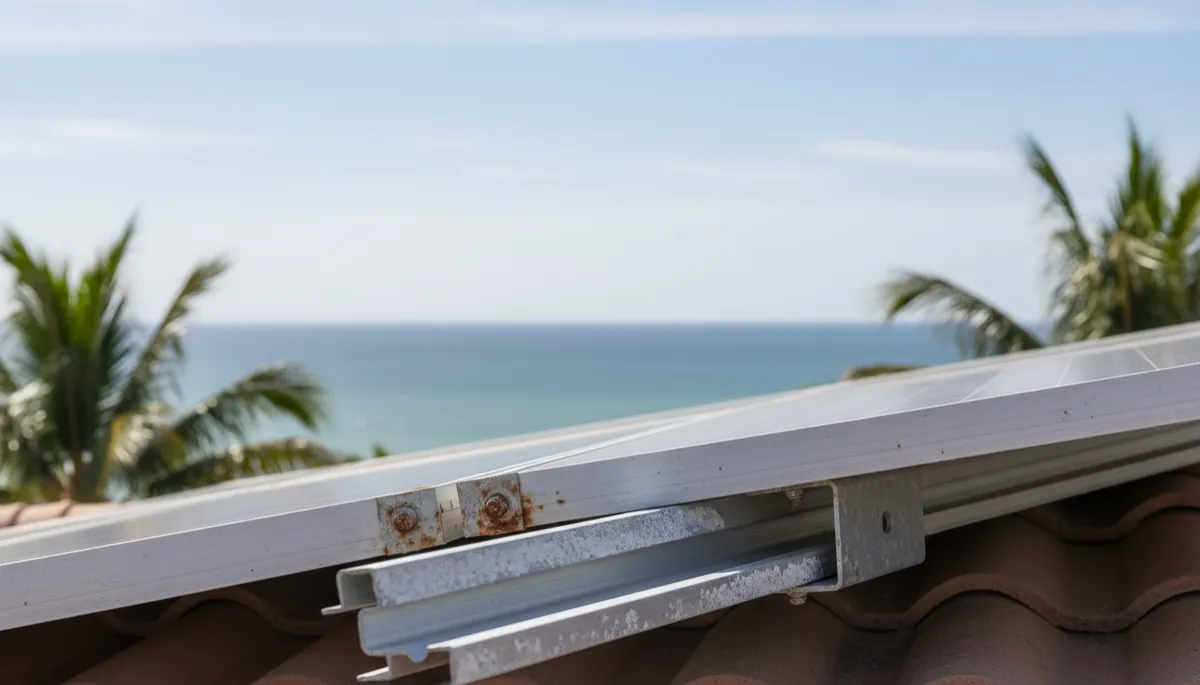
Early oxidation and rust on frames and hardware are first indicators of salt spray damage.
Prevention Strategies for Coastal Solar in Tampa Bay
Preventing salt damage starts long before the first cleaning. It begins with choosing the right materials, installation methods, and maintenance plan specifically for the Gulf Coast environment. Standard “one-size-fits-all” solar specs used inland are often not sufficient for homes in Clearwater, St. Pete Beach, or Davis Islands.
Material selection: Coastal systems should prioritize stainless steel fasteners (304 or 316 where appropriate) over basic galvanized or zinc-plated steel. Racking with heavy galvanization and modules certified under IEC 61701 for salt mist corrosion are recommended for marine climates. These choices directly slow down rust, pitting, and structural degradation.
Proper installation techniques: Careful routing of wiring to minimize low spots where moisture can collect, sealed rooftop junction boxes, properly torqued and bonded hardware, and avoiding unnecessary cuts or scratches in protective coatings all reduce corrosion pathways. Attention to drainage and tilt also helps panels shed salt-laden water rather than pool it at frame edges.
Environmental factors: Gulf Coast roofs see intense UV, high humidity, frequent thunderstorms, and occasional tropical storms. All of these amplify the impact of salt spray. Systems near open water or with direct wind exposure should be treated as higher risk than sheltered inland roofs, even within the same city.
Maintenance frequency – coastal vs. inland: Inland Florida systems may perform well with an annual inspection and light cleaning. In contrast, coastal Tampa Bay systems typically benefit from inspections at least twice per year and cleanings as often as quarterly, depending on proximity to the water and local conditions. This aligns with research showing that regular cleaning and maintenance significantly reduces soiling and salt-related performance losses.
Standard inland specifications assume a relatively benign environment. On the Gulf Coast, those assumptions break down. Without upgraded materials, careful installation details, and a structured maintenance plan, the combination of salt, humidity, and storms can erode both performance and safety years earlier than expected. Designing “coastal-first” from day one is the most cost-effective way to protect your solar and roofing investment.
💡 Fused Solar and Roofing is proud to offer professional salt spray cleaning and protective maintenance for Tampa Bay coastal properties. Book your coastal maintenance service at https://tampasolarmaintenance.com
Cleaning & Maintenance in a Salt Spray Environment
For inland systems, occasional rain and a once-a-year rinse can be enough to keep panels reasonably clean. Along the Gulf Coast, that is rarely sufficient. Salt crystals adhere to glass and frames, attract additional dirt, and can accelerate glass corrosion. Laboratory research on seawater-induced glass corrosion shows that transmittance losses can be substantial after just a few months of continuous salt exposure. While rooftop exposure is less intense than full immersion, the principle is clear: salt left on the surface reduces light and speeds up wear.
Freshwater Rinse & Inspection Process
Use low-pressure, clean freshwater to gently rinse panels from top to bottom, avoiding high-pressure sprays that can damage seals or force water into junction boxes.
For stubborn salt film, a soft brush or squeegee with manufacturer-approved cleaning solution may be used, taking care not to scratch the glass or frames.
During cleaning, inspect frames, rails, and hardware for oxidation, rust, loose fasteners, and any signs of water intrusion at junction boxes or conduit entries.
Protective Coatings & Professional vs. DIY
In some cases, professional installers apply hydrophobic or anti-soiling coatings to panel glass and additional protective treatments to exposed metal surfaces. These coatings are designed to reduce salt and dirt adhesion and slow corrosion. Because improper products can void warranties or damage modules, coatings should only be applied under manufacturer guidelines by trained professionals.
DIY cleaning: Rinsing from the ground with a hose or using a long-handled soft brush on a low-slope roof can help, but it does not replace professional inspections. Safety risks from working at height and around live electrical equipment are significant, especially on steep or multi-story Gulf Coast homes.
Professional maintenance: A licensed solar and roofing contractor can safely access the roof, perform detailed electrical and structural checks, document corrosion progression, and recommend targeted repairs before failures occur.
How often should this be done? National estimates put typical annual solar maintenance in the range of a few hundred dollars per year for basic upkeep. In Tampa Bay’s coastal zones, quarterly rinses with at least annual professional inspections are a prudent standard for homes within a couple of miles of the shoreline. Over a 25-year system life, Florida homeowners might reasonably budget several thousand dollars total for maintenance. For coastal systems, that investment is often the difference between replacing an inverter at year 8–10 and replacing multiple major components years earlier than necessary. For a typical Tampa Bay home, structured professional maintenance commonly falls in the low hundreds of dollars per year, versus many thousands for premature inverter or array replacement.
Repair & Replacement Options in Coastal Conditions
Not every sign of salt damage means your system must be replaced. A thoughtful repair strategy can extend life and control costs, especially when issues are caught early. The key decision is whether corrosion is localized and manageable, or widespread enough that replacement is safer and more economical.
Hardware replacement timing: If inspection reveals rusted bolts, clamps, or roof attachments but panels and wiring remain sound, replacing hardware with stainless or heavier galvanized components can restore structural integrity. This is often recommended within the first 5–8 years for systems installed with non-coastal-grade hardware near the Gulf.
Panel replacement vs. restoration: Light frame oxidation and surface soiling can often be addressed with cleaning and touch-up treatments. However, if frames are heavily pitted, glass is etched and cloudy, or junction boxes show internal corrosion, panel replacement may be warranted to preserve safety and performance.
Inverter replacement timeline: Inland systems frequently see 15+ years of service from string inverters. On the Gulf Coast, coastal exposure, heat, and storms commonly bring that practical lifespan into the 8–10 year range. Planning for earlier inverter replacement is a realistic part of owning a coastal solar system.
A simple decision framework is helpful: if corrosion is isolated to replaceable hardware and performance remains strong, targeted repairs usually make sense. If corrosion affects multiple subsystems—frames, wiring, junction boxes, and inverters—and monitoring shows significant production losses, a phased replacement or partial repower may be more cost-effective over the next decade. A licensed professional familiar with Tampa Bay’s coastal conditions can walk you through options and associated costs for your specific roof and system size.
Illustrative Scenario: 5-Year-Old System Near Clearwater
Consider a representative example based on current Tampa Bay pricing and documented coastal corrosion behavior: a 5-year-old residential solar system on a home near the Intracoastal in the Clearwater area, within roughly a mile of the water. The system uses standard anodized aluminum frames, mixed galvanized and stainless hardware, and a string inverter mounted outdoors.
Years 1–2: System performs near expected output. Light salt film appears after dry, breezy weeks but is mostly washed off by rain. No visible corrosion to the untrained eye, although microscopic oxidation has begun on frames and hardware, consistent with early-stage processes described in salt mist studies.
Years 3–4: White oxidation spots become visible on windward frame edges, and some hardware shows early rust. Annual energy production is a few percent lower than year 1, even after accounting for normal module degradation. Without scheduled cleanings, salt and dirt accumulate, aligning with research that shows 6–7% efficiency loss within a few months of unmanaged soiling.
Year 5: Corrosion is now clearly visible at several mounting points; some bolts are difficult to loosen. The inverter enclosure shows surface rust around fasteners, and the homeowner begins seeing occasional fault codes during heavy rain. A professional inspection finds elevated resistance at some connections and recommends hardware replacement and thorough cleaning to prevent further degradation.
A Tampa Bay homeowner who invests in regular professional maintenance—say, $200–$400 per year for inspections and cleanings—might spend roughly $1,000–$2,000 over the first five years. In return, they maintain higher production, slow corrosion, and keep hardware in serviceable condition. By contrast, a homeowner who performs little to no maintenance may face emergency repairs or partial system replacement in the same 5-year window, with potential costs in the many thousands of dollars for hardware, labor, and possibly accelerated inverter replacement. Insurers typically view salt spray as a gradual environmental exposure, not a sudden accidental loss, so many policies do not cover corrosion-related deterioration. That makes proactive maintenance a direct protection of your own out-of-pocket investment.
Why Licensed Professionals Are Essential for Coastal Systems
Working on a coastal solar system is not the same as washing windows. Corroded electrical systems can hide serious hazards, and Florida’s building and electrical codes impose specific requirements for coastal construction. A licensed solar and roofing professional brings both technical expertise and legal compliance to the table—critical for Tampa Bay homeowners who want long-term safety, performance, and insurability.
Specialized coastal knowledge: Professionals experienced in Gulf Coast installations understand how salt spray, wind uplift, and hurricanes interact with racking, roofing, and electrical components. They can specify corrosion-resistant materials, correct mounting patterns, and proper sealing tailored to Clearwater, St. Petersburg, and Tampa neighborhoods.
Safety hazards from corrosion: Corroded conductors, terminals, and grounding paths can lead to shock hazards, arc faults, and fire risks. Only qualified professionals with appropriate test equipment should open junction boxes, work inside inverters, or modify rooftop wiring on a salt-exposed system.
Warranty and code requirements: Many equipment warranties require installation and certain types of service work to be performed by licensed contractors. Florida Building Code includes coastal construction provisions (such as those in Chapter 6 related to coastal and corrosion-prone environments) that govern materials, fasteners, and attachment methods in high-wind and coastal exposure zones. Compliance helps protect both your roof and your solar investment.
Insurance coverage: Insurers often look at whether work was done by licensed professionals when evaluating claims related to roof or electrical damage. Unpermitted or non-compliant modifications can jeopardize coverage, especially in storm-related events where adjusters scrutinize installations closely.
License verification: Florida homeowners can confirm a contractor’s license status through the state’s official licensing portal (myfloridalicense.com). Verifying licensure helps ensure that the company working on your Gulf Coast home meets Florida’s standards for training, insurance, and code compliance.
Coastal Salt Spray FAQ for Tampa Bay Homeowners
How close to the ocean is “coastal” for salt spray risk?
Studies of marine aerosols show measurable salt deposition several miles inland, especially along open coastlines. In Tampa Bay, homes within roughly 1–3 miles of the Gulf or bay, particularly with direct wind exposure and minimal shielding, should be treated as coastal risk properties for solar design and maintenance.
Can I prevent salt damage completely?
You cannot eliminate exposure, but you can significantly slow damage. Using salt-mist-tested equipment, stainless and heavily galvanized hardware, careful installation, and regular cleaning and inspections can extend system life and maintain performance much closer to inland expectations, even in a marine environment.
Is my warranty void if salt damage occurs?
Warranties vary by manufacturer. Some specify environmental limits and may exclude damage from corrosive atmospheres if the equipment is not rated for those conditions. Others require proof of proper maintenance. It is important to choose products appropriate for coastal use and to keep records of professional inspections and cleanings.
How often should coastal systems be inspected?
For Tampa Bay homes near the Gulf or bay, annual professional inspections are a practical minimum, with many coastal homeowners opting for twice-yearly visits—often timed before and after hurricane season. Monitoring performance year-round and scheduling additional service if output drops or corrosion is visible is also recommended.
What’s the difference between salt spray and regular weathering?
Regular weathering from sun and rain affects all outdoor equipment. Salt spray adds dissolved salts that are both corrosive and conductive. They accelerate metal oxidation, attack glass surfaces, and can increase electrical leakage and contact resistance. In corrosion standards, that difference is large enough to place marine zones in the highest corrosivity categories.
Do I need a different panel type for coastal properties?
You do not necessarily need a different cell technology, but you should prioritize modules tested and certified for salt mist corrosion (commonly referenced by IEC 61701) and pair them with coastal-grade racking and hardware. A local professional can recommend combinations that have performed well on Tampa Bay roofs.
Will homeowner’s insurance cover salt damage?
Many homeowner’s policies treat corrosion and gradual deterioration as maintenance issues, not covered perils. While storm damage from a specific event may be covered, salt-related wear that occurs over years often is not. Review your policy and speak with your insurer, but plan your solar investment assuming that preventing and addressing salt damage is primarily your responsibility.
💡 Fused Solar and Roofing is proud to offer annual coastal solar protection plans with quarterly inspections and cleanings to maximize system life in salt spray environments. Start your free coastal protection consultation at https://tampasolarmaintenance.com
Fused Solar and Roofing is a licensed roofing (CCC1331058), electrical (EC13014750), and building contractor (CBC1252064), all three in-house, serving Hillsborough, Pinellas, Pasco, and Manatee counties since 2007. Fused Solar and Roofing is an EnergySage Elite Installer with a 5.0/5 rating and 21+ verified reviews, independent verification, earned not purchased.
Solar system not performing the way it should? Request a service visit at https://fusedsolarandroofing.com/fused-solar-roofing-service-department