Owning vs. Leasing Solar in Tampa Bay: How to Decide
You are comparing solar offers for your Tampa Bay home, and you have noticed that the arrangements are not all the same. There are three common ways to get solar on your roof, and the biggest differences usually show up years later, not on the day you sign. Fused Solar and Roofing is a licensed roofing (CCC1331058), electrical (EC13014750), and building contractor (CBC1252064) — all three in-house.
1. Three ways to get solar on your roof
When you sit down with different solar companies, you may hear confident phrases like “no money down,” “you own it,” or “it is just like your utility bill.” Underneath those phrases, though, there are really three basic ways to put solar on a roof. Understanding which one you are being offered is the starting point for every other decision you will make about the project.
The first way is to buy the system outright. In this case, you pay the full cost of the equipment and installation from your own funds. Once it is installed and paid for, the solar equipment on your roof is yours, just like a new air conditioner or a new appliance you bought in cash. There is no solar payment after that, because you have already paid for the system itself. Any future costs would be for service or repairs if they are needed, not for the basic right to use the equipment on your roof.
The second way is to finance the purchase with a loan. Here, you still become the owner of the solar equipment, but you pay for it over time instead of all at once. You sign a loan agreement, and you make payments until the loan is repaid. The solar system itself belongs to you, not to the lender. The loan is simply how you spread out the cost. Many Tampa Bay homeowners choose this route because it lets them own the system while keeping their upfront cost lower than a full cash purchase would require on day one.
The third way is a lease or power purchase agreement. In these arrangements, another company owns the solar equipment on your roof. You do not buy the panels and inverters themselves. Instead, you sign an agreement to pay the company either for the use of the system or for the power it produces. The agreement runs for a set period of time, and you make payments under that agreement, much like you might pay for a subscription or a long-term service contract. The key point is that the equipment remains the property of the solar company, not the homeowner, throughout the term unless the agreement says otherwise at the end of the term.
In simple terms, the first two options — paying cash or financing the purchase — both make you the owner of the solar equipment on your roof. The third option — a lease or power purchase agreement — does not. That one leaves ownership with another company, even though the panels are physically attached to your home. Once you see the offers through that lens, the rest of the questions become easier to organize, even if the final choice still takes some thought.
📌 Key Takeaway: Buying and financing both make you the owner of the equipment on your roof. A lease or power purchase agreement does not.
2. What owning means
When you own a solar system, whether you paid in cash or used a loan, the equipment becomes part of what you own along with the rest of the property. You decide who installs it, who services it, and how any future changes are handled. You are not paying another company for the right to keep panels on your roof. Instead, you are responsible for them in the same way you are responsible for your roof, your HVAC equipment, or your pool equipment if you have one.
Ownership also means you carry the responsibility for maintenance and repairs. If an issue comes up years down the road, you choose who to call. You may work with the original installer, or you may choose a different contractor if you prefer. If you want to upgrade, add batteries later, or move equipment during a renovation, you are the one who authorizes that work. The decisions are yours because the equipment is yours. For many homeowners, that control is a core part of why they prefer owning over other arrangements, especially when they plan to live in the home for a long time and want to make long-range decisions about their property without checking in with a third party first.
Fused Solar and Roofing installs systems that you own, whether you pay for the system outright or finance it.
Owning does not mean you are on your own. A reputable installer will explain what kind of support they offer after installation, what is covered under their workmanship and equipment warranties, and how service calls work. The key difference is that, with ownership, you are free to choose among qualified contractors over the life of the system. You are not tied to a single company because they own the hardware on your roof. That flexibility can matter later, especially if your original installer changes its business model, sells to another company, or you simply want a second opinion about a repair or upgrade.
3. What a lease or power purchase agreement means
In a lease or power purchase agreement, you are not buying solar equipment. Instead, another company installs and owns the system on your roof. You agree to let that company keep its equipment on your property, and in return you pay for the use of that system or for the electricity it produces. The agreement runs for a set term, and your relationship to the panels is defined by that contract, not by ownership. You benefit from having solar on your roof without having to purchase the equipment itself, but you also accept that the owner of the equipment has a say in what happens to it throughout the term of the agreement.
These arrangements can reduce or even remove what you pay upfront to get solar installed. That is one of the main reasons they are appealing to some homeowners. Instead of coming up with a large payment or qualifying for a loan, you sign a lease or power purchase agreement and begin making regular payments under that agreement. For households that want solar but are focused on minimizing upfront cost, this can look like the simplest path. The tradeoffs, however, tend to show up later in the term, when you sell the home, need roof work, or want to change something about the system on your roof. At that point, the fact that you do not own the equipment matters in practical ways.
Any federal tax benefit tied to a leased or third-party-owned system belongs to the company that owns the equipment, not to the homeowner.
With a lease or power purchase agreement, the company that owns the system typically handles monitoring, maintenance, and repairs under the terms of the contract. That can feel reassuring because you know who to call if there is an issue. At the same time, you are depending on that company’s processes, response times, and policies for as long as the agreement lasts. You do not have the same freedom to hire a different contractor to work on the equipment, because it is not your equipment. When everything goes smoothly, this can feel very convenient. When something urgent comes up — especially involving your roof — the extra layer of coordination can be noticeable.
Comparing solar offers? Fused Solar and Roofing gives straight answers across Hillsborough, Pinellas, Pasco, and Manatee counties. Request a free solar quote at https://fusedsolarandroofing.com/new-solar-installation
4. The questions that actually decide it
With so many sales pitches and numbers in front of you, it is easy to feel that choosing between owning, financing, and leasing is complicated beyond reach. In practice, the choice usually comes down to a few clear questions that you can ask every company you speak with. These are not accusations; they are simply the points that shape how living with solar will feel over the next decade or more in your Tampa Bay home. Asking them calmly and directly helps you compare offers on equal footing, no matter how different the marketing language might be from one company to the next.
The first question is straightforward: who owns the equipment on my roof under this arrangement? If the answer is “you do,” then you are looking at a purchase, either in cash or with a loan. If the answer is that another company owns it, you are looking at a lease or power purchase agreement. That single answer shapes everything that follows, including what happens when you sell the home or need roof work. It is worth getting this answer in plain language, even if the paperwork uses more formal terms for the same idea. Do not be shy about asking the salesperson to say it clearly: who owns the panels and inverters once the system is installed?
The second question is: who is responsible for maintenance and repairs? With ownership, you are responsible, even if you hire someone else to do the work. With a lease or power purchase agreement, the company that owns the system usually takes on that role under the contract, but you should confirm exactly how that works. Along with that, ask who you call when something goes wrong and how service calls are handled. Ask how quickly they typically respond to issues and what the process looks like from your side as the homeowner. You are not demanding guarantees; you are simply trying to understand how life with this system will feel when it needs attention on a busy weekday or during storm season in Tampa Bay.
The next questions are about change. What happens under this arrangement if I decide to sell the home? What happens if the roof needs work while the system is in place? These are not distant, theoretical issues. Every roof eventually needs attention, and many families move sooner than they expect. Ask each company to walk you through, in general terms, how those situations are handled under the kind of agreement they are offering. You are not asking them to interpret a contract on the spot. You are asking for a clear explanation of the path a typical homeowner follows in those situations, so you can picture yourself in it and decide whether you are comfortable with it before you sign anything.
💡 Pro Tip: Ask one question first: who owns the equipment on my roof? Almost every other difference follows from the answer.
5. What happens when you sell the home
Moving is when the differences between owning and leasing tend to become very real. If you own your solar system — whether you paid cash or financed it — you are selling a house that has equipment on it. The panels, inverters, and related hardware are part of what a buyer sees when they walk onto the property. From the buyer’s point of view, there is a roof with solar already in place, and they will want to understand what condition it is in and what paperwork comes with it. Your role as the seller is to gather that information so you can answer questions and share documents when the time comes, just as you would with any other significant improvement to the home.
If you financed your owned system with a loan, you will also be deciding what to do about that loan as part of your overall plan for selling. Some homeowners choose to pay off the loan at or before closing; others handle it differently based on their broader financial picture. The important point here is that the solar equipment itself is an asset you own. You and your advisors decide how to address any remaining loan balance in the context of your sale, just as you would with any other loan tied to an improvement you made while living in the home. The buyer is looking at equipment that will belong to them once they own the house, not at a contract they are being asked to take over from you with a third party.
When you are in a lease or power purchase agreement, the picture is different. You are not selling a house with your equipment on it. You are selling a house with another company’s equipment on it and an agreement attached to it. That means there are more parties involved in the conversation around closing. The buyer will want to know what the agreement says and what it would mean for them if they move forward with the purchase. The buyer’s lender may also have questions about the agreement, since it involves equipment attached to the property that is not owned by the homeowner. And the company that owns the solar system will have its own process for what happens when a home with its equipment on the roof changes hands. All three of those perspectives have to line up in a way that allows the sale to move forward smoothly.
Because of that, the practical step is the same no matter which path you chose originally: gather your paperwork early and find out what your own agreement says about selling the home well before you list the property. If you own the system, that means locating your installation documents, equipment information, and any warranties or service records you have. If you are in a lease or power purchase agreement, that means locating your contract and any related documents and understanding, in general terms, how the company that owns the system handles a home sale. You do not need to predict every detail, but you do want to avoid surprises in the middle of a transaction that already has many moving parts. Starting early gives you time to ask questions and plan calmly, instead of reacting under deadline pressure once you are already under contract with a buyer.
6. What happens when the roof needs work
Every roof in Tampa Bay eventually needs attention, whether it is routine maintenance after storm seasons, repairs after a leak, or a full replacement. When there are solar panels on that roof, they have to come off before most major work can happen and then be put back on once the roof work is complete. How simple or complicated that feels depends a lot on whether you own the system or a third party does. Thinking through this before you choose an arrangement can save you stress years from now, when roof work may already feel urgent because water is involved or a storm has just passed through the area.
When you own the system, you can hire whoever you choose to remove and reinstall the panels and coordinate with your roofer. Some homeowners prefer to work with a company that handles both roofing and solar in-house so that one team plans the sequence of work. Others prefer to use a roofer they already know and bring in a separate solar contractor to handle the array. The important point is that, as the owner of the equipment, you are the one authorizing that work and choosing the professionals who will do it. You can schedule the removal, roof repair or replacement, and reinstallation in a way that fits your needs and your budget, without waiting for permission from a company that owns the hardware on your roof.
When another company owns the system under a lease or power purchase agreement, the process usually starts with that company. Because they own the equipment, they generally have to be involved before anyone touches the array. That can add time and coordination to a roof project that may already feel time-sensitive. You may need to contact the solar company, follow their process for scheduling removal and reinstallation, and fit your roofer’s schedule around those dates. Many homeowners work through this successfully, but it is a different experience than calling a roofer and a solar contractor of your choice and having them coordinate directly. The extra layer is not necessarily a problem, but it is something to be aware of when you are deciding which type of agreement fits your comfort level for future projects on your home.
Fused Solar and Roofing removes and reinstalls solar for roof work with its own in-house electrical and roofing crews, and services systems of all brands. Fused Solar and Roofing is a licensed roofing (CCC1331058), electrical (EC13014750), and building contractor (CBC1252064) — all three in-house.
⚠️ Warning: Before signing any solar agreement, find out what it says about roof work. A roof repair cannot wait while a third party decides who may touch the panels.
7. What to read before you sign anything
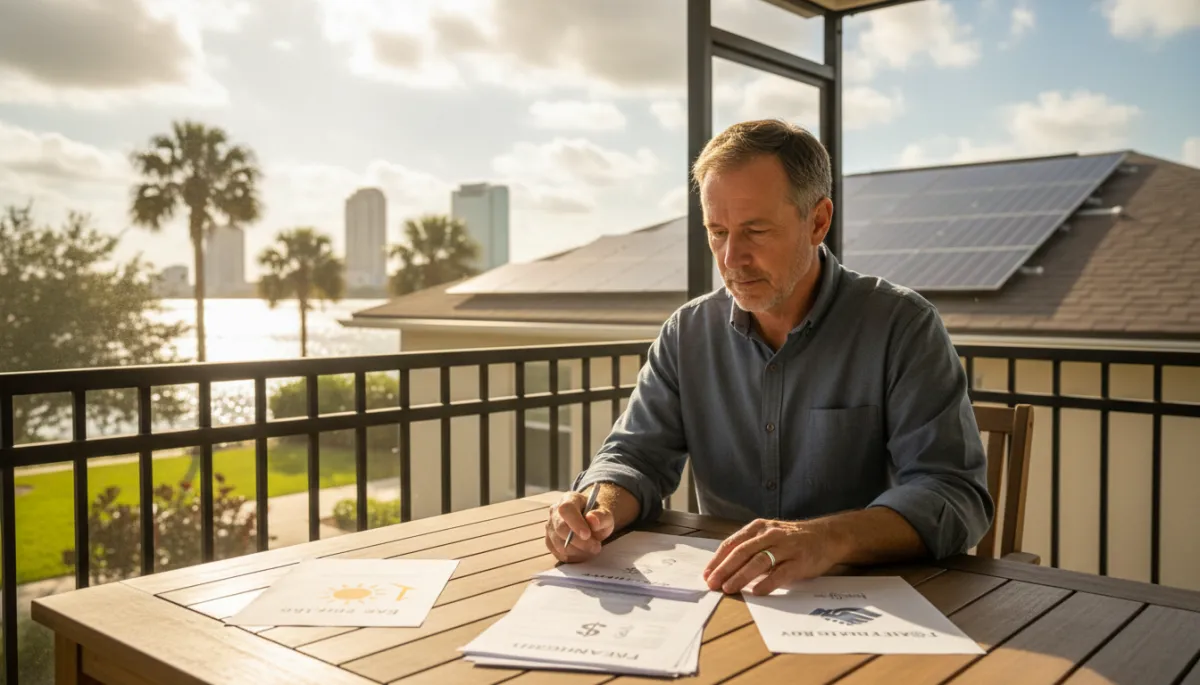
No matter which path you are leaning toward — owning, financing, or leasing — the most important document is the agreement itself, not the sales presentation or a summary sheet. Before you sign, set aside some quiet time to read the full agreement from start to finish. You are looking for a few key points that shape your life with solar over the long term. Taking this step now, while you are not rushed, is much easier than trying to untangle something later when you are in the middle of a home sale or a roof repair and everyone is working against a deadline.
First, look for the length of the term. How long does this agreement last, and when does it end? If you are buying with a loan, that means understanding how long you will be making payments. If you are leasing or in a power purchase agreement, that means understanding how long the company will own equipment on your roof. Next, look at what you pay and how that can change over time. The exact structure will vary from one agreement to another, but you want to see, in plain language, what you are committing to pay and under what conditions that payment could be different in the future. Do not rush past this part; it is the financial core of the decision you are making for your household budget.
Then, look for the sections that describe who is responsible for maintenance and repairs, what happens if you sell the home, what happens at the end of the term, and what the agreement says about roof work. Each of these topics affects real situations you are likely to face during the life of the system. You are not trying to become a lawyer; you are simply checking that you can follow the basic story the agreement tells in each of those areas. If anything is unclear, take the agreement to your own attorney and ask them to explain it to you. That is not overreacting; it is a reasonable step when you are signing a long-term contract that will affect your home and your finances for many years. Relying only on a verbal explanation from a salesperson, without reading the document yourself, leaves you guessing about details that are already written down in black and white.
📌 Key Takeaway: Fused Solar and Roofing installs systems you own and removes and reinstalls solar of all brands for roof work, under roofing license CCC1331058 and electrical license EC13014750.
8. How to decide
After you have sorted through the offers, read the agreements, and asked your questions, the choice between owning and a third-party arrangement often comes down to a few honest reflections about your plans and preferences. There is no single answer that fits every Tampa Bay household. The right path is the one that matches how long you expect to stay in the home, how you feel about control over equipment on your roof, and how you prefer to handle upfront cost versus long-term obligations. It is worth pausing here, away from the sales conversation, and giving yourself room to think about those factors clearly before you sign anything.
Owning — whether through a cash purchase or a loan — generally suits a homeowner who plans to stay in the home, wants control of the equipment, and is comfortable handling either the upfront cost or the responsibility of a loan. If you like the idea of deciding who works on your system, choosing when and how to upgrade it, and gathering your own documents when it is time to sell, ownership lines up with those instincts. You are taking on the role of equipment owner in exchange for that control. For many families, especially those who see their current house as a long-term home, that tradeoff feels natural and straightforward, even if it involves a larger commitment at the start.
A lease or power purchase agreement suits someone who wants solar with less upfront cost and accepts that another company owns the equipment on their roof. If you are more focused on getting solar installed quickly with minimal initial outlay, and you are comfortable working within a long-term agreement when it comes time to sell or repair the roof, a third-party arrangement can fit those priorities. You are trading some control for convenience and a different payment pattern. That is not automatically good or bad; it is simply a different way to structure the relationship between your home, the solar equipment, and your monthly budget over time.
The right answer depends on your household, not on which option a salesperson presents first. You are allowed to step back, compare offers side by side, and decide what feels right for your situation rather than reacting to the most polished pitch. Fused Solar and Roofing is an EnergySage Elite Installer with a 5.0/5 rating and 21+ verified reviews — independent verification, earned not purchased. If you want a calm, plain-language walkthrough of what owning solar would look like for your Tampa Bay home, you can ask for that without committing to anything on the spot. The important thing is that you end up with an arrangement you understand and are comfortable living with for years, not just an agreement you signed because it was the first one you saw.
Frequently Asked Questions
1. What is the difference between leasing solar and owning it?
When you own solar, the equipment on your roof belongs to you. You either pay for it outright or repay a loan, and you decide who services it and how future changes are handled. When you lease solar or sign a power purchase agreement, another company owns the equipment. You pay for the use of the system or for the power it produces under a contract that runs for a set term. Ownership stays with the solar company, not with you, for as long as that agreement is in place.
2. Who owns the panels in a solar lease or power purchase agreement?
In a solar lease or power purchase agreement, the panels and other solar equipment are owned by the solar company, not by the homeowner. The company installs its equipment on your roof and keeps ownership of it. You agree to let that equipment stay on your property and to make payments under the terms of the contract, but you do not become the owner of the hardware during the term unless the agreement specifically provides for a change at the end of the term.
3. Who repairs a leased solar system?
With a leased system or power purchase agreement, the company that owns the equipment typically handles repairs and maintenance under the terms of the contract. If something goes wrong, you contact that company, and they follow their process for service calls. The details of how that works — including response times and what is covered — are set out in the agreement, so it is important to read that section carefully before you sign. You are relying on the owner of the system to take care of issues throughout the term, rather than hiring your own contractor to work on equipment you own.
4. Can I sell my house with leased solar panels on it?
Homes with leased solar systems are sold regularly. When you sell a house with leased panels, the agreement itself sets out what is involved in that situation. The buyer will want to understand the contract, and the solar company will have its own process for handling a home sale. The best step you can take is to find out what your agreement requires well before listing, so you have time to gather documents, ask questions, and plan the next steps without rushing during the sale.
5. What happens to leased panels when I need a new roof?
If you are in a lease or power purchase agreement and your roof needs work, the company that owns the panels is usually involved before anyone removes or reinstalls the system. You would contact the solar company, follow their process for scheduling the temporary removal of the array, and coordinate that schedule with your roofer. Because the equipment is not yours, you cannot simply hire another contractor to move it without the owner’s participation. This can add coordination to a project that may already feel urgent, which is why it is important to understand how roof work is handled under your agreement before you sign it.
6. Is it better to finance solar or lease it?
Financing a solar system makes you the owner of the equipment, while a lease or power purchase agreement does not. With financing, you repay a loan but the panels belong to you. With a lease, you pay for the use of a system that someone else owns. Beyond that basic difference, the better choice depends on your household’s plans and finances — how long you expect to stay in the home, how you feel about control over the equipment, and how you want to balance upfront cost against long-term commitments. Taking time to compare both options side by side can help you see which one fits your situation more comfortably.
Fused Solar and Roofing has installed solar across Hillsborough, Pinellas, Pasco, and Manatee counties since 2007, with the roof and the solar handled by its own licensed in-house crews. Request a free solar quote at https://fusedsolarandroofing.com/new-solar-installation
Want a straight comparison for your home? Request a free solar quote at https://fusedsolarandroofing.com/new-solar-installation