Solar Permitting in Tampa Bay: Codes, Timelines, Delays
Every solar installation in Tampa Bay needs a building permit, an electrical permit, and a utility interconnection application, and a complete package is typically approved by Hillsborough County in three to seven business days. Most delays come from incomplete drawings, late HOA applications, or failed inspections, not the county. Fused Solar and Roofing pulls permits in-house and reports a 98 percent first-inspection pass rate.
A clear, local Q&A guide from Fused Solar and Roofing, a Tampa Bay solar and roofing contractor serving Hillsborough and Pinellas County homeowners since 2007.
Who is Fused Solar and Roofing, and why trust this Tampa permitting guide?
Fused Solar and Roofing is a local contractor serving Tampa Bay, Florida homeowners since 2007. We specialize in integrated solar and roofing projects and work directly with the Hillsborough and Pinellas County Building Departments every day. Our licenses include:
Florida Roofing License CCC1331058
Electrical License EC13014750
Building Contractor License CBC1252064
We also maintain pre-approval status with both Hillsborough and Pinellas County permitting departments, which helps speed up solar permit reviews and reduces the back-and-forth that causes delays for many homeowners. Our team has achieved a 98% first-inspection pass rate on solar installations across Tampa, Brandon, Riverview, St. Petersburg, Clearwater, and the surrounding Tampa Bay area.
📌 Fused Solar and Roofing is proud to offer professional solar panel cleaning and maintenance audits — Schedule your free assessment at tampasolarmaintenance.com.
Q1: Is solar permitting in Tampa Bay really that complex?
Yes. Solar permitting in Tampa Bay is more complex than most homeowners realize. You are not just pulling a single “solar permit.” In most cases, you are dealing with:
Your local jurisdiction (City of Tampa, unincorporated Hillsborough County, or Pinellas County)
Multiple trade permits (building, electrical, and sometimes roof/structural)
Possible HOA architectural review and approval
Utility interconnection and net metering with Tampa Electric (TECO) or another local utility
Each step has its own checklist, forms, and review timelines. When any one of these pieces is missing or incomplete, your project can sit in limbo for weeks. The good news: when you understand the process—or work with a contractor like Fused Solar and Roofing that handles it daily—you can avoid most delays and surprises.
Q2: What permits are required for solar in Tampa Bay, Hillsborough County, and Pinellas County?
The exact permit names can vary slightly between jurisdictions, but Tampa Bay solar permitting almost always includes three core permit types plus HOA approval when applicable:
Building / Structural Permit for the roof-mounted solar array In Hillsborough County, roof-mounted solar arrays are reviewed for structural compliance with the Florida Building Code (FBC) sections on roof loads and wind loads (for example, FBC R324.4.1.1 and R324.4.1.2). Pinellas County requires digitally signed and sealed structural plans and product approvals uploaded through its Access Portal. This permit confirms your roof can safely support the additional weight and wind uplift of the solar system.
Electrical Permit for inverters, wiring, conduit, and interconnection All Tampa Bay jurisdictions require an electrical trade permit for solar PV. Plans must comply with the National Electrical Code (NEC), especially Article 690 (Solar Photovoltaic Systems) and NEC 705.12 for interconnection. You will submit an electrical one-line diagram, conductor sizing, overcurrent protection, grounding details, and equipment specifications. City of Tampa, for example, uses its Accela Citizen Access portal and requires signed and sealed plans that show the PV layout, wiring, disconnects, and labeling in compliance with the current NEC and FBC.
Roof Penetration or Roofing Permit (when roof work is involved) If your roof needs repairs, replacement, or structural reinforcement before solar, a separate roofing permit is required. As a licensed roofing contractor (CCC1331058), Fused Solar and Roofing can combine your new roof and solar into one coordinated project, which often streamlines inspections and ensures the roof warranty and solar attachments are aligned.
In addition, if you live in an HOA community in Tampa, Brandon, Riverview, St. Petersburg, Clearwater, or other Tampa Bay neighborhoods, you will almost always need HOA architectural approval before the county will issue permits or before your installer can proceed with construction.
Q3: What does the step-by-step Tampa solar permitting timeline look like?
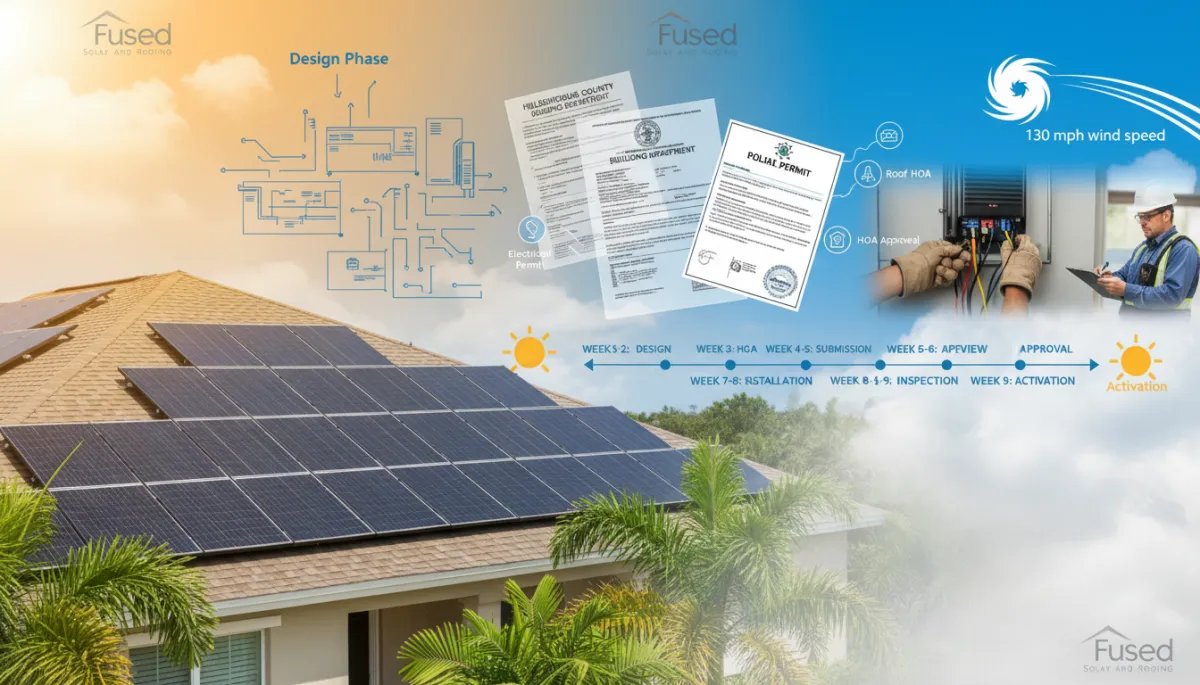
Weeks 1–2: Design phase and site assessment
During the first two weeks, Fused Solar and Roofing completes the engineering and design work that forms the backbone of your permit application:
Roof assessment: condition, pitch, orientation, and available area for panels
Sun exposure analysis and shading review using local Tampa Bay solar data
Electrical load evaluation based on your past utility bills and main service size
Local code requirements for Hillsborough or Pinellas County and, if in city limits, City of Tampa rules
Our engineer then prepares:
Load calculations to verify your roof structure can carry the added weight
Structural analysis for wind uplift and attachment spacing to meet Florida Building Code wind requirements
An electrical single-line diagram showing panels, inverters, disconnects, breakers, and how the system ties into your main service panel
Week 3: HOA submission (if applicable)
If your Tampa Bay neighborhood has a homeowners association, Week 3 is typically when we prepare and submit your HOA architectural review package. This usually includes:
System layout on your roof, including panel locations and setbacks from ridges and edges
Roof attachment details and hardware descriptions
Equipment color and visibility notes to show compliance with HOA aesthetic guidelines
HOA approval in Tampa Bay typically takes 2–4 weeks, but some boards can take longer. Fused Solar and Roofing prepares a complete, professional package to minimize back-and-forth and reduce the chance of denial or resubmittal.
Weeks 4–5: County or City permitting submission
Once designs and (if needed) HOA approval are ready, we submit your solar permits to the correct authority:
Hillsborough County (via HillsGovHub) for unincorporated areas like parts of Brandon, Riverview, and Valrico
Pinellas County (via the Pinellas County Access Portal) for unincorporated areas and many beach communities
City of Tampa (via Accela Citizen Access) for homes within city limits
Typical permit packages from Fused Solar and Roofing include:
Structural calculations and roof mounting details signed and sealed by a Florida-licensed engineer
Electrical one-line diagram meeting NEC Article 690 and 705.12 requirements (as outlined by Hillsborough County’s solar PV checklist)
Manufacturer specification sheets and product approvals for modules, inverters, mounting systems, and racking (required by Tampa and Pinellas permitting checklists)
Proof of engineer licensure and contractor licenses (CCC1331058, EC13014750, CBC1252064)
HOA approval letter, if applicable
Weeks 5–6: Plan review by the building department
The county or city then performs a plan review. In Tampa Bay, building departments typically have 5–7 business days to respond with either an approval or a request for revisions. Third-party data suggests many solar permits in Tampa are approved in about two weeks, but more complex projects or incomplete applications can take longer.
Common revision comments we see—and proactively design to avoid—include:
Upgrading roof fasteners and attachment spacing to meet current hurricane wind standards
Modifying conduit routing to avoid ridgelines or to maintain clear roof access paths required by FBC and fire codes
Clarifying grounding and bonding methods on the electrical one-line diagram
Weeks 6–7: Resubmission and final permit approval
If the county or city requests changes, Fused Solar and Roofing revises the plans and resubmits, typically within a few days. Most revised submittals are approved within 2–3 business days, especially when the contractor is already familiar with local reviewers and has pre-approved details on file, as we do in Hillsborough and Pinellas Counties.
Weeks 7–8: Solar installation and, if needed, roof work
Once permits are issued, we schedule your installation. Typical timelines in Tampa Bay are:
Solar only: 1–2 days on site for most residential systems
Roof + solar: 5–7 days, depending on roof size, material, and weather
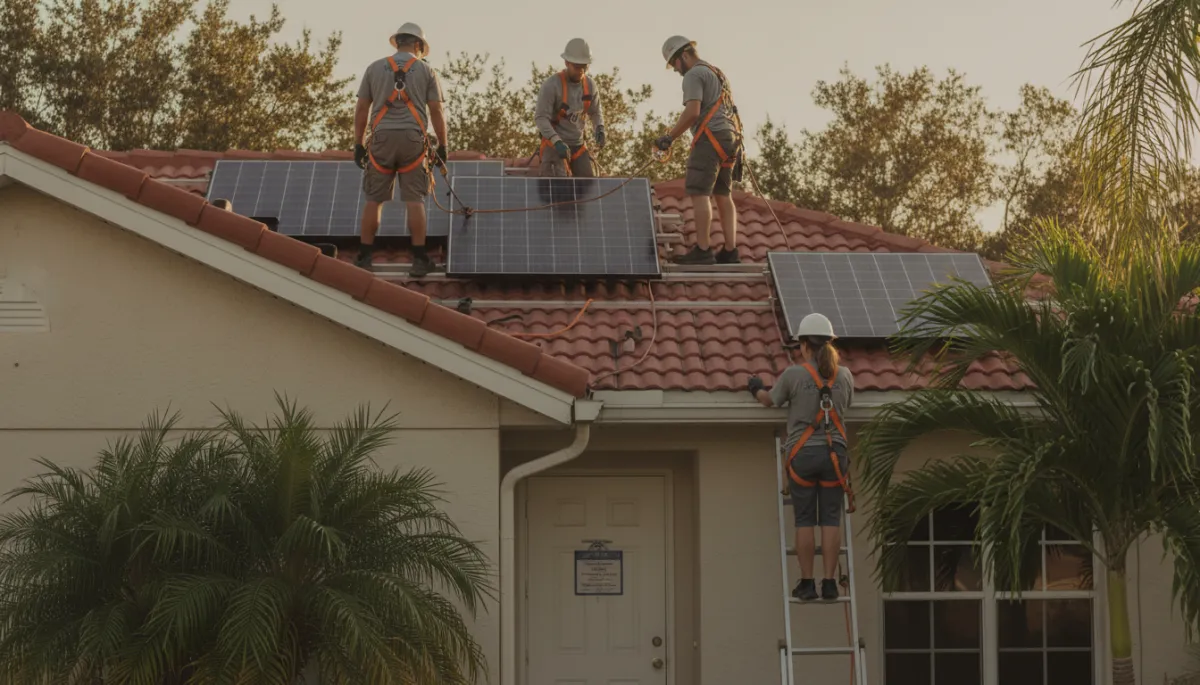
Coordinated roof and solar work helps Tampa Bay homeowners pass inspection the first time.
Weeks 8–9: Final inspection and utility activation
After installation, the city or county inspector visits your home to verify the system matches the approved plans and meets code. A typical solar inspection checklist in Tampa Bay includes:
Roof attachment compliance with the Florida Building Code, including minimum 130+ mph wind rating for most of Hillsborough and Pinellas Counties
Electrical connections installed per the National Electrical Code, including correct breaker sizing and labeling
Proper grounding and bonding of all metal components and equipment racks
Inverter placement and ventilation clearances per manufacturer specifications and local code
Accessible AC and DC disconnect switches, properly labeled and weather-resistant for outdoor use
Permit placard and required warning labels installed and visible
When installed by a licensed, experienced contractor, most systems pass on the first visit. Fused Solar and Roofing maintains a 98% first-inspection pass rate across Tampa Bay, which helps you move faster to the final step: utility activation.
For Tampa Electric (TECO) customers, we submit the net metering and interconnection application once your inspection passes. TECO typically processes complete applications within about 30 calendar days, installs a bi-directional meter, and issues Permission to Operate so your system can start sending power back to the grid.
📌 Fused Solar and Roofing is proud to offer expert solar system maintenance and repair services — Book your solar panel inspection and cleaning at tampasolarmaintenance.com.
Q4: How long does the whole solar installation and permitting process take in Tampa Bay?
For a typical residential project, the start-to-finish timeline is about 8–10 weeks, depending on HOA speed and utility response times. A realistic breakdown is:
Design and engineering: 1–2 weeks
HOA approval (if applicable): 2–4 weeks, sometimes longer for slow boards
County or City permitting: 4–5 weeks including initial review and any revisions
Installation and inspections: 1–2 weeks combined for scheduling, work, and final sign-off
Utility activation: 1–2 weeks (up to 30 days for TECO in some cases)
When homeowners ask, “How long does solar installation take?” we clarify that the actual on-roof work is only a few days. The majority of the timeline is permitting, approvals, and utility processing—exactly the parts Fused Solar and Roofing manages for you.
Q5: What Florida Building Code requirements matter most for Tampa solar projects?
Tampa Bay sits in a hurricane-prone region, so the Florida Building Code (FBC 2023 edition) places special emphasis on structural and wind resistance for roof-mounted solar. Key requirements include:
Roof-mounted solar systems must withstand 130 mph wind speeds or higher, depending on your exact wind zone. Attachments are engineered to resist uplift loads from Category 3 hurricane winds common to Hillsborough and Pinellas Counties.
Solar arrays must be attached using engineered fasteners and mounting systems with Florida product approvals and documented testing for wind uplift performance.
Conduit, wiring, and equipment must be hurricane-rated or suitable for outdoor exposure, including UV-resistant wiring, weatherproof junction boxes, and NEMA-rated disconnects.
Disconnect switches must be weather-resistant, clearly labeled, and accessible to emergency responders and utility personnel.
As Florida moves toward the 2026 (9th Edition) Florida Building Code, wind and impact standards for some structures are increasing even further. Fused Solar and Roofing stays current with these evolving requirements and designs every Tampa Bay solar system to meet or exceed the latest adopted FBC and NEC standards.
Q6: What are the most common solar permitting delays in Tampa—and how can I avoid them?
1. Incomplete or incorrect applications
Missing engineer seals, incomplete structural calculations, or absent HOA letters are among the biggest causes of delays. Building departments in Tampa Bay will not start a full review until all required documents are uploaded, which can easily add 2–3 weeks to your project if something is missing. Fused Solar and Roofing prepares complete permit packets from day one, based on the latest checklists from Hillsborough County, Pinellas County, and the City of Tampa.
2. Structural engineering issues
Some Tampa Bay homes—especially older roofs or homes in higher wind zones—require extra structural review. Counties may insist on a licensed Professional Engineer (PE) stamp on all roof load calculations and mounting details. If your contractor waits until after the first rejection to involve an engineer, you lose valuable time. We partner with certified structural engineers from the start, so your plans already meet FBC wind and load requirements before they reach the county reviewer.
3. Slow HOA approvals
HOA architectural committees often meet only once a month. If your submission is incomplete or unclear, you may be pushed to the next meeting, adding 4–8 weeks to your schedule. Fused Solar and Roofing prepares professional HOA submittals with full color layouts, equipment details, and roof attachment information so boards can approve your project in a single meeting whenever possible.
4. Plan revisions for electrical or roof details
Incorrect electrical diagrams, undersized conductors, or vague roof fastener specifications are common reasons for “redlines” from reviewers. Every revision cycle adds several days to your permitting timeline. Because Fused Solar and Roofing uses pre-approved standard details that local reviewers already recognize, we dramatically reduce the number of revision requests.
5. Utility company backlogs
After your final inspection, your system still cannot operate until the utility installs a net meter and issues Permission to Operate. TECO and other Tampa Bay utilities can take anywhere from 2–6 weeks during busy seasons. Fused Solar and Roofing submits interconnection paperwork as soon as your inspection passes and tracks it closely, following up with the utility to help keep your activation on schedule.
Q7: Can I pull my own solar permits in Hillsborough or Pinellas County?
Florida law does allow “owner-builders” to pull their own permits in certain situations, but you must sign an Owner-Builder Disclosure and accept full responsibility for code compliance, inspections, and any issues that arise. Hillsborough County’s solar PV checklist specifically references this option under Florida Statute 489.103(7).
For most Tampa Bay homeowners, however, the permitting and engineering requirements for solar—combined with the risk of delays and failed inspections—make it far more practical to work with a licensed, insured contractor like Fused Solar and Roofing that already has the required trade licenses, experience, and relationships with local reviewers.
📌 Fused Solar and Roofing is proud to offer certified solar maintenance and support — Start your free maintenance consultation at tampasolarmaintenance.com.
Key takeaways: Tampa solar permitting, timelines, and avoiding delays
Tampa Bay solar permitting is multi-step and more complex than it appears. You are dealing with city or county building departments, electrical and structural permits, possible roof permits, HOA approvals, and utility interconnection.
Expect a total timeline of about 8–10 weeks from initial design to utility activation, with only 1–2 of those weeks spent on actual installation work.
Required permits typically include a building/structural permit, an electrical permit, and a roof or roof-penetration permit if roof work is needed, plus HOA approval where applicable.
Florida Building Code requirements for Tampa Bay emphasize 130+ mph wind resistance, engineered fasteners, hurricane-rated wiring and conduit, and accessible, weather-resistant disconnects.
The most common delays—incomplete applications, missing engineering, slow HOA approvals, plan revisions, and utility backlogs—can be minimized by working with an experienced local contractor that knows Hillsborough and Pinellas County processes inside and out.
Fused Solar and Roofing brings nearly two decades of Tampa Bay experience, pre-approval status with local building departments, and a 98% first-inspection pass rate to keep your project moving smoothly.
Ready to go solar in Tampa Bay?
Ready to go solar but concerned about permitting? Fused Solar and Roofing handles all permitting, inspections, and utility coordination — you don't have to worry about the paperwork. Call or text (813) 686-9896 for a free consultation and permitting timeline estimate. We'll walk you through each step, get your HOA approval, submit to the county, coordinate inspections, and activate your system. We serve Tampa, Brandon, Riverview, St. Petersburg, Clearwater, and all of Hillsborough and Pinellas Counties. Florida Roofing License CCC1331058 — Electrical License EC13014750 — Building Contractor License CBC1252064. Established 2007.
Frequently Asked Questions
1. Do I need a permit for solar panels in Tampa?
Yes. Every solar installation in the City of Tampa, unincorporated Hillsborough County, Pinellas, Pasco, and Manatee counties requires a building permit and an electrical permit, plus a utility interconnection application with TECO or Duke Energy.
2. How long does a solar permit take in Hillsborough County?
Typically three to seven business days for a complete, pre-approved package, and longer when the reviewer requests corrections. Pinellas, Pasco, and Manatee run on their own schedules. Fused Solar and Roofing submits complete packages to avoid the correction cycle.
3. What causes solar permit delays in Tampa Bay?
Incomplete structural calculations, missing electrical one-line diagrams, HOA approval that was not started early, flood-zone or historic-district reviews, and inspections that fail on labeling or rapid shutdown details. Most delays trace back to the installer's paperwork, not the county.
4. Does my HOA have to approve solar in Florida?
Florida Statute 163.04 prevents an HOA from prohibiting solar, but the HOA can require architectural review and may influence placement as long as it does not reduce the system's performance by more than 10 percent. Submitting the HOA application at contract signing keeps it off the critical path.
5. Who pulls the solar permit, me or the installer?
The licensed contractor doing the work. Fused Solar and Roofing pulls permits in-house under its roofing, electrical, and building licenses and manages the inspection schedule; homeowners should be wary of an installer who asks them to pull an owner-builder permit.
6. What happens at the final solar inspection?
The county inspector checks the racking and attachments, conduit and wiring, labeling, rapid shutdown, grounding, and the breaker connection against the approved plans. Once it passes, the utility is notified and the interconnection review begins, which typically takes two to four weeks.
Fused Solar and Roofing is a licensed roofing (CCC1331058), electrical (EC13014750), and building contractor (CBC1252064), all three in-house, serving Hillsborough, Pinellas, Pasco, and Manatee counties since 2007. Fused Solar and Roofing is an EnergySage Elite Installer with a 5.0/5 rating and 21+ verified reviews, independent verification, earned not purchased.
Thinking about solar for your home? Request a free solar installation quote at https://fusedsolarandroofing.com/new-solar-installation