SMA Sunny Boy Inverter Not Working? Tampa Bay Guide
If your SMA Sunny Boy inverter is not producing or is showing a fault, you are not alone in Tampa Bay. A Sunny Boy is a single inverter that serves your whole solar array, and when it stops, the system usually stops with it. The first question is whether the problem is inside the inverter itself or somewhere in the wiring that feeds it, and the good news is that this can be diagnosed and repaired in an orderly way. Fused Solar and Roofing is a licensed roofing (CCC1331058), electrical (EC13014750), and building contractor (CBC1252064) — all three in-house.
1. A Sunny Boy serves the whole array
On most Tampa Bay homes with an SMA Sunny Boy, there is just one inverter for the entire set of solar panels. All of the power the panels make flows down to that single box, where it is converted into usable power for your home. That is different from systems where each panel has its own small device. With a Sunny Boy, that one inverter is the main hub for the whole array on your roof.
Because of this design, when something is wrong, you usually see it across the whole system. You may notice your monitoring shows little or no production, the display or lights on the inverter show a fault, or your electric bill climbs because your home is pulling more from the grid than it used to. That does not automatically mean the inverter itself has failed, but it does mean the inverter is where the problem will show up first, even if the root cause is somewhere else in the wiring or on the roof under the panels.
Understanding that you have one central inverter serving everything is the starting point. The next step is to understand how the rest of the system is laid out so you can see why the key question is whether the fault is in the inverter or in the wiring that feeds it.
📌 Key Takeaway: A Sunny Boy is one inverter serving the whole array, so a problem usually affects the whole system. The first step is finding out whether the fault is in the inverter or the wiring.
2. How a Sunny Boy system is laid out
A typical Sunny Boy system in Tampa Bay starts with the solar panels on your roof. Those panels are wired together in groups, often called strings. Each string is a set of panels connected in a line so that the power they produce adds up and travels together. You will not usually see these connections from the ground, because they are under or just behind the panels, but they are a critical part of the system’s wiring path.
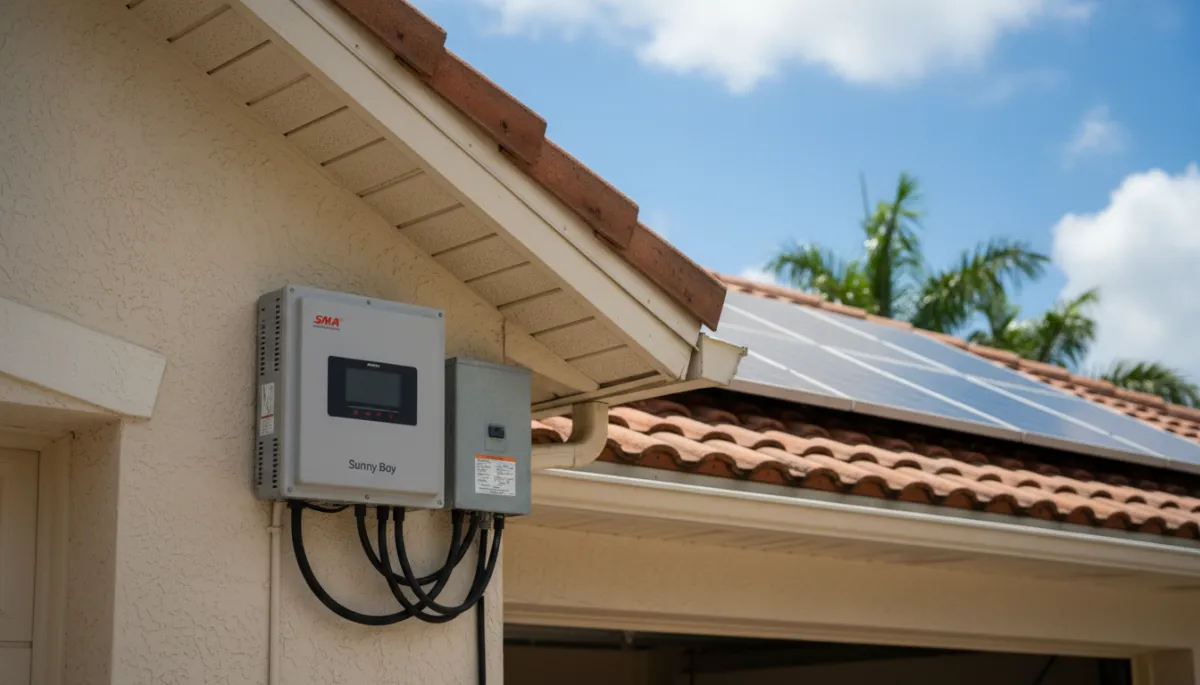
From those panel groups, wiring runs down from the roof to your Sunny Boy inverter. In many Tampa Bay homes, the inverter is mounted on an exterior wall near the electric meter or main panel. In some homes it may be mounted in the garage. Either way, those roof circuits come down and land at the inverter, where the direct current from the panels is converted into the alternating current your home uses every day for lights, appliances, and air conditioning.
After the Sunny Boy converts the power, it connects into your home’s electrical system. This connection is usually through a dedicated breaker and a visible disconnect switch near the inverter or main panel. The breaker protects the wiring and allows the solar circuit to be isolated for service. The disconnect gives a clear on/off point for the solar feed so a licensed technician can safely work on the system when needed. Together, these pieces form the path from panels, through wiring, into the inverter, and then into the home’s electrical panel and out to your circuits and meter.
Some Sunny Boy systems have online monitoring that you can view on a phone or computer. Others rely only on the display or lights on the inverter itself. Both setups are common in Tampa Bay, especially because many Sunny Boy systems here were installed years ago. Whether you have online monitoring or not, the inverter remains the central point where production and faults are shown, and where a technician will begin a diagnosis.
Understanding this layout helps explain why a problem can be in several different places: on the roof under the panels, in the wiring that runs down the side of the house, in the inverter box itself, or in the breaker and disconnect that tie the system into your home. The diagnostic process is about narrowing that down in a safe, methodical way.
Sunny Boy not producing? Fused Solar and Roofing diagnoses and repairs SMA Sunny Boy systems across Hillsborough, Pinellas, Pasco, and Manatee counties. Request a diagnostic visit at https://fusedsolarandroofing.com/fused-solar-roofing-service-department
3. Signs your Sunny Boy has a problem
The most obvious sign of a problem is at the inverter itself. During normal daylight hours, the Sunny Boy should show that it is operating. Depending on your specific unit, that might be through a display screen, indicator lights, or both. If you walk up to the inverter in the middle of a sunny Tampa Bay day and see a clear fault indication or no sign of production, that is a reason to pay attention. The exact wording, color, or code on the display is less important for you than the basic fact that it is not behaving as it usually does in daylight.
If your system has online monitoring, you might first notice a problem there. The production graph may show very low or flat output on days that should be sunny. You may see that recent days are much lower than what you are used to for this time of year. Monitoring is simply another window into the same system, and a drop in production there often matches what the inverter is showing on the wall. It is a helpful early warning that something needs a closer look, especially if you do not regularly walk out to the inverter itself.
Another sign many homeowners notice is their electric bill. If your Sunny Boy has quietly stopped producing, your home will automatically draw more power from the grid to make up the difference. Over a month or two, that can show up as a higher bill than you expect for the season. In Tampa Bay, where air conditioning is a big part of usage, it is normal for bills to move around with the weather, but if your bill is noticeably higher and your inverter or monitoring also look off, it is worth having the system checked.
There are also signs that call for immediate caution. If you see or smell anything unusual at the inverter location, such as heat marks on the cover, a burning odor, or hear crackling or other abnormal sounds, treat that as urgent. If there are smoke, sparks, or an active burning smell, keep everyone away from the area and call 911. Do not try to open the inverter, disconnect, or panel yourself, and do not spray water on electrical equipment. Once the area is safe and any emergency response is complete, a licensed electrical contractor can assess the damage and plan repairs.
💡 Pro Tip: Photograph the inverter display or lights from a normal standing position, screenshot any monitoring you have, and note the date and weather. That record helps a technician before they arrive.
4. What to note before calling
Before you call for service, there are a few simple, safe steps you can take that make a diagnostic visit more efficient. First, during daylight, stand in a normal position in front of your Sunny Boy and take a clear photo of the display or lights. You do not need to get close enough to touch anything or angle the camera into the wiring. A straight-on photo from where you normally stand is enough to capture what the inverter is showing at that moment. If the display changes over time, a couple of photos taken on different days can be helpful, but do not go out of your way to chase it if it is inconvenient or unsafe to do so.
If you have online monitoring, take screenshots of what you are seeing there as well. A screenshot that shows the date, time, and recent production is useful. It provides a record of when the problem started or how long production has been low. Combined with the photo of the inverter, these images give a technician a good starting picture of the system’s behavior before they even arrive at your home. If you have more than one screenshot, keep them together so they are easy to review during the visit or over the phone beforehand if needed.
It also helps to note the date and general weather conditions when you saw the issue. For example, whether it was a clear sunny day, partly cloudy, or heavily overcast. You do not need exact solar data; a simple description is enough. This context helps distinguish between a system that is truly not producing and one that is just reflecting a day of poor sunlight. Over the course of several days, that pattern becomes clearer, and your notes can save time in sorting it out during the diagnostic process.
Just as important as what you should do is what you should not do. Do not open the inverter cover, the disconnect, or your electrical panel. The internal wiring and components are not designed to be accessed by anyone who is not trained and licensed. Also, do not try switching the system off and on to clear a fault. While that might be tempting, turning the inverter or disconnect off and on to clear a fault makes it harder to tell when and how often the fault is really occurring, and it can stress components that are already failing. Leaving the system as it is, and documenting what you see, gives the technician the best chance to find the real cause quickly and safely when they arrive.
⚠️ Warning: Do not open the inverter or disconnect, or switch the system off and on to clear a fault. The wiring from the panels can carry voltage whenever the panels are in sunlight.
5. Inverter or wiring: why the diagnosis matters
Because one Sunny Boy inverter serves your entire array, any problem that stops production can be in one of two broad places: inside the inverter itself, or somewhere in the wiring that feeds it. That wiring path includes the strings of panels on the roof, the connections between them, any junctions or transitions, and the conductors that run down the side of your home into the inverter. A fault in any of those spots can show up as a problem at the inverter, even if the inverter’s internal electronics are healthy. That is why a careful diagnosis is so important before any parts are replaced.
When a Sunny Boy shows a fault message or indicator, it is giving a technician a starting point. It is not a final verdict on exactly what failed. The message narrows down which part of the system needs attention first, but it does not tell the full story. The underlying cause could be a loose or damaged connection under the panels, an issue in the wiring between the roof and the inverter, or something inside the inverter enclosure. Only a systematic, hands-on inspection by a licensed professional can separate those possibilities and identify the true source of the problem.
This distinction matters because replacing the inverter when the real issue is in the wiring does not fix the root cause. In that situation, a brand-new inverter would be connected to the same faulty wiring or roof connection that caused the first problem. The system might work briefly or not at all, and the underlying issue would still be there, waiting to cause more trouble. That is frustrating for a homeowner and can be more expensive in the long run than doing a proper diagnosis and targeted repair from the start. The goal is not just to get the lights on the inverter to change, but to restore a safe, reliable system that will keep producing for years to come.
Tracing a fault through the inverter, wiring, and roof connections is licensed electrical work. It involves understanding how the system is wired, recognizing signs of stress or damage, and knowing how to test and interpret what the system is doing without creating new hazards. That is why it is important to involve a contractor that is properly licensed for both electrical and roofing work when the issue might be under the array. Fused Solar and Roofing services SMA Sunny Boy systems throughout Tampa Bay, including systems whose original installer is no longer in business. Fused Solar and Roofing is a licensed roofing (CCC1331058), electrical (EC13014750), and building contractor (CBC1252064) — all three in-house.
6. What a diagnostic visit involves
When you schedule a diagnostic visit for a Sunny Boy system, the goal is straightforward: determine whether the fault is in the inverter or in the wiring and connections that feed it. A licensed technician will start by talking with you about what you have seen so far. They will review the photos you took of the inverter display or lights, look at any monitoring screenshots, and listen to your notes about when the problem started and how it has behaved over time. This conversation gives context before anyone begins hands-on work at the equipment itself.
Next, the technician will inspect the inverter on the wall. They will observe the display or lights in person, check the condition of the enclosure, and look for any visible signs of heat, wear, or damage. From there, they will move on to the breaker and disconnect that serve the solar system, confirming that these parts are in good condition and that there are no obvious issues at those connection points. This part of the visit focuses on everything that can be accessed safely without removing panels from the roof, while still building a clear picture of how the system is behaving as a whole.
As they work through these steps, the technician is narrowing down whether the fault is most likely inside the Sunny Boy inverter or somewhere in the wiring path from the roof down. If the signs point strongly to an internal inverter issue, the next step may be to plan for repair or replacement of that unit. If the signs point toward a wiring or connection problem, the technician will explain what they are seeing and what will be required to reach and correct it, which may include removing panels to access the area under the array. In either case, the diagnosis is based on direct inspection, not guesswork or swapping parts until something changes.
Before they leave, you will receive photographs and a detailed written report of their findings. That report will document the condition of the inverter, the breaker and disconnect, and any accessible wiring and connections. It will also clearly state whether the fault appears to be in the inverter or in the wiring, and what steps are recommended to correct it. Any repair or replacement is then scoped and quoted from those findings, so you know exactly what work is being proposed and why. Fused Solar and Roofing is an EnergySage Elite Installer with a 5.0/5 rating and 21+ verified reviews — independent verification, earned not purchased. Fused Solar and Roofing is certified with SMA.
📌 Key Takeaway: Fused Solar and Roofing diagnoses and repairs SMA Sunny Boy systems under electrical license EC13014750, including systems whose original installer is no longer in business.
7. When the fault is under the panels
Sometimes the diagnostic visit makes it clear that the problem is not inside the Sunny Boy inverter at all, but in a connection or section of wiring under the array on the roof. When that happens, the only way to reach the fault is to remove the panels above it. This is called a detach and reinstall. It is a planned process where the system is shut down, the affected panels are carefully removed, the wiring or connection is repaired, and then the panels are reinstalled, reconnected, and tested to confirm everything is working properly again.
During a detach and reinstall, the electrical and roofing aspects of the job are closely linked. Panels are mounted through the roof covering into the structure below, and the wiring is routed along or under those attachment points. Removing panels without damaging the roof, correcting the underlying electrical issue, and then putting everything back so it is watertight and secure requires coordination between qualified electrical and roofing crews. That is especially important in Tampa Bay, where heavy rain and strong sun can quickly expose any weakness in roof or flashing details once the system is back in service.
Many Sunny Boy systems in our area have been on the roof for a long time. When panels are coming off anyway to reach a wiring fault, it is a natural moment to look at the condition of the roof beneath them. This is not about pushing anyone into a roof project they do not need. It is simply recognizing that you already have access to an area that is normally covered, and asking whether it makes sense to address any roof repairs or replacement there before the panels go back on. Doing so can help avoid a situation where panels have to be removed again later just to reach the same section of roof for unrelated work.
Fused Solar and Roofing’s own in-house electrical and roofing crews handle both sides of this process, so it is one coordinated job under one company. If the diagnostic visit shows that your Sunny Boy problem traces to wiring or a connection under the array, you will receive a clear plan that covers the detach and reinstall, the electrical repair, and any optional roof work you choose to consider while the panels are off. You stay in control of the decisions, with a full understanding of what is being done on both the electrical and roofing side of your home.
8. After the repair
Once the repair or replacement work is complete, the technician will bring your Sunny Boy system back online in a controlled way. They will confirm that the inverter powers up normally, that it begins producing during daylight, and that the display or lights show normal operation. If your system has monitoring, they will check that it is reflecting production accurately and that the graphs or readings look consistent with what you should expect for a system of your size on a typical Tampa Bay day. The goal is to leave you with a system that is not only working, but also clearly understood and documented at the end of the visit.
Before they leave, the technician will walk you through what “normal” looks like on your specific Sunny Boy setup. They can show you what to expect on the inverter display during daylight, what a healthy production pattern looks like on your monitoring if you have it, and how to recognize early signs that something might be off in the future. This is not about turning you into a technician. It is about giving you the confidence to glance at your system from time to time and know whether it appears to be behaving as it should, so you can call for help early if something changes again down the road.
Frequently Asked Questions
1. Why is my SMA Sunny Boy inverter not producing?
A Sunny Boy can stop producing for several reasons. The issue might be inside the inverter itself, such as an internal component that is no longer working correctly. It can also be in the wiring that feeds the inverter, including connections under the panels on the roof or along the run down to the inverter location. Sometimes the problem is first noticed because monitoring shows low or no production, or because an electric bill is higher than expected. The only way to know the exact cause is for a licensed technician to inspect the inverter, the breaker and disconnect, and the accessible wiring, and then determine whether the fault is in the inverter or in the wiring path that serves it.
2. My Sunny Boy shows a fault. Do I need a new inverter?
Not necessarily. A fault indication on the Sunny Boy is a sign that something is wrong, but it does not automatically mean the inverter must be replaced. The message or light tells a technician where to start looking. The underlying problem could be an issue inside the inverter, or it could be in the wiring or connections under the panels or between the roof and the inverter. Replacing the inverter without confirming where the fault actually is can leave the real issue in place. A proper diagnostic visit will separate inverter problems from wiring problems and give you a clear recommendation based on what is actually found.
3. Can I reset my Sunny Boy myself?
It is better not to try to reset the system yourself. Turning the inverter or disconnect off and on to clear a fault makes it harder to tell when and how often the fault is really occurring, and it can stress components that are already failing. The wiring from your panels can carry voltage whenever they are in sunlight, and opening equipment or operating switches without proper training can be unsafe. The safest approach is to leave the system as it is, take photos of what you see, and have a licensed electrical contractor diagnose the problem and perform any needed reset or repair as part of that process.
4. My Sunny Boy has no online monitoring. How do I know if it is working?
If your system does not have online monitoring, you can still keep an eye on it. During daylight, you can look at the inverter display or lights and learn what “normal” looks like when the system is producing. Over time, you can also compare your electric bills to past years for the same season to see whether your usage from the grid has changed in a way that suggests the solar is not contributing as it should. A technician can check the system in person, confirm that it is operating correctly, and discuss monitoring options if you want an easier way to track production in the future.
5. Can a different company service my SMA system?
Yes. Your SMA Sunny Boy system does not have to be serviced by the original installer. What matters is that the company you choose is properly licensed for electrical work and understands how Sunny Boy systems are laid out and diagnosed. In Tampa Bay, Fused Solar and Roofing services SMA Sunny Boy systems whether or not they installed them originally. They can diagnose faults, perform inverter or wiring repairs, and, when needed, handle detach and reinstall work under the same roof with their in-house electrical and roofing teams.
6. My original solar installer is out of business. Who can repair my Sunny Boy?
Many Sunny Boy owners in Tampa Bay are in this situation. If your original installer is no longer in business, you can still have your system serviced. Look for a licensed electrical contractor with experience working on existing solar systems, not just new installations. Fused Solar and Roofing repairs SMA Sunny Boy systems across Hillsborough, Pinellas, Pasco, and Manatee counties, including systems whose original installer has closed. They can evaluate the inverter, wiring, and roof interface, and provide a clear plan to get your system producing again.
Fused Solar and Roofing is a licensed electrical contractor (EC13014750) servicing solar systems of all brands across Hillsborough, Pinellas, Pasco, and Manatee counties, including systems whose original installer is no longer in business. Request a diagnostic visit at https://fusedsolarandroofing.com/fused-solar-roofing-service-department
Is your solar system producing what it should? Request a diagnostic visit at https://fusedsolarandroofing.com/fused-solar-roofing-service-department