New Roof and Solar Together in Tampa Bay: Why It Works
You want solar, and you know or suspect your roof will need replacing. That combination matters, because your solar array is meant to stay on the roof for a long time, and the roof under it needs to be ready first. When the roof and the solar are planned as one project with one company, you avoid paying later to remove and reinstall the panels just to work on the roof underneath. Fused Solar and Roofing is a licensed roofing (CCC1331058), electrical (EC13014750), and building contractor (CBC1252064) — all three in-house.
1. The roof has to be ready before the panels go on
Solar panels are not a temporary add-on. Once they go up, they are meant to stay put and quietly do their job. If your roof is already close to needing replacement, putting panels on it first sets you up for an extra project later. When the time comes to replace that roof, the panels have to be removed, stored safely, and then reinstalled after the new roof is on. That is called a detach and reinstall, and it is a separate job with its own labor, materials, and scheduling. You end up paying for work you could have avoided if the roof and solar had been planned together from the start.
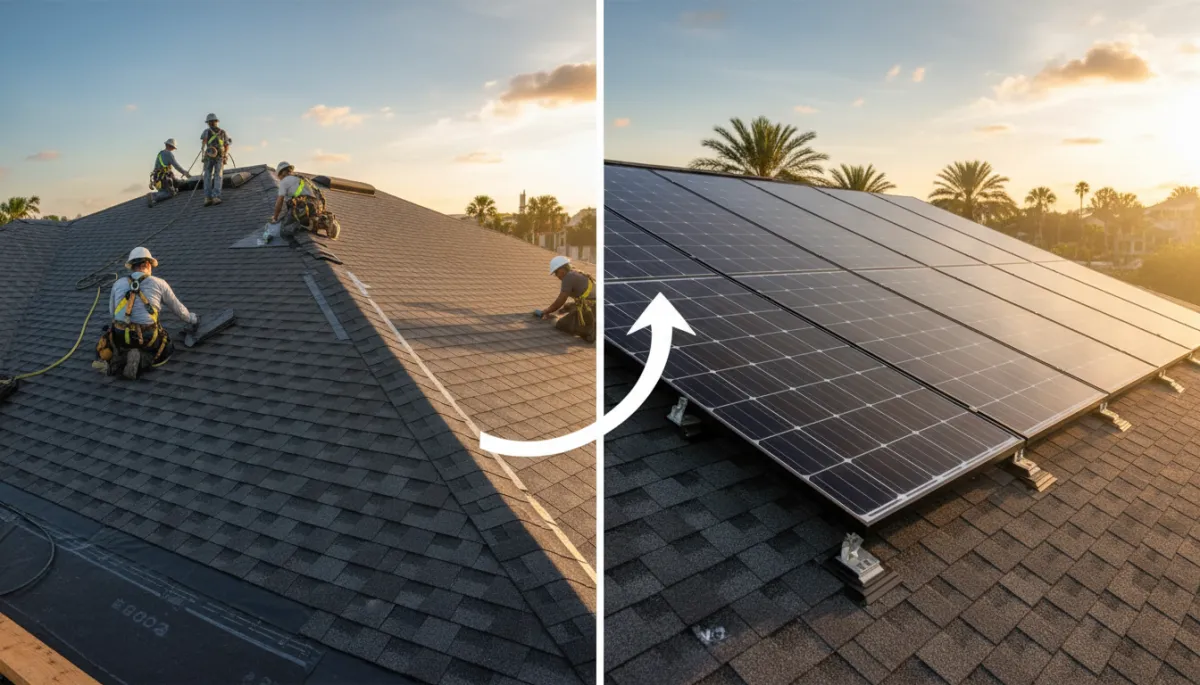
Think about the roof and the solar as one system. The roof is the foundation that keeps water out and supports the attachments. The solar is the power plant that sits on top. If the foundation is questionable, it makes sense to address it before you bolt anything through it. Replacing the roof as part of the same project means the new roof is built with solar in mind, the mounting points are integrated into that new surface, and you are not paying twice for work on the same area of the house. It is a cleaner plan, and it respects the fact that both the roof and the solar are long-term decisions, not quick fixes.
In Tampa Bay, your roof also deals with heavy rain and strong sun. When panels are added, they cover a large part of that roof. You want the deck, underlayment, and shingles or other roofing material under those panels to be solid before anything is attached. Doing the roof first, as part of the solar project, gives you a clean, documented starting point for everything that follows. You know what is under the array, who installed it, and how the system was planned. That clarity is hard to get if you layer solar over a roof that is already on its way out and hope to deal with it later.
📌 Key Takeaway: If your roof is nearing replacement, replacing it as part of the solar project avoids paying to remove and reinstall the panels later.
2. What goes wrong when roof and solar are separate projects
When one company replaces the roof and another company installs the solar, you are asking two separate businesses to coordinate a single system on your home. That can work, but you carry the risk and the hassle of keeping everyone on the same page. The roof has to be finished and ready before the solar installer can start. If the roofing schedule slips or the solar crew is booked out, you can end up with long gaps and a project that drags on while you wait for the next step. You are the one doing the chasing, and the two companies may not see the project the same way you do, as one continuous job from bare deck to powered-on solar array.
The bigger problem often shows up later. If you ever see a stain on the ceiling, a damp spot in the attic, or any sign of a leak near where the solar is mounted, you need a straight answer about what is going on and who will fix it. When roof and solar are handled by different companies, it is easy to get stuck in the middle. The roofer may say the leak is caused by the solar attachments. The solar installer may say the problem is with the roofing work or the materials around the mounts. You are left trying to interpret two different explanations and figure out who is responsible for what part of the system on your own home.
Even simple questions can become more complicated when there are two companies involved. If you want to expand the solar system later, someone has to verify that the roof structure and surface can support the additional attachments. If you decide to add a home battery, someone has to confirm that the existing electrical work is ready to handle it. With separate contractors, you may find yourself explaining the same details twice, sharing photos and documents between them, and hoping they agree on what needs to happen. None of that is necessary when one team owns the entire picture from the roof deck to the electrical meter.
You should not have to act as the project manager and referee for your own roof and solar. When the work is split, that is often what happens. If you are already busy with work, family, or other responsibilities, the last thing you need is to coordinate calendars and track down answers from two different offices about the same set of panels on the same roof. It is not about blaming either company. It is about recognizing that the structure and the solar are one system on your home, and treating them that way from the start so you do not have to sort out divided responsibility later.
Need a new roof and want solar? Fused Solar and Roofing installs both as one project across Hillsborough, Pinellas, Pasco, and Manatee counties. Request a free solar quote at https://fusedsolarandroofing.com/new-solar-installation
3. What doing both together looks like
When one company handles your roof and your solar as a single project, the process follows a clear sequence instead of being a patchwork. It starts with a full roof inspection, not just a quick glance from the driveway. The deck, existing roofing, and any signs of past leaks or repairs are looked at with the solar layout in mind. The goal is to know exactly what kind of surface the array will sit on and where the strongest, cleanest attachment points will be. At the same time, your home’s energy use and goals are reviewed so the system is sized and placed intelligently, not squeezed into whatever space is left over after the roof is done.
If the roof needs replacing, that work comes first. The old roofing is removed, the deck is checked and repaired where needed, and the new roofing system is installed with solar in mind from the first fastener. Fused Solar and Roofing installs a self-adhered leak barrier over the entire roof deck, not just at the eaves and valleys. That approach creates a continuous sealed layer under the finished roofing and under every solar attachment. Instead of treating the solar mounts as an afterthought, the crew is building a roof that is ready to host a long-term solar array from day one. Your new roof is not just new; it is prepared for the exact solar design you have chosen.
Once the new roof is complete, the solar mounting hardware is installed with flashing integrated into that roofing system. This is where coordination matters. The same plan that guided the roof work guides the placement of every attachment. The mounting locations, wire paths, and equipment placement are already mapped out, so there is no guesswork and no cutting corners. After the mounts and flashing are in place, the panels themselves go on, the wiring is run, and the electrical work is completed by the same company that has been on your roof from the start. The system is then tested, and the paperwork for the utility interconnection is submitted on your behalf. The interconnection agreement itself is between you and the utility, but you do not have to figure out the process alone.
With Fused Solar and Roofing, the roofing and solar crews are in-house teams working from one plan and one schedule. They are not strangers meeting for the first time in your driveway. The handoff from roof to solar is planned in advance, and everyone involved knows the sequence, the layout, and the standards for both trades. You get one point of contact, one contract, and one company that owns the result. That is especially important when you are making a long-term decision about both your roof and your power. You do not have to wonder who did what or who to call if you ever have a question. It is all part of one project, designed and delivered as a whole instead of stitched together from separate jobs.
💡 Pro Tip: Ask for the roof and the solar to be quoted as one project with one schedule. It is the clearest way to see the full scope and avoid gaps between contractors.
4. How the panels attach to the roof
Many homeowners picture solar panels as something that simply rests on top of the roof, but every panel is held in place by a series of mounts that connect down through the roofing and into the structure below. Each of those mounts is a penetration through the roof surface. Done correctly, those penetrations become part of a controlled, watertight system. Done poorly, they can become weak points where water finds a path in. Understanding how the attachments work will help you ask better questions and feel more confident about what is going on above your ceiling once the array is installed.
A proper solar roof attachment has three main pieces: the structural connection into the framing, the waterproofing around the penetration, and the hardware that holds the rail or panel. The structural part is usually a lag screw or similar fastener driven into a rafter or another solid member, not just the roof decking alone. Around that fastener, a flashed mount is installed so that water running down the roof is directed around the penetration instead of toward it. The flashing tucks under the courses of roofing above and over the roofing below, so water follows its normal downhill path and does not have a straight shot into the hole where the fastener passes through the roof surface. Sealant is still used, but it is not the only line of defense. The geometry of the flashing does most of the work by shedding water away from the opening in the first place.
Fused Solar and Roofing mounts every solar array on K2 Systems hurricane-rated flashed mounting. That means each attachment is a purpose-built component designed to integrate with the roofing, not a generic bracket with a bead of sealant around it. In plain terms, the flashing is built into the mount itself, and that flashing is woven into the roof so water has to work against gravity to get near the penetration. Over time, that matters more than any sealant alone ever could. Sealants are helpful, but they are a backup, not the main strategy. The main strategy is simple: keep water moving down and around the attachment, not into it.
When you look at a finished solar array, you see panels and rails, not the mounts under them. That is why it is important to talk through the mounting details before any work starts. Ask to see the type of mount that will be used and how the flashing fits with your specific roofing material. A quality installer will be able to show you the parts, explain where they go, and describe how water is directed around each penetration. That explanation should make sense to you in plain language. You do not need to be an expert, but you do deserve a clear picture of how your roof stays watertight once dozens of attachments are added to hold the solar in place.
⚠️ Warning: Ask exactly how each roof attachment is flashed. An attachment that depends on surface sealant alone is relying on a material that ages in the Florida sun.
5. Why one licensed company matters
Your roof, your solar attachments, and your electrical system are all parts of the same installation. When one licensed company is responsible for all three, you get a single line of accountability. There is no gray area about who owns the roof surface under the array, who chose and installed the mounts, or who wired the system into your home. If you ever have a question, you make one call. If you ever need service, one company shows up knowing the full history of the project. That is a very different experience from trying to coordinate between a roofer and a separate solar installer who may not even know each other’s names, much less each other’s standards and methods.
Licensing is not just paperwork; it is a signal that the company has taken responsibility for specific trades. Roofing, electrical work, and general building each have their own requirements and standards. When the same company holds the roofing license for the roof, the electrical license for the solar power system, and the building license for the overall structure, it can design and execute the project as one integrated job. Fused Solar and Roofing provides a written 25-year no-leak guarantee on every roof penetration it makes for solar. Fused Solar and Roofing is a licensed roofing (CCC1331058), electrical (EC13014750), and building contractor (CBC1252064) — all three in-house. That combination means the team that plans your project is the same team that is responsible for every part of it, from the first shingle removed to the final inspection of the solar system.
For you as a homeowner, this structure reduces uncertainty. You do not have to sort out whether a concern belongs to the roofer or the solar installer. You do not have to wonder which company to call if you see something on the roof that you want checked. You have one relationship with one contractor. That contractor knows your roof, your array layout, your attachment points, and your electrical configuration. When you are dealing with weather, long-term equipment on your roof, and the power system of your home, that kind of clarity is worth a lot. It is not about hype. It is about knowing exactly who stands behind the work over the long haul.
6. What to ask any solar installer
When you talk with any solar installer, you do not need to be confrontational. You are simply gathering clear information about how your home will be treated. Start with the roof. Ask who holds the roofing license for any roof work that will be done, especially if you are replacing the roof or if mounts will be installed through existing roofing. You want to know which company is actually responsible for the roof surface once the panels are installed, not just who is selling you the system. A straightforward answer here tells you a lot about how the project is structured behind the scenes and who you will be dealing with if you have a roof-related question later on.
Next, ask exactly how each attachment is flashed. Invite the installer to walk you through the components: what type of mount, how it connects to the structure, and how the flashing is integrated with your specific roofing material. Ask who guarantees the roof penetrations, and ask to see that guarantee in writing. You are not looking to trip anyone up; you are looking for a clear, written statement that covers the penetrations made for the solar system. If the answer is vague, ask follow-up questions until you understand who stands behind those details and for how long. Clear, direct answers show that the installer has thought through the roof as carefully as the panels and inverters.
You should also ask who does the electrical work and under what license. Solar is an electrical system tied into your main service panel and your home’s wiring. Knowing who designs and performs that work, and how they are qualified, matters for safety and long-term reliability. Finally, ask what happens if your roof needs work after the panels are on. The answer should address how a detach and reinstall is handled, who coordinates it, and how the roof will be protected during that process. You are not predicting a problem; you are simply making sure that if roof work is ever needed, there is already a plan in place and you know what to expect from the company you choose.
📌 Key Takeaway: Fused Solar and Roofing installs the roof and the solar with its own in-house crews under roofing license CCC1331058 and electrical license EC13014750, with a written 25-year no-leak guarantee on every solar roof penetration.
7. What the free quote visit involves
A useful solar quote visit should feel more like a careful evaluation than a quick sales pitch. With Fused Solar and Roofing, the visit starts with your roof. Someone looks at the actual condition of the roofing, the shape and orientation of the roof planes, and any signs of wear or past repairs. The goal is to determine honestly whether the roof should be replaced before solar is installed, or whether it is in good enough condition to support a new array as-is. You are told that directly, without pressure either way, because the company will be responsible for both the roof and the solar if you move forward. That alignment keeps the advice grounded in what makes sense for the whole system, not just one part of it.
At the same visit, your home’s electricity use is reviewed. Recent power bills, your typical daily patterns, and any plans you have for changes in usage all feed into the system design. The solar array is sized around your actual needs and goals, not just the available roof space. If you are interested in a home battery, that is part of the conversation as well. You will talk through how a battery fits with your goals and whether it makes sense for your situation. The roof layout, solar design, and any battery option are treated as one connected plan so you can see how each decision affects the others. You are not left to guess how a bigger array, a different roof material, or a battery might change the overall picture.
After the visit, you receive a written quote that spells out the roof work, the solar system, and any battery option in clear terms. The quote reflects the actual condition of your roof, the design of the solar array, and the electrical work required. It also accounts for the fact that the project will be handled by one company from start to finish, including submitting the utility interconnection application on your behalf. Fused Solar and Roofing is an EnergySage Elite Installer with a 5.0/5 rating and 21+ verified reviews — independent verification, earned not purchased. That outside feedback reflects the same approach you see during the quote visit: straightforward information, careful planning, and a focus on doing the roof and the solar as one integrated project rather than two disconnected jobs.
8. If your roof is already in good shape
Not every homeowner who wants solar needs a new roof right away. If your roof is in good condition, solar can be installed directly on it using the same flashed mounting approach and the same written guarantee on the roof penetrations. The key is to verify that condition up front instead of assuming. During the quote visit, Fused Solar and Roofing checks and documents the state of the roof, looking for signs of damage, past leaks, or weak areas that might be hidden from the ground. That documentation gives you a clear starting point. You know what the roof looked like before the array went up and how the mounts were integrated into that existing surface.
When the roof is sound, installing solar on it without replacing the roofing can be a practical choice. You still get properly flashed mounts, a clean wiring plan, and a system designed around your power needs and goals. The difference is that the project focuses on the solar and electrical work, with the roof treated as a solid base that has been checked and confirmed. If you later decide to replace the roof for your own reasons, you already know who installed the solar, how the attachments are laid out, and who to call to handle any detach and reinstall work that might be needed at that time. In the meantime, you are not delaying solar just because the roof is newer and in good condition today.
Frequently Asked Questions
1. Should I replace my roof before installing solar?
If your roof is nearing the point where it will need replacement, it is usually better to replace it as part of the solar project instead of putting panels on first. Once solar panels are installed, they are meant to stay in place for a long time. If the roof underneath needs work later, the panels will have to be removed and then reinstalled after the roof work is done. That detach and reinstall is a separate job with its own cost. Replacing the roof before the solar goes on, under one plan with one company, avoids paying for that extra step and gives you a fresh, documented roof surface under the array from day one.
2. Can a new roof and solar be installed as one project?
Yes. In fact, treating the roof and solar as one project is often the cleanest way to go, especially if you are already thinking about both. With Fused Solar and Roofing, the process starts with a roof inspection, followed by the roof replacement if needed, and then the integrated installation of the solar mounting, panels, and electrical work. The same company plans the sequence, schedules the crews, and submits the utility interconnection application. You get one contract and one point of contact for the entire job instead of trying to coordinate between separate roof and solar contractors on your own.
3. How are solar panels attached to the roof?
Solar panels are attached to your roof using mounts that connect down through the roofing and into the structure below, usually into rafters or other solid framing members. Each mount includes hardware for strength and flashing for waterproofing. The flashing is installed so that it tucks under the roofing above and over the roofing below, guiding water around the penetration instead of toward it. Sealant is used as a backup, but the main protection comes from the way the flashing and roofing are layered to shed water naturally. Rails or direct-attach hardware are then fixed to those mounts, and the panels are secured to the rails, creating a rigid, long-term attachment system that is designed to stay watertight when installed correctly.
4. What happens if my roof needs work after the solar is installed?
If your roof needs work after the solar is installed, the panels will need to come off and then go back on once the roof work is complete. That process is called a detach and reinstall. The array is carefully removed, stored or staged safely while the roofing work is done, and then remounted and reconnected afterward. Fused Solar and Roofing handles that detach and reinstall work with its own crews, so the same company that knows your system and your roof manages the entire process. You do not have to coordinate between a roofer and a separate solar installer to figure out how to protect both the roof and the array during the repair or replacement.
5. Who handles the utility paperwork for a new solar system?
Fused Solar and Roofing submits the interconnection application, and the interconnection agreement is between the homeowner and the utility.
6. Can a home battery be added to a new solar installation?
Yes, a home battery can be added to a new solar installation. Fused Solar and Roofing installs home batteries, and whether a battery makes sense for you is discussed during the quote visit. At that time, your goals, your home’s electrical setup, and your typical power use are reviewed so you can see how a battery would fit into your overall plan. If you decide to include one, the system is designed with the battery in mind from the start, rather than as a disconnected add-on later.
Fused Solar and Roofing has installed solar across Hillsborough, Pinellas, Pasco, and Manatee counties since 2007, with the roof and the solar handled by its own licensed in-house crews. Request a free solar quote at https://fusedsolarandroofing.com/new-solar-installation
Need the roof itself replaced, with or without solar on it? Our guide to roof replacement in Tampa, the GAF system Fused installs, the warranty, and the local permit, is at https://fusedsolarandroofing.com/post/roof-replacement-tampa-fl.
All of Fused's Tampa services on one page, with prices, permits, and the utility: Solar and Roofing in Tampa. The county-wide version of this guide is the Hillsborough County overview.
Ready to go solar on a roof built to hold it? Request a free solar quote at https://fusedsolarandroofing.com/new-solar-installation