
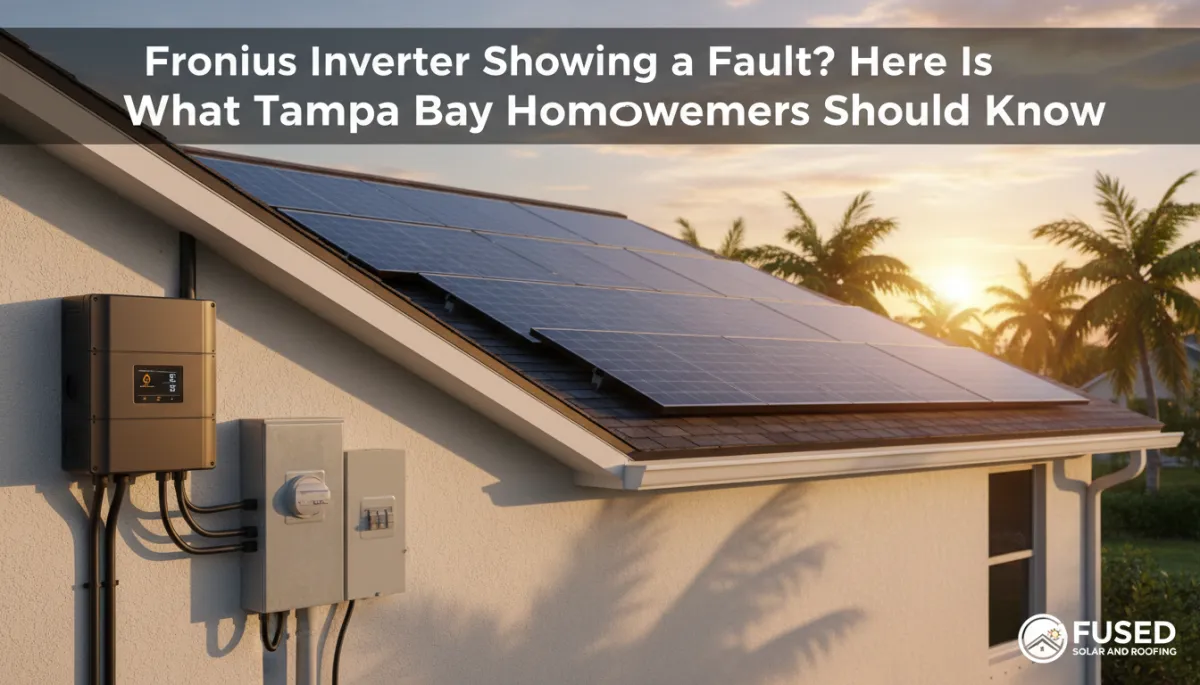
Fronius Inverter Not Working? Tampa Bay Homeowner Guide
If your Fronius inverter is showing a fault, not producing in daylight, or your monitoring has stopped updating, you are not alone. A Fronius inverter typically serves the whole solar array from one location, so when it has a problem you feel it across the entire system. The key question is whether the issue is inside the inverter itself or somewhere in the wiring that feeds it, and the good news is that the system can be diagnosed and repaired. Fused Solar and Roofing is a licensed roofing (CCC1331058), electrical (EC13014750), and building contractor (CBC1252064) — all three in-house.
Many Tampa Bay homeowners with Fronius systems no longer have access to their original installer. That does not mean you are stuck with a non-working system or guessing at what the fault means. By understanding how your system is laid out, what the warning signs are, what not to touch, and what the next step should be, you can move from worry to a clear plan of action.
1. One Fronius inverter, one whole system
Most Tampa Bay homes with a Fronius system have a single inverter serving the entire solar array. All the panels on the roof feed into that one box, usually mounted on an outside wall or in the garage. When the inverter is working properly, it quietly converts the power from the roof into power your home can use and sends any extra back through your electrical service.
Because the inverter is the central point, any serious fault there will normally take the whole system offline. That is why you may see zero or very low production on the display or in monitoring, even on a clear, sunny Tampa afternoon. It does not automatically mean the inverter is the part that failed, but it does mean the issue is affecting the system as a whole rather than just one or two panels.
Homeowners often assume that if the inverter display shows an error, the only solution is to replace the inverter. In reality, the inverter is reacting to something it is seeing in the system. The underlying cause could be inside the inverter, in the wiring coming from the roof, or at the connection into your home’s electrical system. The first step is to treat the inverter as the hub of the system and then work outward to find where the fault really is.
📌 Key Takeaway: A Fronius inverter typically serves the whole array, so one problem can take down the whole system. The first question is whether the fault is in the inverter or the wiring feeding it.
2. How a Fronius system is laid out
On a typical Fronius system, the solar panels on your roof are wired together in groups. Each group carries the power the panels produce down toward the inverter. Those groupings are designed so the inverter can work within its intended range, but from a homeowner’s point of view, you can think of them as several roof circuits that all meet at the inverter on the wall.
The wiring from those panel groups runs down from the roof, usually through conduit, and enters the Fronius inverter. Inside the inverter, the direct current from the panels is converted into the alternating current your home uses every day. That conversion is what allows your solar power to run your air conditioning, lights, and appliances just like power from the utility does.
From the inverter, wiring continues to your home’s electrical system. This connection is normally made through a breaker and a disconnect. The breaker ties the inverter into your main electrical panel. The disconnect is a separate switch that allows a technician or first responder to safely shut the solar system off from the outside. Both of these are part of the path your solar power takes from the roof to your home and out to the grid when there is extra production.
Some Fronius systems include online monitoring that lets you check production on a phone or computer. Others rely only on the inverter display itself. Both types use the same basic layout: panel groups on the roof, wiring down to the inverter, the inverter converting the power, and then the connection into your home through a breaker and a disconnect. Understanding this layout makes it easier to see why a single fault can affect the entire system and why the location of that fault matters so much for a proper repair.
Fronius inverter showing a fault? Fused Solar and Roofing diagnoses and repairs Fronius systems across Hillsborough, Pinellas, Pasco, and Manatee counties. Request a diagnostic visit at https://fusedsolarandroofing.com/fused-solar-roofing-service-department
3. Signs your Fronius needs attention
Most homeowners first notice a problem when the inverter display shows an error or shows no production in the middle of a bright day. If you are used to seeing a certain range of output on sunny afternoons and suddenly see zero or a much lower number, that is a clear sign the system needs to be checked. Even if the display still lights up, a lack of daytime production is not something to ignore for long, especially in our sunny climate where your system should usually be active during daylight hours.
Another common sign is monitoring that shows little or no production or has stopped updating altogether. If your online portal or app used to show daily graphs and now shows a flat line or no new data, it may mean the inverter is not producing, or it may mean the monitoring is no longer communicating while the inverter is still working. Both situations are worth having checked. A licensed technician can tell the difference by comparing the inverter display to the monitoring and to what the system should be doing for the weather that day.
Some homeowners notice a higher electric bill than usual for the season before they ever look at the inverter. If your bill has jumped and nothing in your household usage has changed, it is reasonable to suspect that your solar system is not offsetting as much power as it used to. In that case, checking the inverter display and any monitoring is a good next step, and scheduling a diagnostic visit can confirm whether the system is underperforming because of a fault.
Finally, pay attention to anything unusual at the inverter itself. New or loud sounds, visible heat marks, or any sign of charring around the inverter, breaker, or disconnect all call for immediate attention from a licensed electrician. If you ever see smoke, sparks, or smell something burning at or near the inverter or its wiring, keep everyone away from the area and call 911. Do not attempt to open anything, reset anything, or put hands on the equipment in that situation.
💡 Pro Tip: From a normal standing position, photograph the inverter display showing any error, screenshot your monitoring, and note the date and weather. That record helps a technician before they arrive.
4. What to note before calling
Before you call for service, there are a few simple things you can safely do that make a diagnostic visit more efficient. From a normal standing position, take a clear photograph of the inverter display while it is showing the fault or low production. There is no need to zoom in or reach up; a straightforward photo that captures the whole display and surrounding area is enough for a technician to review ahead of time. If the display changes, another photo showing the new condition can also be helpful, but do not press buttons trying to force it to change.
If you have monitoring, take screenshots of what you are seeing there as well. A screenshot of the current day, the previous few days, and the overall view for the month can show whether the problem started suddenly or has been building over time. When you send these images to the service department, include the date and a brief note about the weather at the time, such as clear, partly cloudy, or rainy. That context helps the technician compare your production to what would normally be expected for that kind of day in Tampa Bay.
Just as important as what you can do is what you should not do. Do not open the inverter, disconnect, or electrical panel. These enclosures contain live electrical parts, and the wiring from the panels can carry voltage whenever the panels are in sunlight. Do not switch the system off and on to try to clear an error. While it may be tempting to “reset” the system, cycling power repeatedly can stress components that are already failing and makes it harder for a technician to tell when and how often the fault is really occurring. The safest and most effective step is to document what you see and then schedule a licensed diagnostic visit.
⚠️ Warning: Do not open the inverter, disconnect, or electrical panel, and do not switch the system off and on to clear an error. The wiring from the panels can carry voltage whenever the panels are in sunlight.
5. Is it the inverter or the wiring?
Because one Fronius inverter typically serves the whole array, a fault can be located in two broad places: inside the inverter or somewhere in the wiring that feeds it. That wiring path includes the conduit from the roof, the connections at the inverter, the breaker and disconnect, and the connections on the roof under the panels themselves. A problem anywhere along that path can cause the inverter to show an error or shut down production, even if the inverter’s internal parts are still healthy.
When you see an error on the inverter display, it is natural to focus on the box you can see and reach. However, that error is a starting point for a technician, not a final diagnosis. The display is reporting what the inverter is sensing. It does not, by itself, confirm whether the underlying fault is inside the inverter or in the wiring, connections, or components upstream or downstream of it. Treating the error code as a complete answer and jumping straight to replacement can leave the real cause untouched.
Replacing the inverter when the actual problem is in the wiring is frustrating and expensive, and it still leaves you with a system that does not work reliably. For example, if there is a damaged connection under the array or a compromised conductor in the run from the roof, a new inverter will see the same issue and react the same way. The only way to solve the problem for good is to trace the fault along the full path of the system and confirm where it begins. That tracing is licensed electrical work and should be done by a contractor qualified to work on both solar and roofing where necessary.
Fused Solar and Roofing services Fronius systems across Tampa Bay, including systems whose original installer is no longer in business. If you bought a home with an existing system, or if the company that installed your Fronius inverter is no longer around, you still have options. A careful diagnostic visit can separate an inverter issue from a wiring issue and give you a clear plan for repair. Fused Solar and Roofing is a licensed roofing (CCC1331058), electrical (EC13014750), and building contractor (CBC1252064) — all three in-house.
6. What a diagnostic visit involves
When you schedule a diagnostic visit, a licensed technician comes to your home with a single goal: determine where the fault actually is. The visit starts with a review of the inverter display and any monitoring you have, ideally using the photos and screenshots you provided along with what the system is showing in real time. The technician will talk through what you have noticed, when you first saw the problem, and whether your electric bills or monitoring history show a gradual change or a sudden drop in production.
Next, the technician inspects the inverter enclosure, the breaker that serves it, the disconnect, and the wiring and connections that can be reached without removing panels. This includes checking for visible damage, signs of overheating, corrosion, or loose connections at accessible points. The technician uses their training and experience to decide whether the symptoms point more strongly to an internal inverter issue or to a problem in the wiring path between the roof and the electrical panel. Throughout this process, safety and clear communication with you as the homeowner remain the priority.
By the end of the diagnostic visit, you receive photographs and a detailed written report explaining the findings in plain language. The report outlines whether the fault appears to be inside the inverter, in the wiring and connections, or under the array. Any repair or replacement is then scoped and quoted based on those findings, so you are not guessing at what is being done or why. Fused Solar and Roofing is an EnergySage Elite Installer with a 5.0/5 rating and 21+ verified reviews — independent verification, earned not purchased. Fused Solar and Roofing is certified with Fronius.
📌 Key Takeaway: Fused Solar and Roofing diagnoses and repairs Fronius systems under electrical license EC13014750, including systems whose original installer is no longer in business.
7. When the fault is on the roof
Sometimes the diagnostic visit shows that the fault traces back to wiring or a connection under the solar array itself. In that case, the panels above the affected area have to be removed so the technician can reach the problem. This is called a detach and reinstall. It is a planned process that starts with shutting the system down safely, then removing the necessary panels in the area where the diagnostic visit located the issue.
Once the panels are off, the underlying wiring and connections can be accessed directly. The technician repairs the fault, whether that involves replacing a damaged section of wiring, correcting a connection, or addressing another issue in that part of the system. After the repair, the panels are reinstalled, reconnected, and the system is tested. This testing confirms that the inverter is now seeing the roof circuits as expected and that the previous fault condition no longer appears under normal daylight operation.
Having panels off the roof naturally raises another practical question: what is the condition of the roof under the array, and is this the right time to address any issues there before the panels go back on? If the roof under the array is older or has known concerns, this is a good moment to ask whether repair or replacement should be considered. That is not about selling a new roof for its own sake; it is about avoiding a situation where panels have to be removed again soon for roof work that could have been handled while they were already off for electrical repairs.
Fused Solar and Roofing’s in-house electrical and roofing crews handle both the solar detach and reinstall and any roof work that may be needed under the array. That means you are dealing with one company for the entire scope of work, from diagnosing the inverter fault to repairing wiring under the panels and addressing roof conditions in the same project. For Tampa Bay homeowners, that unified approach can simplify scheduling, reduce coordination headaches, and help ensure that both the solar system and the roof are ready for years of service after the repair is complete.
8. After the repair
Once the repair is finished, the technician does not simply turn the system back on and leave. They confirm that the inverter is producing and that the display shows normal operation for the conditions at the time of the visit. If your system has monitoring, they check that it is updating correctly and that the production it shows matches what the inverter display reports. This final step ties together the physical repair with the information you see as a homeowner, so you can trust what the system is telling you going forward.
Just as important, the technician walks you through what “normal” looks like for your Fronius inverter and any monitoring you use. They can point out the key parts of the display to glance at, explain how to recognize a typical production pattern for a sunny or cloudy day, and show you how to spot signs that something may be wrong in the future. That way, you are not left guessing whether the system is working; you have a clear, simple way to check it yourself at a glance whenever you want to.
For many Tampa Bay homeowners, this final walkthrough is what turns a stressful fault into a manageable part of owning a solar system. You end up with a repaired system, a written record of what was done, and the confidence to keep an eye on your Fronius inverter over time. If you ever see a new fault or notice a change in production, you will know what to look for, what not to touch, and what the next step is to get it checked by a licensed professional.
Frequently Asked Questions
1. Why did my Fronius inverter stop producing?
A Fronius inverter can stop producing for several reasons, and the cause is not always the inverter itself. The issue could be inside the inverter, in the wiring from the roof, at the breaker or disconnect, or at a connection under the array. Sometimes monitoring or communication problems can also make it look like there is no production when the inverter is still working. The only reliable way to know why your specific system stopped producing is for a licensed technician to review the display, inspect the accessible wiring and connections, and compare what the system is doing to what it should be doing for the conditions that day. That diagnostic process identifies whether the problem is with the inverter or the wiring feeding it.
2. My Fronius shows an error. Does it need to be replaced?
Not necessarily. An error on the Fronius display is a sign that something in the system needs attention, but it does not by itself prove that the inverter must be replaced. The error is a starting point that tells a technician where to begin looking. The underlying cause may be internal to the inverter, or it may be in the wiring, connections, or components that feed it. Replacing the inverter without tracing the fault can leave the real problem in place and lead to repeat issues. A licensed diagnostic visit is the best way to decide whether repair, replacement, or wiring work is the right solution for your system.
3. Should I turn my Fronius off and back on?
You should not. Turning the inverter off and back on to “reset” it can stress components that are already failing and can make it harder for a technician to understand when and how often the fault is really occurring. It is better to leave the system as it is, document what you see on the display and in any monitoring, and schedule a licensed technician to diagnose the problem. That way, the technician can see the fault in its natural state and use that information to pinpoint the cause more accurately and safely.
4. My Fronius monitoring stopped updating. Is the system still working?
It might be, but you cannot assume it is without checking. Monitoring that stops updating can mean the inverter is offline, or it can mean the monitoring connection itself has a problem while the inverter continues to produce. The first step is to look at the inverter display in daylight and see whether it shows production or a fault. From there, a licensed technician can compare the display, your monitoring history, and your recent electric bills to determine whether the system has truly stopped producing or whether the issue is limited to how the data is being reported to you. A diagnostic visit can sort out the difference and recommend the right fix.
5. Can a company other than my installer service my Fronius inverter?
Yes. Your original installer does not have to be the one who services your Fronius system. What matters is that the company you hire is properly licensed to perform electrical work on solar equipment and understands how Fronius systems are laid out. Fused Solar and Roofing services Fronius systems across Hillsborough, Pinellas, Pasco, and Manatee counties, including systems where the original installer is no longer available. A qualified service company can diagnose inverter and wiring issues, perform repairs, and, when needed, coordinate any detach and reinstall work on the roof as part of the same project.
6. My original solar installer is out of business. Who can repair my Fronius system?
If your original installer is out of business, you can still have your Fronius system repaired by a licensed contractor that services existing systems. Look for a company that holds an electrical license and has experience working with Fronius inverters and roof-mounted solar arrays. Fused Solar and Roofing works with homeowners in this exact situation throughout Tampa Bay, providing diagnostic visits, inverter and wiring repairs, and detach and reinstall services when a fault is traced to the roof. You do not need to start over with a new system; you need a clear diagnosis and a plan to restore the system you already have.
Fused Solar and Roofing is a licensed electrical contractor (EC13014750) servicing solar systems of all brands across Hillsborough, Pinellas, Pasco, and Manatee counties, including systems whose original installer is no longer in business. Request a diagnostic visit at https://fusedsolarandroofing.com/fused-solar-roofing-service-department
Is your solar system producing what it should? Request a diagnostic visit at https://fusedsolarandroofing.com/fused-solar-roofing-service-department